Strange Story Of 100 Years Ago
pp. 21-22 · Read in the full issue
How the Anvil of Love Come From Spain to Mangaia
By William S. Bond
ONE September morning in the year 1828, the population of Mangaia (Cook Group) gathered on the beach in a state of great excitement, watching the approach of a large sailing ship.
Four years previously another ship, carrying the missionary John Williams, had visited the island, and there was much speculation as to whether this was another visit of the messengers of the new God. , After a while, eight youths were bold enough to launch their canoes over the reef and venture out to the strange craft.
Among them was Puakeri, 16-years-old son of Karamatangi, chief of the Tavaenga district.
The lads were enticed aboard the ship by the friendly gestures of the crew and a tempting display of foodstuffs, and were soon seated in the main cabin round a table laden with food. As they ate, the smiling foreigners brought more dishes, and later, gifts of clothing, with which the boys were delighted.
A considerable time passed while they were being thus entertained, but even tually they were overcome with the desire to return to the shore, to display their wonderful garments and boast of then good fortune. They suffered a terrible shock when they came on deck to find the ship under full sail, on an empty sea.
Young Puakeri ran to the bows and flung himself down in an extremity of grief. The first mate of the vessel came quietly behind him patting his shoulder and speaking soothing words, and even tually persuaded the boy to accompany him to his cabin, where he gave him more clothes and did his best to make turn understand that he wished to be his fl A n few days later, the ship hove to off Aitutaki, where a further five youths were enticed aboard by the same tactics.
THUS, IS young Cook Islanders became members of the crew of a Spanish whaler. They were fortunate, inas much that they w<?re well treated by the captain and other officers, and had nothing to complain of, except the intense home-sickness of all Polynesians parted from their loved ones.
For several years, the vessel roamed the South Pacific in quest of whales, and a long voyage brought them to Spain, and the port of Barcelona, where they dis charged their cargo and took on fresh stores. Later, they sailed round the coast to Corunna, which was the home port of the mate, who had remained a firm friend of Puakeri. The mate’s real name is not known, “Tarana”, being the nearest that Puakeri could get to its pronun ciation. Although the Mangaian became very familiar with spoken Spanish, he never learned to write the language.
The mate took Puakeri to his home, where he was treated with every kindness, and he became familiar with the town and surrounding countryside.
IN his story, Puakeri described his emo tions at his first contacts with the white-man’s world, outstanding of which was his amazement and terror at the first sight of a horse, and other animals.
The other Maoris were taken to the homes of other members of the crew and, presumably, were also well-treated.
After five months of shore life, they returned to the ship; and several years
were passed in tramping round the coasts of Spain, France and Holland, carrying timber and general cargoes.
One winter’s day they were forced to seek shelter in a cove a hundred miles from Corunna. Five days later the order was given to hoist anchor but the anchor was fouled, and resisted all efforts to move it.
The captain called for a volunteer to go down and endeavour to clear the
anchor. Puakeri offered. At his first try he followed the chain to the limit of his endurance, but was still far from the bottom. A second dive was no more successful.
As he came to the surface, the captain, a short-tempered bully who had replaced the kindly skipper of whaling days, put a hand on his head and thrust him down again. Puakeri followed the chain until his lungs were bursting; but still it went on into the gloom.
When he broke surface the captain again thrust him down, but he swam clear of the ship, being much distressed by his efforts and the intense coldness of the water, and terrified by the captain’s anger.
The mate protested that the man had made a very commendable effort —but his interference only added to the captain’s anger and he shouted that he would have the unfortunate Maori shot the next morning.
That night, the other Polynesians sat with Puakeri, weeping in despair. At mid night, the mate came silently into their midst and bade Puakeri follow him to the bows. .
“Tarana” pointed to a tall pine on the shore.
“You see that tree?” he whispered. ‘You must swim ashore and climb that tree and wait till I come. When it is safe, you must make your way to the road, which
will lead you to Corunna. But it will not be safe to travel on the road—you must use it only as a guide and keep to the bush. Go to my home and await my coming. Now go and bid farewell to your friends.”
After a sad leave-taking, Puakeri re turned to the deck. Now, he said, he was suddenly overcome with the realisation of the great goodness of the God of Whom the missionaries had brought word, only four years before he had been snatched away from his Mangaian home; and he earnestly prayed for the first time in his life.
DROPPING quietly into the water, Puakeri struck out for the shore.
Exhausted by the icy waves, he was rolled up onto the beach, where he lay unconscious until revived by the warmth of the morning sun; whereupon, he crawled to the shelter of the bush and climbed the tall pine.
Aboard the ship, his absence was soon discovered, and the captain—ignorant of the bond of friendship between Puakeri and “Tarana” —ordered the mate ashore with a search party, which included a well-trained dog.
Arrived on shore, the mate divided the party, and sent the men off in opposite directions, himself taking the central trail with the dog. When they reached the tree, the dog began barking furiously.
After hanging a small bag, containing dried meat and biscuits, on a lower branch, the mate took the animal by the collar and dragged it well clear.
When the others came running up, he said that the dog had been chasing birds, and proceeded to lead the party on a day-long wild-goose chase.
PUAKERI descended from the tree, took the bag of food, and started on the 110 miles hike to Corunna.
After an adventurous and exhausting journey of 10 days, existing on the small supply of meat and biscuits, and twice narrowly avoiding capture, he came to the town in the dusk of evening, and made his way to the house of his friend, where he was welcomed by “Parana's” two sisters.
The girls had received a note warning them of his coming, and they hurried him to the cellar—and only just in time. A few minutes later, police officers called, engaged in a house-to-house search for the runaway Maori; but the girls effec tually concealed his presence.
“Tarana” himself soon arrived, having left the ship and obtained a shore job at the harbour.
For six months Puakeri remained hid den in the house, meanwhile assisting with the house-work. Being the son of a high chief, Puakeri had been carefully preserved from the sunlight during his boyhood, as was the Cook Islands custom, so that his skin was very fair. Six months in the house had lightened his acquired tan, so that in European clothes and with a fair knowledge of the language, he passed as a Spaniard. So “Tarana” now produced him as a relative and found him employment at the harbour as his own assistant. The two had become remark ably devoted to each other, and life went on happily for another six months, ONE day, Puakeri was accosted by a drunken sailor. He had difficulty in following the man’s conversation, but one word electrified him—“ Tahiti!”. He followed the sailor to his ship to inquire her destination. From the deck another sailor called to him:— “Hey, Joe!” (Joe was the name by which he was popularly known). “We are going to Tahiti—wouldn’t you like to come with us?”
For the rest of that day he seethed with conflicting emotions, and in the
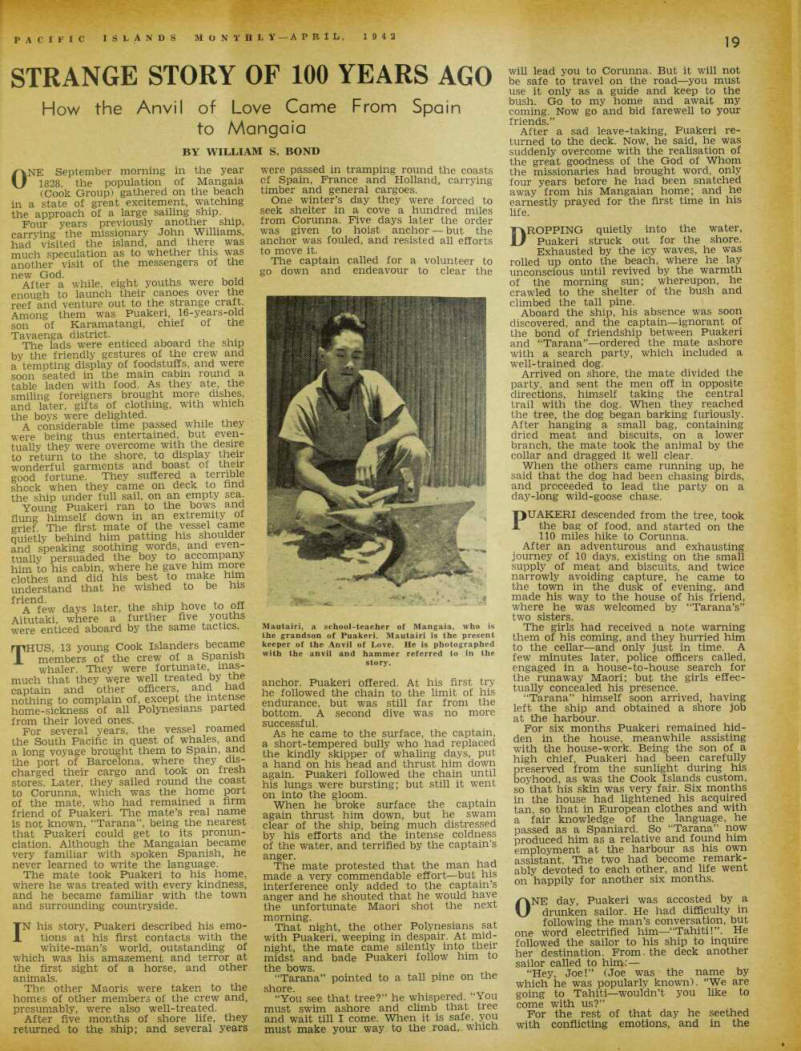
Mautairi, a school-teacher of Mangaia, who is the grandson of Puakeri. Mautairi is the present keeper of the Anvil of Love. He is photographed with the anvil and hammer referred to in the story.
evening he told “Tarana’ that he wished t 0 grief o "was Pe profound as he had hoped they would remain as brothers for the rest of their days. The ship was sailing in three days time, and the next two days passed m sadness.
On the third day a farewell feast was prepared. In the centre of the table was a heavy blacksmith’s anvil and a hammer.
“Tarana” stood with tears in his eyes. and, indicating the anvil, he began in a broken voice:— “I have already told you that I did not want us to part but you wish to return to your own people. I am not blaming you for breaking our vow. because if I were you I know I should feel just the same.
“But I know we are not going to part.”
He placed his hand on the anvil. “Take this anvil with you and keep it carefully, as I have cared for you. I will tell this to my children and to my children’s children, through my word and my handwriting—that they have a relation on the island of Mangaia, in the far South Sea.
I know that you also will tell this to your grandchildren.
“If ever one of my children stand before your door I know that you will be glad to receive him. I know that someday one of them will come—and this anvil—the everlasting token of our friendship—shall be the guide. Long may you live, and God bless you.”
Puakeri spoke in reply, thanking “Tarana” and his sisters for their kindness to him. and promising that the anvil should remain in his familv for ever “Tarana” accompanied Puakeri to’ the shin and naid his nassne-p captain to take every care of him until thev reached Tahiti “ AN uneventful voyase brought them at length to Puakeri wPnf lengrn to ianiu, where Puakeri went
immediately to the London Missionary Shortly afterwards, the “John Williams” called at Tahiti, and was permission to travel on the vessel to the was explained to him that the ship would not be calling at the Cook Islands on the outward voyage, but would first go to New Zealand and Sydney, and would visit Mangaia on the return passage.
A lew days after leaving Tahiti, the ship was abreast of Aitutaki. When Puakeri learned that he was passing through the Cook Group, he became frantic with excitement. He was assailed by a sudden areaa mat if he passed on now, some new trick of fate might once more spirit him away; and he pleaded with the commander to put him ashore at Aitutaki.
Ib captain tried to assure him that he would reach Mangaia much sooner if he remained with the vessel; but, heedless all argument, the distracted man began Pumng on his clothes with the intention jumping into the sea in an endeavour to r>^ ln ? • *s® fast-receding island. perceiving tnat any further attempt at ESSS? 1 ? 1 wa P ca P tain was * -,P ut *'v® ship about and put 1 „ T vP£v. r • asb Q re 1115 belongings wnicn included tne anvil. *, . . pUAKERI was forced to spend a number of years on Aitutaki, during .. * 1C tim ? * married a woman of laland and four children were born ?- ut ’ las i’ John Williams brought to Man g aia - .
So ’ as a man of 45 > Puakeri returned J^i e^* S il and seen since he paddled his canoe over the reef on that September morning 29 years before. He was indeed a lucky man for the com- £? mons wh ° h l d b ! en kidnapped with him were never heard of again.
Upon his return to Mangaia Puakeri him to test his knowledge
ports and wfs easily clnvfnced oHhe
accuracy of the Mangaian’s account of his remarkable adventures Because on the one hand, Agostini was glad to make the acquaintance of one familiar with his beloved France white Puaklri was naturally attracted to this man from Thl
Mediterranean X remindS himTf hte
other Latin friend, the two became close friends, and remained so for the rest of their days.
Assisted by Puakeri Agostini conducted a trading business, using as his store a cave in the rocky foreshore at Kumu kumu, midway between the villages of Tavaenga and Ivirua.
In Keia village, which is situated on the “makatea” behind the main settle ment of Oneroa, there is a massive tomb stone, which tells us that Josenh Agos tini died in 1873, after more ’ than 36 years’ residence on the island. Behind the grave stands the time-blackened ruin of Joseph’s solidly built coral-lime house.
Trees crowd closely about it, some thrust ing their branches from within the roof less walls. On this property Agostini bestowed the name of “Paris”—the name by which it is still known to the natives, Today, Te Tupaki-anga-auri Aroa—The Anvil Of Love—still rests in Mangaia in the care of Mautairi, a school-teacher, who is the grandson of Puakeri.
It is used for beating out fish-spears— pealing forth its call to the children of “Tarana’s” children in far-off Spain.
Letters and other small articles may be sent from Australia by post to members of the fighting services in Papua and New Guinea, free of charge. This con cession was announced on March 31.