Is This Propaganda From
pp. 14-15 · Read in the full issue
The North?
Some Questions About “War Correspondents '"
Despatches From Port Moresby
rOSE who know Australia’s Pacific Territories, and the ways of politi cians an< * bureaucrats are noting, with concern, what appears to be propa ganda from the north, which is being published in the principal Australian newspapers, and which may affect the future administration of these Territories.
In a sentence, Australian public opin ion is being coached in the belief that the Territories’ administrations were weak, cock-eyed and ultra-conservative; that they did not co-operate with the military authorities; and that the mili tary administration, having got rid of the civil administrations, has shown strength and ability in—as one published article phrased it—“restoring order out of chaos”. rE channels through which this pro paganda is being distributed are “our special war correspondents on the North Australian front”—in other words, three Australian newspaper re porters who know nothing much about war except what the military chiefs tell them, and whose knowledge of the his tory and affairs of Australia’s Pacific Territories can be judged from the some what grotesque nonsense published from week to week by the trustful Australian newspapers.
As a matter of fact, the comments of “our special war correspondents on the North Australian front” are a source of delight to the thousands of Territories’ evacuees in Australia—they so bring entertainment into a somewhat grim and sad world.
It would be hard to say when the three war correspondents are funnier—when they are discussing high strategy, or when they proceed to paint glamorous word-pictures of life in Australia’s tro pics. Probably, the biscuit for sheer fatuity must be handed to the young gentleman who described how the dolce far niente life of Port Moresby’s official and civil population was broken up by the efficient and realistic military.
People \yho know something of the real Papua loved that one.
Stuck In Port Moresby
LITTLE harm would be done if our “war correspondents” merely enter tained us with their delusions that they are Gunthers or Knickerbockers, and that Papua is Malaya or West Africa; but the thing is more serious than that.
They are the guests of the military— they have to be, because the military is in supreme control in Papua and New Guinea. Maybe, they sometimes get an aeroplane ride out of Port Moresby, but for the most part they are stuck in that dismay and uninteresting place, and they see nothing of the war or the country except a little air activity. Obviously, then, most of what they write is filtered through military headquarters, and what they send must be passed by military censors. Actually, no other system would be possible.
But let us see the shape that this fil tered material is taking. We refer to a despatch by one Folkard, published in Melbourne “Herald” on March 16, and another by one Johnston, published in “West Australian” of March 18. There
have been others—but those will suffice We do not propose to quote the articles —anyone interested may examine them But none will deny that in these par ticular productions of “our special war correspondents”, and in similar des patches, the tendency is to heap criti cism and ridicule upon the late civil administrations, and praise the reform ing zeal of the new military administra tion.
If this stuff is not propaganda, why is it sent?
That Horrid Union Jack!
MR. Folkard, for example, points out, as a shocking instance of adminis tiative shortcomings, that the Union Jack always was flown from Gov ernment House flagpole at Port Moresby.
But the military have changed this—the Australian flag now graces the official flag-pole. To “our war correspondent”, this is a significant event; and, if any one read him seriously, one would get the impression that Major-General Mor ns here has nipped in the bud a very dreadful piece of anti-Australianism. In fact, one cannot imagine how these “war correspondents”, trained in the school of the New Journalism, refrained from heading the despatch “Fifth Column Activity Discovered in Government House at Port Moresby”!
Actually, the explanation probably is quite simple. It was the British flag which was used when Commodore Ers kine proclaimed a protectorate on Nov ember 6, 1884, and when Sir William Macgregor formally annexed the Terri tory on September 4, 1888; and, as the same form of administration has con tinued ever since, it was natural and proper that the use of the Union Jack be continued—especially in view of the need of not confusing the native mind in relation to these symbols of govern ment.
It was equally natural and proper that the newly-installed Australian military administration should use the Australian flag. But why make such a song-and dance about it?
Our “war correspondent” also seeks to connect the flag incident with the appar ently shocking fact that the Administra tor of Papua received his commission direct from the Governor-General of Australia. In the name of common sense, from whom else should he receive it?
Control Of Natives
MR. Folkard and Mr. Johnston make much of the alleged fact that the recently-supplanted civil adminis tration had lost control over the native population, and that the military ad ministration had taken drastic steps to “bring order out of chaos”, and to round up, for restoration to duty, 120 native policemen whom the wicked civil ad ministration had turned loose into the bush.
This seemed so extraordinary a state ment to broadcast in Australia that we decided to check up on it. We could not locate Mr. Leonard Murray (civil ad ministrator) ; but several senior mem bers of the Papuan service are living in Sydney (the military administration shipped them out of Port Moresby at a
few hours’ notice) and we found them literally spitting with indignation over this valiant effort of “our war corres pondents”.
So far as control over the natives is concerned, we were informed that, of the 17 out-stations, 14 were carrying on in normal fashion when civil administration ceased on February 14. Control had been withdrawn from only three—Sama ra!, Misima and Trobriand Islands, which, of course, are menaced by Japan ese sea and air activities in New Guinea.
The native constables did not go bush in the manner suggested by “our war correspondents”. It appears that about 150 trained native constables were main tained in Port Moresby, and their duties were mostly of a patrol charac ter. When the military took over, and established patrols, many native police were not needed, so 100 were formally disbanded and paid off, and their uni forms and equipment were taken from them and stored, and they were told they could return to their homes.
The officer in command of Papuan natives, who had enlisted for military service, was informed of what was being done, and he accepted an invi tation to interview these trained men, and invite them to join the military services.
Prisoners From The Gaols
ONE ardent writer says that “the police and the prisoners from the gaols” went bush together. That, again is a distortion of the facts.
It appears that, prior to shipping the administrator of the Territory and his senior officials out of the Territory, the military commander did not indicate that he intended to establish some form of government for the natives. The place was being bombed periodically; and in the circumstances, the senior offi cials deemed it wise and humanitarian to release the prisoners from the gaols before civil administration and control were withdrawn.
This was done. It would not have been done, say the deported officials, if the military authorities had given any clear indication that they intended to continue this section of the native administration.
Future Administrative Problem
DISCUSSION of these things may seem rather trivial, in view of the war situation. But this is only the surface of a problem that is grave, and goes deep.
Everyone who knows the Territories, and especially those with memories of 1914-18. believes that the restoration of a civil administration and civilian acti vities in those Territories will call for determination and a courageous spirit.
The history of every tropical territory occupied by military during the last war shows that the military will use every device of ingenuity and bureaucracy to hang on to the better-paid administra tive jobs.
The nature and volume of the propa ganda which has appeared in Australian newspapers per medium of “our war cor respondents” have aroused suspicion and acute uneasiness among the numerous senior officials who were shipped out of Papua. . „ . , The junior administrative officials were absorbed into the army and remained mostly in administrative jobs. But what of the seniors? What chance have they of getting back the well-paid positions, to attain which they suffered all the hardships and discomforts of life in a primitive tropical territory?
A similar problem eventually will arise
in New Guinea, when the Japs have been thrown out and the military administra tion takes over the administration of the Territory—as it must, for the dura tion of the war. Whatever remains of the senior class of New Guinea’s public service, after the Japs and the jungle have finished with it, will be stood aside in Australia, just as the men from Papua have been. What does the future hold for them? , Is there to be one Territory in future, where now there are two? Who is to control any such reorganisation—the old, experienced civil officials of Papua and New Guinea, or the newly-come military officials, whom “our war correspondents already are presenting to the Australian people as natural-born tropical adminis trators?
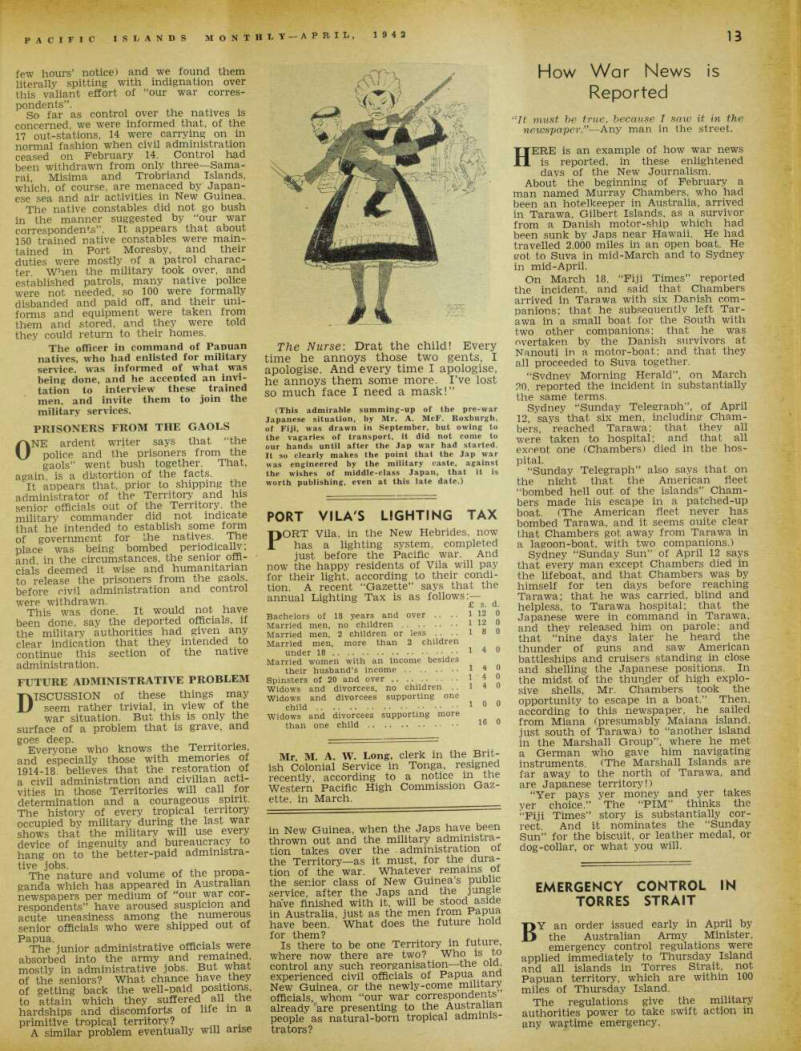
The Nurse : Drat the child! Every time he annoys those two gents, I
apologise. And every time I apologise,
he annoys them some more. I’ve lost so much face I need a mask!” (This admirable summing-up of the pre-war Japanese situation, by Mr. A. McF. Roxburgh, of Fiji, was drawn in September, but owing to the vagaries of transport, it did not come to our hands until after the Jap war had started.
It so clearly makes the point that the Jap war was engineered by the military caste, against the wishes of middle-class Japan, that it is worth publishing, even at this late date.)