Territories Public
Servants Canberra's New Regulations
AS soon as military administration was established in Papua and New Guinea, *° meet the advancing Japs, the position of the public servants in those Territories became difficult and invidious, and it has remained so ever since.
A proportion of the public service per sonnel of New Guinea, especially senior men, lias disappeared. Of those who escaped the invaders, most of the men under 45 have been absorbed into the military—as have also all the younger men of Papua.
The remaining senior men from New Guinea, and 28 senior men from Papua, too old for military service, are now in Australia—their jobs and their personal possessions gone, their customary salaries (earned through long years of tropical service) cut off, their careers more or less wrecked and their whole future completely uncertain.
For many weeks, they have been kick ing their heels in Australia, living on their own resources, or anxiously seek ing jobs. Imagine grey-haired men. who have spent their lives in tropical ad ministration—and who stuck to the tropical services because thev were assured of superannuation after 20 or 25 years’ service—scrambling around in the Australian labour market, classified as unskilled men! Yet that is what actu ally occurred, and is occurring. rERE was — and still is — also uncer tainty about the future of all the elderly people who had alreadv retired on superannuation. They were told that there was doubt whether funds now would be available. But all Gov ernmental funds—including superannua tion funds—were brought awav from both Territories.
Presumably, the trouble is that the superannuation funds cannot meet ail claims unless there are annual grants from Government funds; and, as the Governments now are out of action, the outlook is obscure.
But these were Australian territories and Australia cannot do other than assume an obligation like superannua tion allowances. Why should a retired Australian public servant continue to receive his pension while a retired Papuan is passed over?
By the same token, why should the senior Papuan public servants be finan cially punished because of war, while the Australian public servants continue to receive full emoluments?
HOWEVER, the position of these Ter ritories public servants has been considered by the Australian Gov ernment; and the following statement was issued in Melbourne by the Prime Minister on April 13;— “War Cabinet decided on April 9 that consideration would be given to the question of the treatment to be accorded officers of the Public Services of Papua and New Guinea, in consequence of those Territories being placed under military control.
“It had been decided that all recrea tion leave for which officers are eligible, and long leave will be granted. When an officer is authorised to retire from the Service, he will be allowed any fur lough to which he is entitled.
Efforts are being made to place all officers who reach Australia in employ ment in the Commonwealth Public Ser , un til such time as they may be able to resume their appointments in the Territory.
“Officers who have reached the retir ing age will be permitted to retire with all leave, furlough and normal superan nuation privileges. If such officers, how ever are appointed to the Common wealth Service, half superannuation allowance only will be paid. A detention allowance will be paid in the case of officers who are now in the Territories and are detained by the enemy or are awaiting evacuation, but superannuation will remain the responsi bility of such officers.
“Officers who have enlisted or are now serving with the military forces are to have their salaries made up to their civil rates for the first 16 days of service, where this has not already been done and superannuation contributions of those serving in the AIF will be paid by the Commonwealth Government. In the case of those serving in the AMF. super annuation contributions will be paid by the_ Government to the extent to which military pay is less than their civil pay.” . Regulations to give effect to the deci sion of the Government in this matter are being prepared and it is expected that they will be issued at an early date.
Mr. T. A. Greene, accountant and clerk in the British Service, Condominium of the New Hebrides, has been away from the Group since December, on leave.
News was received in the New Heb rides last month that a young British officer, Jeffrey Seagoe, formerly of Vila, was wounded recently in the Far East.
He was among the first New Hebrides men to enlist for service overseas.
Mr. Kenneth P. Finger, South Seas Evangelical Mission worker in the Solo mon Islands, recently married Miss Marion Belot, of Sheffield, Tasmania.
War conditions have prevented their return to BSI and Mr. Finger has accepted an appointment at the Home Mission Station, Turriff, Victoria.
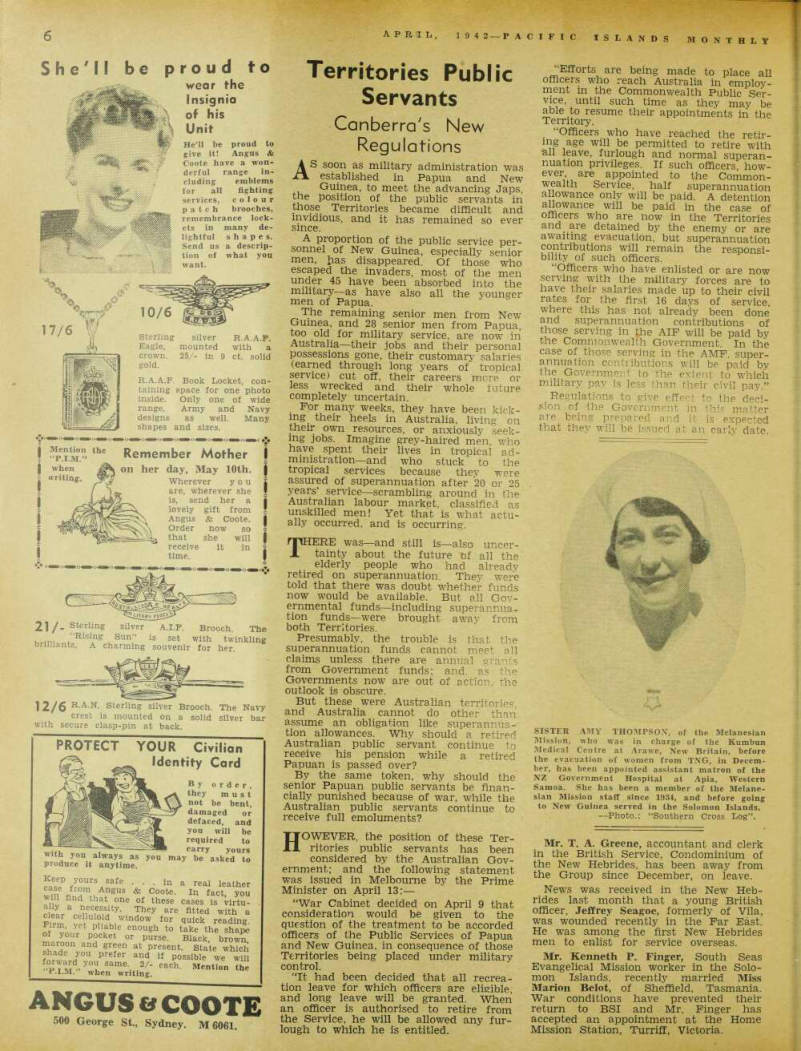
SISTER AMY THOMPSON, of the Melanesian Mission, who was in charge of the Kumbun Medical Centre at Arawe, New Britain, before the evacuation of women from TNG, in Decem ber, has been appointed assistant matron of the NZ Government Hospital at Apia, Western Samoa. She has been a member of the Melane sian Mission staff since 1934, and before going to New Guinea served in the Solomon Islands. —Photo.: “Southern Cross Log”.