Tugi, of Tonga
pp. 34-35 · Read in the full issue
Tribute to Distinguished Polynesian
By Our Tongan Correspondent
T N I, he unexpected death recently of 1 ® UiUami Tugi, CBE, consort of Salote a nd Premier of the Kingdom, Tonga lost one of her hiehest more n than iefS ’ anc L a S ood patriot. Tugi, more than any other man since King George Tubou I, achieved much for his people and country.
Born on November 1, 1887 Tue-i waq a hnTof d Tc e n ndant ., 9f the Tui Ha'atakalaua Tnkir/hJ gan Hls father - Jiaoji Tuku a h°. succeeded Rev. Shirley Baker a? from 1890 to 1893. Mele Siuhkuffibu, his mother, was a great of a r d p~f?rao gl T^ e K of Tuku’aho (grandfather hLv?h?rtv? b - ou I -- By reas °n of his Tugl r £ ceived the nickname of Mailefihi (many-branched luaile tree) meaning that in his person was fused the various branches of the royal and chiefly families of the Kingdom. rlf f? 5 s^ aid that the influence of £ e t ermmes W hat manner of TWi Chl i d be pomes: this was true of lugi. The character of the young prince was moulded under the strong influence of his mother, herself a woman of sterling character and deep religious piety Tug! received primary education at the Wesleyan school attached to Tubou College and in 1896 he was sent to Newington College, Sydney, together with a number of other Tongan lads. His college days, however, were cut short by his father s sudden death in 1897. when he was thrown from a horse.
Returning to Tonga, lie enrolled at Tubou College. There, on the same foot ing as the sons of the common people he learned at first hand the daily round of
the Tongan in his domestic life. This thp m int g r5 r °£ Sed him s y m Pathy for me lot of the ordinary people, besides giving him a genuine love of the soil. 0 Graduating from college as dux in 1905, T?ih^ n +v, tW0 v/ ears as tutor at iTrm hen he occupied a minor post m the Tongan Government Service.
IN 1911, Tugi went to England to repre sent Tonga at the Coronation of George V. For fully a year, he stayed in Britain visiting places of historic in terest and touring agricultural and industrial areas. This period abroad, gaming a closer acquaintance with the English tongue and rubbing shoulders with Englishmen at the hub of Empire, had a broadening effect on his outlook On his return to Tonga, he was ap pomted Governor of Vavau, a post ne filled with credit until he became Minister for Lands in 1917. He married Crown Princess Salote in September, 1917—the year before she came to the throne.
When Tu’ivakano resigned the office of Premier in 1923, Tugi succeeded him. The 18 of Tugi’s premiership were marked by the steady, progressive policy pursued by the Government, under his leadership. Establishment of the banana ex P°Jt, industry, which brought financial relief to the country when copra prices fell to low levels, was due mainly to his personal effort and perseverance To improve the general health of the people, Tugi increased the efficiency and the facilities of the medical service. To him goes credit for sending selected Ton gan5 to the Central Medical School at Suva (Fiji), to be trained as NMP’s However, it was in the fields of educa tion and agriculture, in which he carried out notable reforms, that Tugi’s life work lay.
EARLY in his public career, he became convinced of the unsuitableness of , „ Tonga’s educational system, which followed purely academic lines. He wisely felt that, as each Tongan on reaching 16 became entitled to an allotment of 84 acres and was in effect a peasant farmer, an education of a practical nature em bracing agricultural and technical tuition would be more suitable.
For years he tried unsuccessfully to convert the Government College into an agricultural and technical institution, with compulsory attendance for every native lad; but the opposition was too strong. Undaunted, he persisted with the idea; finally, in 1938, the Tongan Parlia ment agreed to the plan. Although Tugi’s end came before the full realisation of his plan, he succeeded in laying down a sound education policy that promises to contribute more than any other factor to
promote the welfare and independence of the people. , . , . .
His deep interest in the land led him to effect many agricultural reforms. In 1940, he put through Parliament the Agricultural and Organisation Act, which provided for the complete organisation of Tongan agricultural pursuits on modern lines—the most comprehensive measure
ever attempted in this direction in the history of the country.
These, of couse, were the most note worthy of Tugi’s achievements; but as his interests were wide and varied, so were his activities. Tongans fittingly re ferred to him as “Koe tagata alafua”— a man of many parts. His strong hands were evident in all spheres of Tongan life and, in recognition of this devoted service to his country, he was created a Commander of the British Empire in 1937.
THOSE who came in contact with Tugi could not fail to admire his character and high ideals. His friendly, at tractive disposition and sympathetic na ture made him easy of approach and a friend of all, just as his courtesy and consideration of others endeared him to all sections of the community—chiefs and people, Tongans and European alike.
Tugi’s open-handed generosity was a by-word; his good deeds were legion.
Every year, he gave away hundreds of pounds, in money and goods, not only to those who sought his help—and they were many—but to all who seemed to need assistance. His generosity, together with his patience and gentleness, were some times mistaken by an undiscerning few as signs of weakness; but, hidden beneath those qualities, were a will of steel and a purposeful firmness, which were often revealed in adversity.
Despite his social rank, his political position, and the great influence he wielded in the affairs of the country, he remained simple, modest and unaffected.
Thus, briefly, is told the story of the life and work of a man whose strength of character and high sense of duty, allied to sound common-sense and wide ex perience, suited him eminently to the role he played as one of the makers of modem Tonga. In its history his name will live alongside those of such Tongan leaders as King George Tubou I, J.
Tuku’aho, J. Mateialona, T. Bolutele Tu’ivakano and others.
Tugi’s life may be epitomised in the word “service”. His was a life of high endeavour.
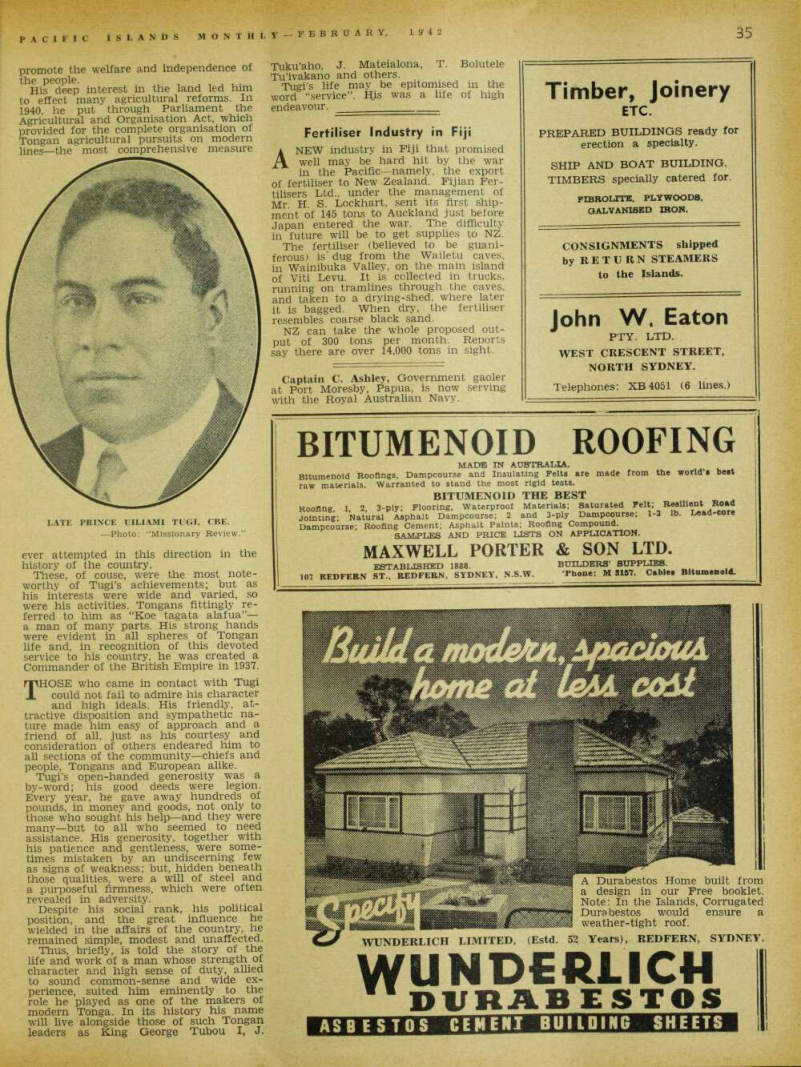
Late Prince Uiliami Tugi, Cbe.
—Photo; “Missionary Review.”