Timor
p. 26 · Read in the full issue
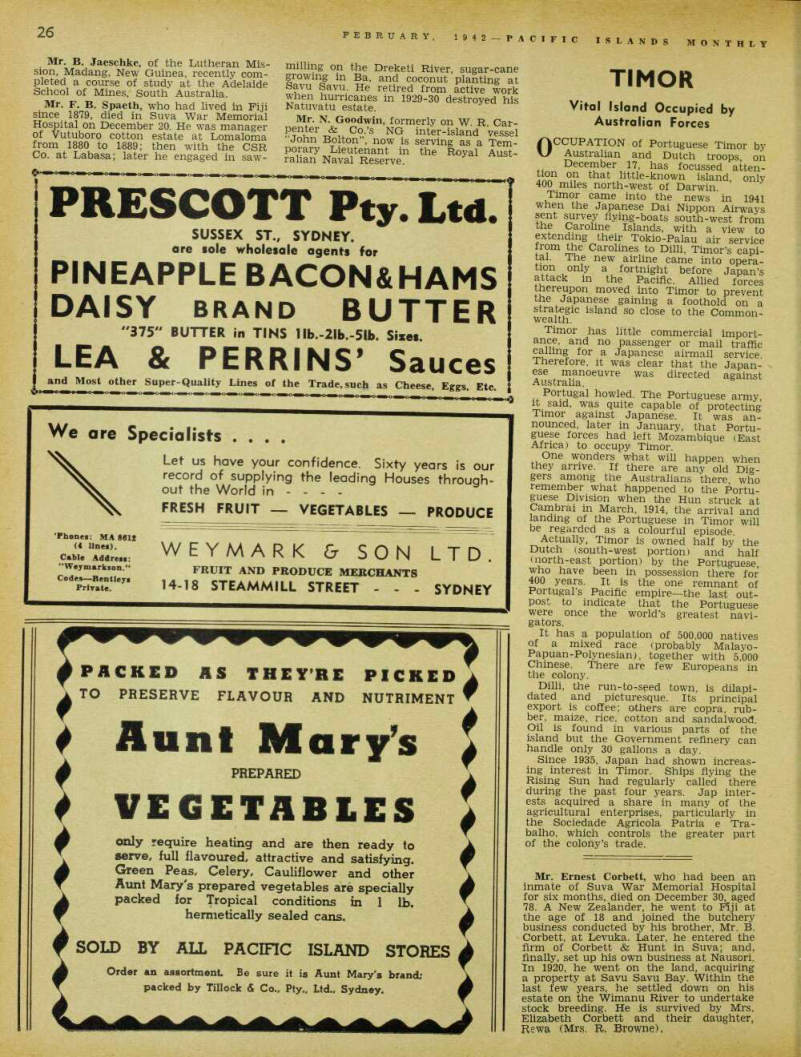
Vital Island Occupied by Australian Forces
OCCUPATION of Portuguese Timor by Australian and Dutch troops on December 17, has focussed atten k°n °.? that little-known island, only 400 miles north-west of Darwin.
Timor came into the news in 1941 when the Japanese Dai Nippon Airways sent survey flying-boats south-west from the Caroline Islands, with a view to extending their Tokio-Palau air service r ? m Carolines to Dilli, Timor’s capi tal. The new airline came into opera tion only a fortnight before Japan’s attack in the Pacific. Allied forces thereupon moved into Timor to prevent the Japanese gaining a foothold on a strategic island so close to the Common wealth.
Timor has little commercial import ance, and no passenger or mail traffic calling for a Japanese airmail service Therefore, it was clear that the Japan ese manoeuvre was directed against Australia.
Portugal howled. The Portuguese army, it said, was quite capable of protecting Timor against Japanese. It was an nounced, later in January, that Portu guese forces had left Mozambique (East Africa) to occupy Timor.
One wonders what will happen when they arrive. If there are any old Dig gers among the Australians there who remember what happened to the Portu guese Division when the Hun struck at Cambrai in March, 1914, the arrival and landing of the Portuguese in Timor will be regarded as a colourful episode.
Actually, Timor is owned half by the Dutch (south-west portion) and half (north-east portion) by the Portuguese, who have been in possession there for 400 years. It is the one remnant of Portugal’s Pacific empire—the last out post to indicate that the Portuguese were once the world’s greatest navi gators.
It has a population of 500,000 natives of a mixed race (probably Malayo- Papuan-Polynesian), together with 5,000 Chinese. There are few Europeans in the colony.
Dilli, the run-to-seed town, is dilapi dated and picturesque. Its principal export is coffee; others are copra, rub ber, maize, rice, cotton and sandalwood.
Oil is found in various parts of the island but the Government refinery can handle only 30 gallons a day.
Since 1935, Japan had shown increas ing interest in Timor. Ships flying the Rising Sun had regularly called there during the past four years. Jap inter ests acquired a share in many of the agricultural enterprises, particularly in the Sociedade Agricola Patria e Tra balho, which controls the greater part of the colony’s trade.
Mr. Ernest Corbett, who had been an inmate of Suva War Memorial Hospital for six months, died on December 30, aged 78. A New Zealander, he went to Fiji at the age of 18 and joined the butchery business conducted by his brother, Mr. B.
Corbett, at Levuka. Later, he entered the firm of Corbett & Hunt in Suva; and, finally, set up his own business at Nausori.
In 1920, he went on the land, acquiring a property at Savu Savu Bay. Within the last few years, he settled down on his estate on the Wimanu River to undertake stock breeding. He is survived by Mrs.
Elizabeth Corbett and their daughter, Rewa (Mrs. R, Browne),