territorial aXtment in the Tost wS
pp. 5-6 · Read in the full issue
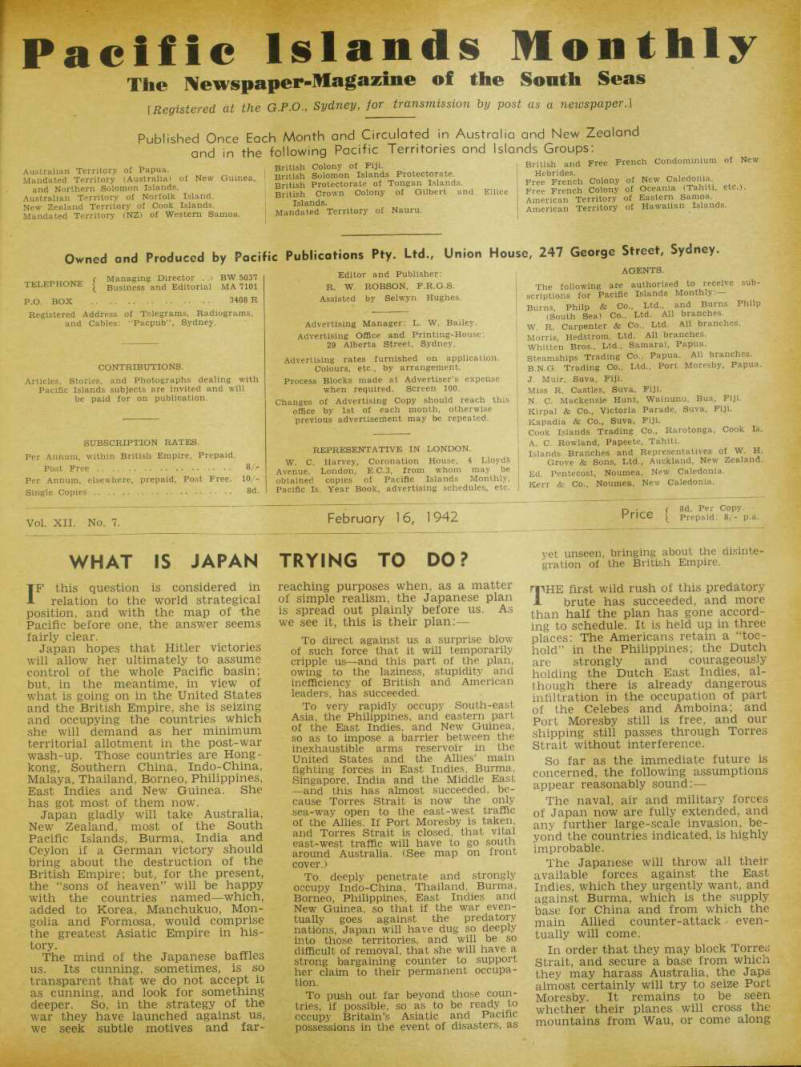
What Is Japan Trying To Do?
IF this question is considered in relation to the world strategical position, and with the map of the Pacific before one, the answer seems
fairly clear. . ,
Japan hopes that Hitler victories will allow her ultimately to assume control of the whole Pacific basin; but, in the meantime, in view of what is going on in the United States and the British Empire, she is seizing and occupying the countries which pVip will demand ns her minimum
territorial aXtment in the Tost wS
temtonai allotment in tne posj wd wash-up. Those countries are Hongkong, Southern China, Indo-Chma, Malaya, Thailand, Borneo, Philippines, East Indies and New Guinea. She has got most of them now.
Japan gladly will take Australia, New Zealand, most of the South Dn niHn Tclrmrlt- TnHlO n y\4 Pacific Islands, Burma, India and Ceylon if a German victory should bring about the destruction of the British Empire; but, for the present, the “sons of heaven” will be happy with the countries named—which, added to Korea, Manchukuo, Mongolia and Formosa, would comprise the greatest Asiatic Empire in hisf . o uoffioc The mind of the Japanese baffles us. Its cunning, sometimes, is so transparent that we do not accept it as cunning, and look for something deeper. So, in the strategy of the war they have launched against us, we seek subtle motives and far-
reaching purposes when, as a matter
of simple realism, the Japanese plan
is spread out plainly before us. As we see it, this is their plan:— To direct against us a surprise blow 0 f such force that it will temporarily cripple us—and this part of the plan, owing to the laziness, stupidity and inefficiency of British and American leaders, has succeeded.
To very rapidly occupy South-east Asia, the Philippines, and eastern pait of the East Indies, and New Guinea, s 0 as to impose a barrier between the inexhaustible arms reservoir in the united States and the Allies’ main fighting forces in East Indies, Burma, Singapore, India and the Middle East —and this has almost succeeded, be cause Torres Strait is now the only sea-way open to the east-west traffic °tthe Port Moresbyistaken £111(1 IS CIOSOQ, tllclt Vltcll east-west traffic will have to go south around Australia. (See map on front cover.) To deeply penetrate and strongly occupy Indo-China, Thailand, Burma, Borneo, Philippines, East Indies and New Guinea, so that if the war even tually goes against the predatory nations, Japan wil! have dug so deeply into those territories, and will be so difficult of removal, that she will have a strong bargaining counter to support her claim to their permanent occupa tion.
To push out far beyond those coun tries, if possible, so as to be ready to occupy Britain’s Asiatic and Pacific possessions in the event of disasters, as
yet unseen, bringing about the disinte gration of the British Empire.
THE first wild rush of this predatory brute has succeeded, and more than half the plan has gone accord ing to schedule. It is held up in three places; The Americans retain a “toe hold” in the Philippines; the Dutch are strongly and courageously holding the Dutch East Indies, al though there is already dangerous infiltration in the occupation of part of the Celebes and Amboina; and Port Moresby still is free, and our shipping still passes through Torres Strait without interference.
So far as the immediate future is concerned, the following assumptions appear reasonably sound: — The naval, air and military forces of Japan now are fully extended, and any further large-scale invasion, be yond the countries indicated, is highly improbable.
The Japanese will throw all their available forces against the East Indies, which they urgently want, and against Burma, which is the supply base for China and from which the main Allied counter-attack even tually will come.
In order that they may block Torres Strait, and secure a base from which they may harass Australia, the Japs almost certainly will try to seize Port Moresby. It remains to be seen whether their planes will cross the mountains from Wau, or come along
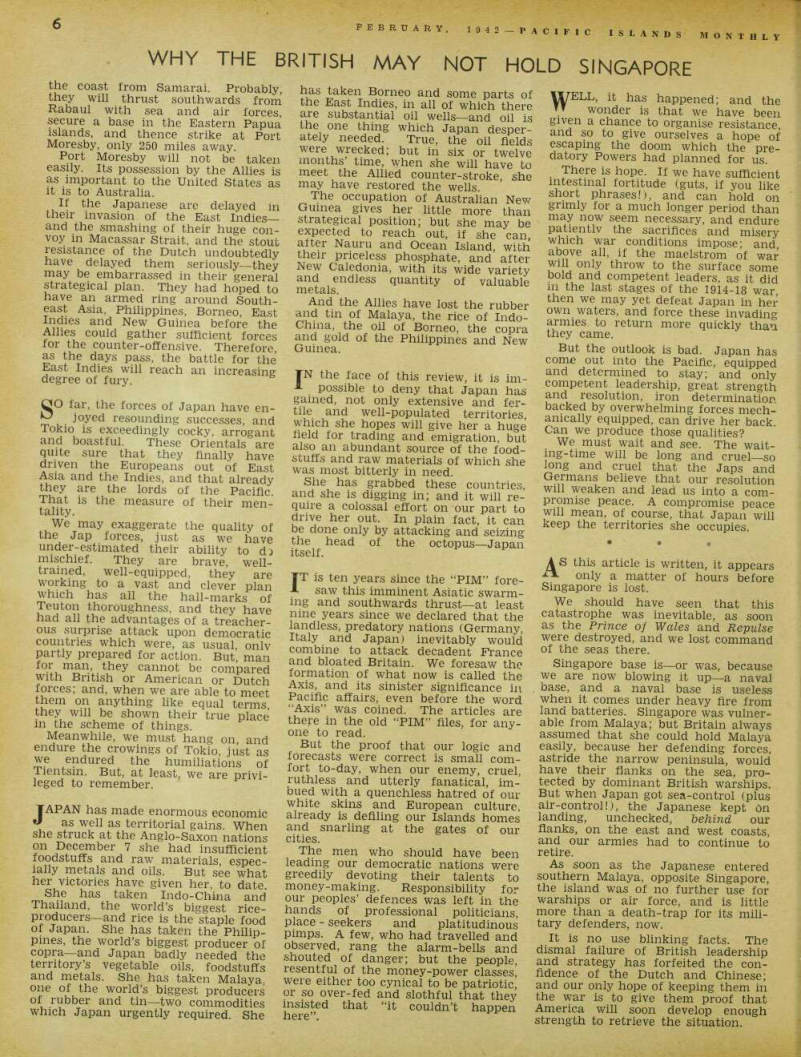
WHY THE BRITISH MAY NOT HOLD SINGAPORE
the coast from Samarai. Probably they will thrust southwards from Rabaul with sea and air forces, secure a base in the Eastern Papua islands, and thence strike at Port Moresby, only 250 miles away.
Port Moresby will not be taken easily. Its possession by the Allies is as important to the United States as it is to Australia.
If the Japanese are delayed in their invasion of the East Indies— and the smashing of their huge con voy in Macassar Strait, and the stout resistance of the Dutch undoubtedly have delayed them seriously—they may be embarrassed in their general strategical plan. They had hoped to have an armed ring around South east Asia, Philippines, Borneo, East Indies and New Guinea before the Allies could gather sufficient forces for the counter-offensive. Therefore as the days pass, the battle for the East Indies will reach an increasing degree of fury.
QO far, the forces of Japan have enjoyed resounding successes, and Tokio is exceedingly cocky, arrogant and boastful. These Orientals are quite sure that they finally have driven the Europeans out of East Asia and the Indies, and that already they are the lords of the Pacific.
That is the measure of their men tality.
We may exaggerate the quality of the Jap forces, just as we have under-estimated their ability to d) mischief. They are brave, well trained, well-equipped, they are working to a vast and clever plan which has all the hall-marks of Teuton thoroughness, and they have had all the advantages of a treacher ous surprise attack upon democratic countries which were, as usual, onlv partly prepared for action. But, man for man, they cannot be compared with British or American or Dutch forces; and, when we are able to meet them on anything like equal terms they will be shown their true place in the scheme of things.
Meanwhile, we must hang on, and endure the Growings of Tokio, just as we endured the humiliations of Tientsin. But, at least, we are privi leged to remember.
APAN has made enormous economic as well as territorial gains. When she struck at the Anglo-Saxon nations on December 7 she had insufficient foodstuffs and raw materials, espec ially metals and oils. But see what her victories have given her, to date.
She has taken Indo-China and Thailand, the world’s biggest rice producers—and rice is the staple food of Japan. She has taken the Philip pines, the world’s biggest producer of copra—and Japan badly needed the territory’s vegetable oils, foodstuffs and metals. She has taken Malaya one of the world’s biggest producers of rubber and tin—two commodities which Japan urgently required. She
has taken Borneo and some parts of the East Indies, in all of which there are substantial oil wells—and oil is the one thing which Japan desper ately needed. True, the oil fields were wrecked; but in six or twelve months’ time, when she will have to meet the Allied counter-stroke, she may have restored the wells.
The occupation of Australian New Guinea gives her little more than strategical position; but she may be expected to reach out, if she can, after Nauru and Ocean Island, with them pnceiess phosphate, and after New Caledonia, with its wide variety and endless quantity of valuable metals.
And the Allies have lost the rubber and tin of Malaya, the rice of Indo china, the oil of Borneo, the copra and gold of the Philippines and New Guinea.
TN the face of this review, it is im possible to deny that Japan has gained, not only extensive and fer tile and well-populated territories, which she hopes will give her a huge field for trading and emigration, but also an abundant source of the food stuffs and raw materials of which she was most bitterly in need.
She has grabbed these countries, and she is digging in; and it will re quire a colossal effort on our part to drive her out. In plain fact, it can be done only by attacking and seizing the head of the octopus—Japan itself.
TT is ten years since the “PIM” fore- A saw this imminent Asiatic swarm ing and southwards thrust—at least nine years since we declared that the landless, predatory nations (Germany, Italy and Japan) inevitably would combine to attack decadent France and bloated Britain. We foresaw the formation of what now is called the Axis, and its sinister significance in Pacific affairs, even before the word “Axis” was coined. The articles are there in the old “PIM” files, for any one to read.
But the proof that our logic and forecasts were correct is small com fort to-day, when our enemy, cruel, ruthless and utterly fanatical, im bued with a quenchless hatred of our white skins and European culture, already is defiling our Islands homes and snarling at the gates of our cities.
The men who should have been leading our democratic nations were greedily devoting their talents to money-making. Responsibility for our peoples’ defences was left in the hands of professional politicians, place - seekers and platitudinous pimps. A few, who had travelled and observed, rang the alarm-bells and shouted of danger; but the people, resentful of the money-power classes, were either too cynical to be patriotic, or so over-fed and slothful that they insisted that “it couldn’t happen here”.
W ELL > it has happened; and the V wonder is that we have been given a chance to organise resistance, and so to give ourselves a hope of escaping the doom which the pre datory Powers had planned for us.
There is hope. If we have sufficient intestinal fortitude (guts, if you like short phrases!), and can hold on grimly for a much longer period than may now seem necessary, and endure patientlv the sacrifices and misery which war conditions impose; and above all, if the maelstrom of war will only throw to the surface some bold and competent leaders, as it did in the last stages of the 1914-18 war then we may yet defeat Japan in her own waters, and force these invading armies to return more quickly than they came.
But the outlook is bad. Japan has come out into the Pacific, equipped and determined to stay; and only competent leadership, great strength and resolution, iron determination backed by overwhelming forces mech anically equipped, can drive her back.
Can we produce those qualities?
We must wait and see. The wait ing-time will be long and cruel—so long and cruel that the Japs and Germans believe that our resolution will weaken and lead us into a com promise peace. A compromise peace will mean, of course, that Japan will keep the territories she occupies. • * * AS this article is written, it appears A only a matter of hours before Singapore is lost.
We should have seen that this catastrophe was inevitable, as soon as the Prince of Wales and Repulse were destroyed, and we lost command of the seas there.
Singapore base is—or was, because we are now blowing it up—a naval base, and a naval base is useless when it comes under heavy fire from land batteries. Singapore was vulner able from Malaya; but Britain always assumed that she could hold Malaya easily, because her defending forces, astride the narrow peninsula, would have their flanks on the sea, pro tected by dominant British warships.
But when Japan got sea-control (plus air-control!), the Japanese kept on landing, unchecked, behind our flanks, on the east and west coasts, and our armies had to continue to retire.
As soon as the Japanese entered southern Malaya, opposite Singapore, the island was of no further use for warships or air force, and is little more than a death-trap for its mili tary defenders, now.
It is no use blinking facts. The dismal failure of British leadership and strategy has forfeited the con fidence of the Dutch and Chinese; and our only hope of keeping them in the war is to give them proof that America will soon develop enough strength to retrieve the situation.