Isolated Palmerston
pp. 44-45 · Read in the full issue
Island Marsters' Descendants Live in Contentment
From Our Own Correspondent
Rarotonga, Oct. 7.
HOW would our modern Polynesian fare without his long-accustomed European conveniences and luxuries?
Many an argument has been waged on this issue among those interested in Is lands culture and welfare. Perhaps this is the answer.
Recently the Cook Islands schooner “Tiare Taporo” paid a call at romantic Palmerston Island, the first ship sighted at this lonely group of atolls for “well over four years. The crew and passengers re discovered a veritable “Typee”, for the members of the Marsters family who in habit the main island have shown in no uncertain manner that where there’s a will there’s a way. Half-Polynesian, half- European, they have been isolated from this bedlam world for long enough to have to re-adopt many of their ancient ways of life.
Nowadays, there are 52 people on Palmerston—since half the population availed themselves of the C.I. Admini stration’s offer in 1936 to transfer to
other islands of the Cook Group. They are all descendants of a virile English man, William Marsters, who settled there in 1862 with four or five Polynesian women.
All members of the present five sep arate families are in the best of health, with perfect teeth, except in two cases where young men had been away from the island for a number of years. The women have as fine a physique as the men.
The main drawback to living on Palm erston, of course, is the fear of hurri canes, which have in the past swept the island nearly out of existence.
The last four years have not been wasted. As a result of a kind of four year-plan, three large new taro swamps have been constructed. To grow taro on an atoll is no mean feat and can be accomplished only by the arduous labour of excavating the sandy earth until water is reached, then scraping up the available humus and filling the hole up again. The size of these patches can be imagined when it is estimated that 1,500 tons of sand and stone must be displaced for one patch alone. Other tasks have been the building of canoes, and the
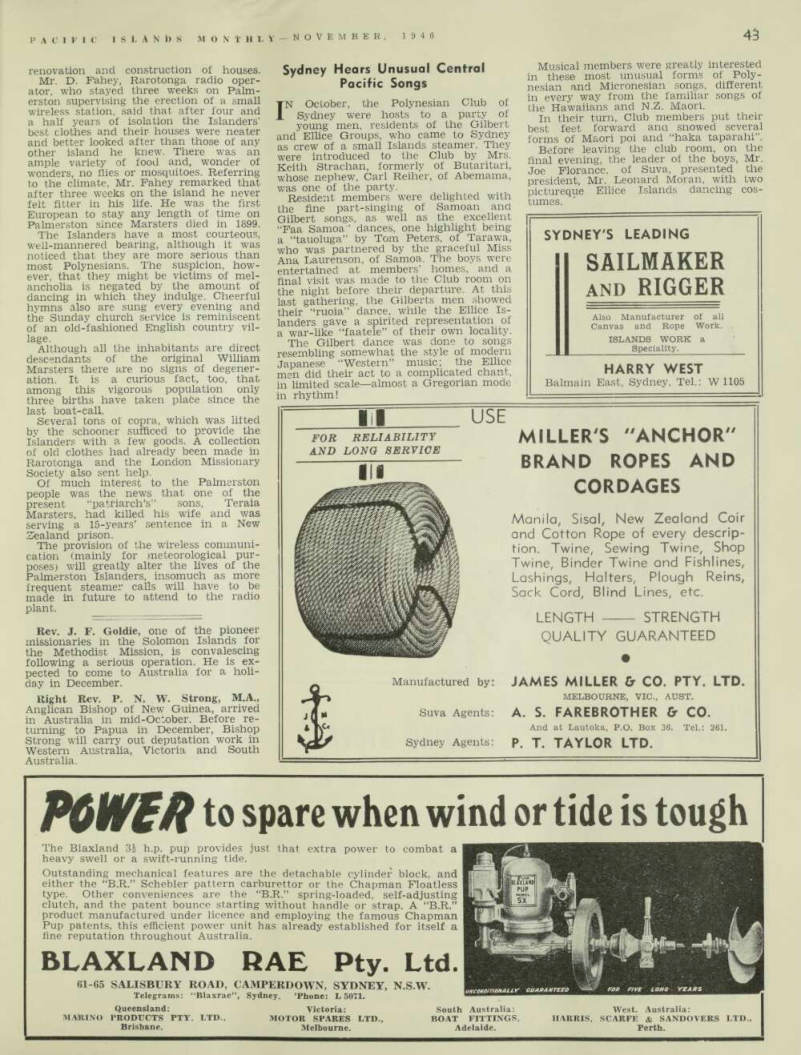
Stalwart girls of Palmerston Island.
renovation and construction of houses.
Mr. D. Fahey, Rarotonga radio oper ator, who stayed three weeks on Palm erston supervising the erection of a small wireless station, said that after four and a half years of isolation the Islanders’ best clothes and their houses were neater and better looked after than those of any other island he knew. There was an ample variety of food and, wonder of wonders, no flies or mosquitoes. Referring to the climate, Mr. Fahey remarked that after three weeks on the island he never felt fitter in his life. He was the first European to stay any length of time on Palmerston since Marsters died in 1899.
The Islanders have a most courteous, well-mannered bearing, although it was noticed that they are more serious than most Polynesians. The suspicion, how ever, that they might be victims of mel ancholia is negated by the amount of dancing in which they indulge. Cheerful hymns also are sung every evening and the Sunday church service is reminiscent of an old-fashioned English country vil lage.
Although all the inhabitants are direct descendants of the original William Marsters there are no signs of degener ation. It is a curious fact, too, that among this vigorous population only three births have taken place since the last boat-call.
Several tons of copra, which was lifted by the schooner sufficed to provide the Islanders with a few goods. A collection of old clothes had already been made in Rarotonga and the London Missionary Society also sent help.
Of much interest to the Palmerston people was the news that one of the present “patriarch’s” sons, Teraia Marsters, had killed his wife and was serving a 15-years’ sentence in a New Zealand prison.
The provision of the wireless communi cation (mainly for meteorological pur poses) will greatly alter the lives of the Palmerston Islanders, insomuch as more frequent steamer calls will have to be made in future to attend to the radio
plant.
Rev. J. F. Goldie, one of the pioneer missionaries in the Solomon Islands for the Methodist Mission, is convalescing following a serious operation. He is ex pected to come to Australia for a holi day in December.
Right Rev. P. N. W. Strong, M.A., Anglican Bishop of New Guinea, arrived in Australia in mid-October. Before re turning to Papua in December, Bishop Strong will carry out deputation work in Western Australia, Victoria and South Australia.