How To Make Soap
pp. 39-40 · Read in the full issue
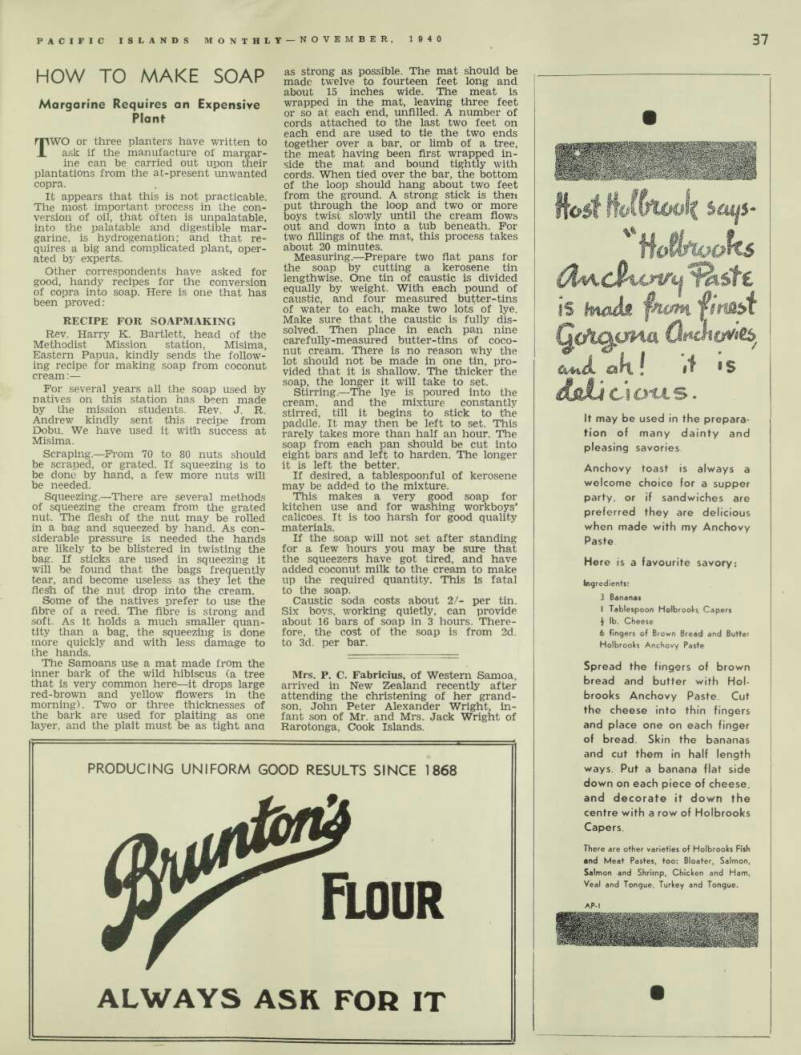

Margarine Requires an Expensive Plant
TWO or three planters have written to ask if the manufacture of margar ine can be carried out upon their plantations from the at-present unwanted copra.
It appears that this is not practicable.
The most important process in the con version of oil, that often is unpalatable, into the palatable and digestible mar garine, is hydrogenation; and that re quires a big and complicated plant, oper ated by experts.
Other correspondents have asked for good, handy recipes for the conversion of copra into soap. Here is one that has been proved;
Recipe For Soapmaking
Rev. Harry K. Bartlett, head of the Methodist Mission station, Misima, Eastern Papua, kindly sends the follow ing recipe for making soap from coconut cream:— For several years all the soap used by natives on this station has been made by the mission students. Rev. J. R.
Andrew kindly sent this recipe from Dobu. We have used it with success at Misima.
Scraping.—From 70 to 80 nuts should be scraped, or grated. If squeezing is to be done by hand, a few more nuts will be needed.
Squeezing.—There are several methods of squeezing the cream from the grated nut. The flesh of the nut may be rolled in a bag and squeezed by hand. As con siderable pressure is needed the hands are likely to be blistered in twisting the bag. If sticks are used in squeezing it will be found that the bags frequently tear, and become useless as they let the of the nut drop into the cream.
Some of the natives prefer to use the fibre of a reed. The fibre is strong and soft. As it holds a much smaller quan tity than a bag, the squeezing is done more quickly and with less damage to the hands.
The Samoans use a mat made from the inner bark of the wild hibiscus (a tree that is very common here—it drops large red-brown and yellow flowers in the morning). Two or three thicknesses of the bark are used for plaiting as one layer, and the plait must be as tight ana
as strong as possible. The mat should be made twelve to fourteen feet long and about 15 inches wide. The meat is wrapped in the mat, leaving three feet or so at each end, unfilled. A number of cords attached to the last two feet on each end are used to tie the two ends together over a bar, or limb of a tree, the meat having been first wrapped in side the mat and bound tightly with cords. When tied over the bar, the bottom of the loop should hang about two feet from the ground. A strong stick is then put through the loop and two or more boys twist slowly until the cream flows out and down into a tub beneath. For two fillings of the mat, this process takes about 20 minutes.
Measuring.—Prepare two flat pans for the soap by cutting a kerosene tin lengthwise. One tin of caustic is divided equally by weight. With each pound of caustic, and four measured butter-tins of water to each, make two lots of lye.
Make sure that the caustic is fully dis solved. Then place in each pan nine carefully-measured butter-tins of coco nut cream. There is no reason why the lot should not be made in one tin, pro vided that it is shallow. The thicker the soap, the longer it will take to set.
Stirring.—The lye is poured into the cream, and the mixture constantly stirred, till it begins to stick to the paddle. It may then be left to set. This rarely takes more than half an hour. The soap from each pan should be cut into eight bars and left to harden. The longer it is left the better.
If desired, a tablespoonful of kerosene may be added to the mixture.
This makes a very good soap for kitchen use and for washing workboys' calicoes. It is too harsh for good quality materials.
If the soap will not set after standing for a few hours you may be sure that the squeezers have got tired, and have added coconut milk to the cream to make up the required quantity. This Is fatal to the soap.
Caustic soda costs about 2/- per tin.
Six boys, working quietly, can provide about 16 bars of soap in 3 hours. There fore, the cost of the soap is from 2d. to 3d. per bar.
Mrs. P. C. Fabricius, of Western Samoa, arrived in New Zealand recently after attending the christening of her grand son, John Peter Alexander Wright, in fant son of Mr. and Mrs. Jack Wright of Rarotonga, Cook Islands.
Miss Thora Richardson, chairman’s assistant and schoolteacher at the Methodist Mission’s station at Salamo, Papua, was in Australia on leave in October.
Sister W. E. Manning has returned to New Zealand from Malaita, 8.5.1., where she was a nurse at the Melanesian Mis sion’s hospital.
Mr. K. S. and Mrs. Willis, and family, arrived in Australia recently on furlough.
He is connected with the Native Hospital at Port Moresby, and during his absence Mr. P. Jensen will relieve him.