Ready Aid
pp. 9-10 · Read in the full issue
What Australia is Doing For French Colonies in the Pacific
SUBSTANTIAL economic assistance has been given to the French Colonies in New Caledonia and the New Hebrides by the Commonwealth of Aus tralia, in re-arranging customs and tariff duties so as to permit a freer interchange of goods.
The most important market hitherto enjoyed by the products of New Cale donia (chrome and nickel, copra and coffee) and New Hebrides (copra, coffee and cocoa) have been lost owing to war conditions, and Australia is not able to provide substantial new markets for those products.
However, as the French communities require the foodstuffs and manufactures of Australia, and deserve all the assist ance which the British can give them, Australia has made an effort to adjust her war-time economy to the new condi tions. ( -*< In the case of New Caledonia the fol lowing economic arrangements have been made.
New Caledonian Trade
WHEN France collapsed New Caledonia, was faced with two problems: First, to find a country to supply her with manufactured goods; and second, a mar ket for her exports to pay for them. Aus tralia, obviously, was the answer to both questions, and in August the adverse tariff which had operated against Aus tralia for many years was rescinded and a more favourable rate introduced.
Minerals comprise 84 per cent, of the total value of New Caledonia’s exports.
Great Britain and America have been taking the bulk of the chrome ore pro duction for many years; and Japan, who is not permitted to take smelted metals out of the Colony, is importing large quantities of nickel ore arid low grade iron ore.
Australia, to-day, is taking 450 of the 750 tons of nickel matte produced each months. It was reported in October that Japan offered to buy the whole of the Colony’s coffee, copra and trochus shell production, if she were allowed to buy the balance of 300 tons of this matte.
New Caledonia’s copra and trochus shell are in the same position as those of other Pacific territories; but the position of the kauri timber and cattle hide ex ports, which have been coming to Aus tralia for over 30 years, remains unaltered and is considered quite satisfactory.
Another industry which was playing an important part in the Colony’s export trade was canned meats. This company, with headquarters at Ouaco, held large contracts with the French Government, but now has ceased canning operations.
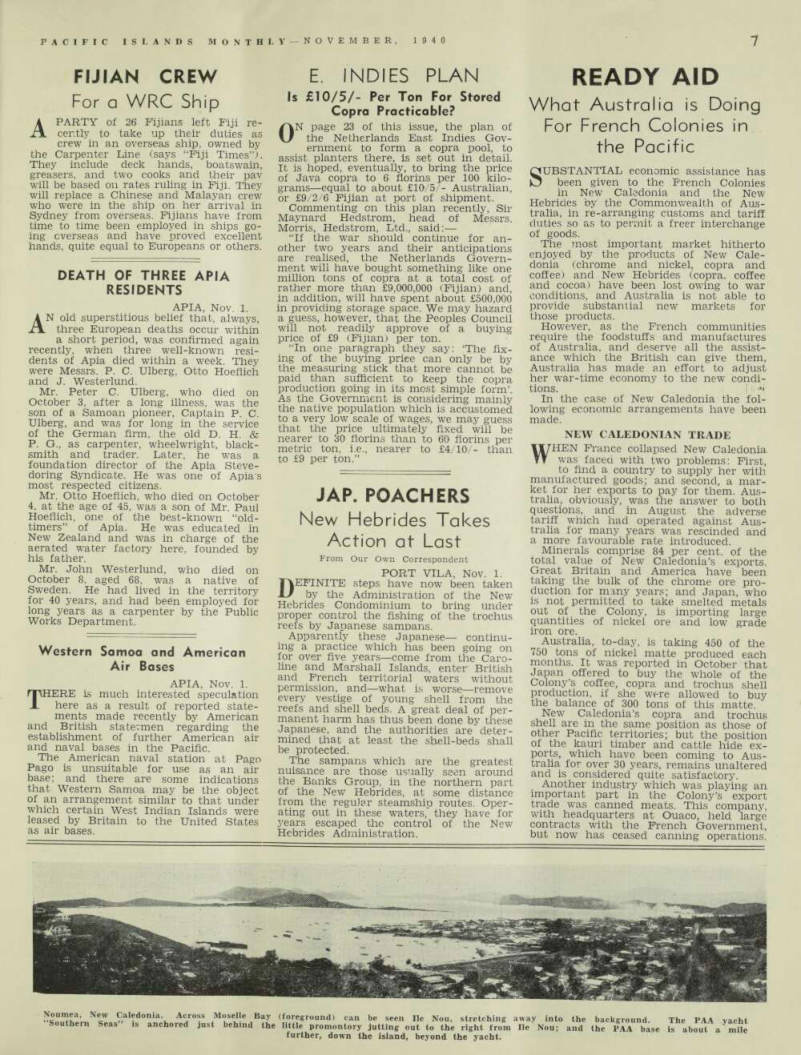
Noumea, New Caledonia. Across Moselle Bay (foreground) can be seen He Non, stretching away into the background. The PAA yacht Southern Seas is anchored just behind the little promontory jutting out to the right from He Nou; and the PAA base is about a^ile further, down the island, beyond the yacht.
In New Caledonia it is hoped that Great Britain will give the Colony portion of its large canned meats order.
Fate Of Coffee Industry
riTHE most important question in New JL Caledonia to-day, is the future of the 2,000 tons a year coffee industry.
Formerly, Australia had placed this com modity on the prohibited imnorts list; but this ban has been lifted* and the coffee now is on the same footing as any other country namely, it pays a duty of 4d. a lb., plus primage and war tax— and about 20 tons, the first of a trial shipment of 75 tons, arrived in Sydney early this month.
The New Caledonian people would like to see this duty modified; but, in Aus tralia, it is pointed out that the local
market has been well catered for in the past by countries with whom the Com monwealth has important trade connec tions. It is considered that any attempt to introduce New Caledonian coffee onto the Australian market will have to be done gradually, not only because of public tastes, but because every ton of this coffee entering Australia does so to the detriment of other coffee exporters.
It is understood, however, that the Com monwealth Government is considering the question of reviewing the duty on New Caledonian coffee.
PRIOR to the capitulation New Cale donia was connected with Australia and other French possessions in the Pacific by two shipping services. A French vessel ran from Sydney to Noumea, New Hebrides and Indo-China. The same line ran vessels from Noumea to Marseilles via Tahiti and the Panama Canal. Both of these services have ceased.
The New Caledonian Government now is trying to establish a trans-Pacific ser vice from Sydney to Noumea, New Hebrides, Fiji, Tahiti, San Francisco, and possibly Mexico, where it is stated, there is an “open market” for copra. But there is a serious shortage of suitable ships.
Exchange Problem Difficult
IN 1939, New Caledonia imported goods valued at 188,182,274 francs while ex ports totalled 157,634,628 francs, and this unfavourable trade balance now has been accentuated by restricted export trade. This in turn has reduced the Colony’s overseas exchange. Although New Caledonia’s requirements to-day have been estimated at £75,000 a month, the Colony is exporting goods to the value of only £25,000 per month.
All overseas funds from the sale of goods have to be placed in a Government pool, and the New Caledonian exporter is paid in francs. All purchases abroad have to be made through an overseas
exchange commission, which at present allots merchants and traders a certain amount of exchange per month, based on 1939 import figures. A merchant who wants to buy in Australia, for example, makes out a list of his needs and their prices, and presents this to the exchange commission. If he has not already ex ceeded his monthly allotment and the goods asked for are genuine necessities, he is given an order to take to the local Banque de ITndo-Chine, where he obtains a draft on an Australian bank.
One Noumea merchant said he was get ting exchange representing about one third of his usual requirements; but, ow ing to the rise in prices, this money would purchase only one-fifth of his needs.
In the unsettled period, when the future of the franc was uncertain, many people bought up larger quantities of goods of all descriptions, arguing that whatever the currency, the goods would retain their value, and this, together with the fact that the Colony is no longer getting nor mal supplies from abroad, has caused a severe shortage of manufactured goods.
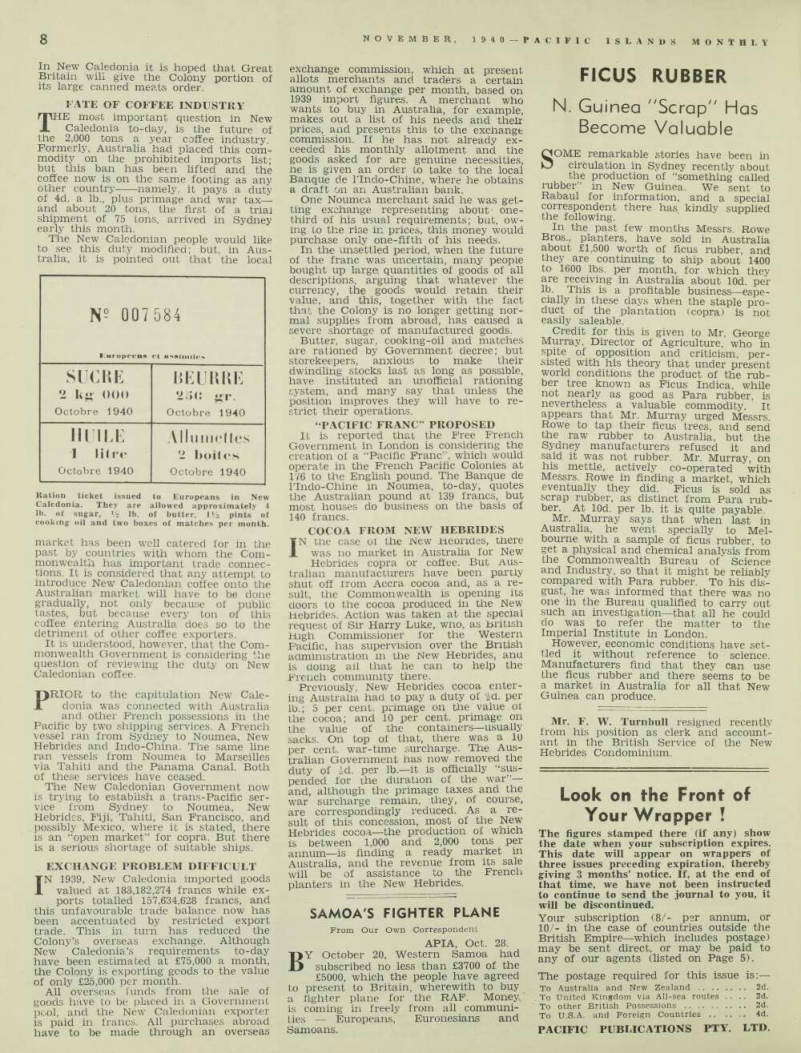
Butter, sugar, cooking-oil and matches are rationed by Government decree; but storekeepers, anxious to make their dwindling stocks last as long as possible, have instituted an unofficial rationing system, and many say that unless the position improves they will have to re strict their operations.
‘ Pacific Franc” Proposed
It is reported that the Free French Government in London is considering the creation of a “Pacific Franc”, which would operate in the French Pacific Colonies at 176 to the English pound. The Banque de ITndo-Chine in Noumea, to-day, quotes the Australian pound at 139 francs, but most houses do business on the basis of 140 francs.
Cocoa From New Hebrides
IN the case of the New Heondes, there was no market in Australia for New Hebrides copra or coffee. But Aus tralian manufacturers have been partly shut off from Accra cocoa and, as a re sult, the Commonwealth is opening its doors to the cocoa produced in the New Hebrides. Action was taken at the special request of Sir Harry Luke, who, as British High Commissioner for the Western Pacific, has supervision over the British administration in the New Hebrides, and is domg ail that he can to help the French community there.
Previously, New Hebrides cocoa enter ing Australia had to pay a duty of id. per lb.; 5 per cent, primage on the value of the cocoa; and 10 per cent, primage on the value of the containers —usually sacks. On top of that, there was a 10 per cent, war-time surcharge. The Aus tralian Government has now removed the duty of Id. per lb—it is officially “sus pended for the duration of the war” — and, although the primage taxes and the war surcharge remain, they, of course, are correspondingly reduced. As a re sult of this concession, most of the New Hebrides cocoa—the production of which is between 1,000 and 2,000 tons per annum—is finding a ready market in Australia, and the revenue from its sale will be of assistance to the French planters in the New Hebrides.
Ration ticket issued to Europeans in New Caledonia. They are allowed approximately 4 1b. of sugar, ½ 1b. of butter. 1½ pints of cooking oil and two boxes of matches per month.