Internationa! Moves and Counter-Moves
pp. 7-8 · Read in the full issue
TO a degree never before seen in the history of the world, this great war partakes of the character of a game of chess. There is intense fighting between specialists—but, ex cept for the blitzkrieg which smashed Poland and France, there has been extraordinarily little military move ment, and the total casualties in this war up to date do not yet equal the bloody slaughter of one great battle in the 1914-18 struggle.
It has been largely a war of economic manipulation, and of inter national realignments. Judged on that basis, the economic advantages remain principally with the Demo cracies (especially in relation to sea power) ; but the advantages of the international realignments unques tionably have been secured by the Dictators, who now dominate the whole of Europe, except for Portugal in the far west, and Greece, Turkey and Russia in the east. This game of international chess goes on, tensely and mercilessly. Present and threat ened moves affect the position in the Pacific; and enough of them can be discerned to indicate that the events of the next few months may decide the course of the war.
Let us briefly review the recent moves. Hitler, early in 1940, was cer tain that he could smash France. He knew—what we did not know—that while the French people were still sound democrats, the core of France —the commercial and political
“princes”—was rotten. But, before attacking France, he took a step which he believed ensured the over throw of Britain—namely, he seized the whole Atlantic coast, from northern Norway through Denmark to Holland and Belgium. With the overthrow of France, and the seizure of French channel ports, he calcu lated that he was in a position to blanket the British Isles with sub marine commerce-destroyers, simul taneously with his aerial blitzkrieg against Britain.
The coup de grace was to be given by Italy, which entered the war as France collapsed. It was calculated that Italy, immediately, would take control of the Mediterranean and sever Britain’s Imperial lifeline through the Mediterranean, North Africa and Suez.
It was a plan of diabolical clever ness, framed by a master chess player, and it just about succeeded. By July, all Central Europe was under German domination; Russia literally was “scared stiff”; and Spain, the Balkan nations, and Turkey, awaited only the final collapse of England to submit to German hegemony.
IN August and September, the demo cracies made their moves, and the picture changed. Britain would not submit, and refused to be invaded. On the seas, she still was supreme, and she gave back blow for blow in the air. In the Mediterranean, the daunt
less British Navy countered the threat of a German-dominated French navy, and sent the chicken-hearted Italians scuttling to their heavily-protected naval bases. The United States gave Britain immense moral and material aid.
So Germany’s “master-mind”, find ing itself unexpectedly thwarted by British resolution, made a new plan.
It brought Japan into the Axis pact, with a view to compelling the United States to keep their men and muni tions at home. It planned a pincers movement by German armies, south wards through Spain and the Balkans, to pinch off the British forces in Egypt and Palestine, and so get control of the Mediterranean; and, as the first step towards preparing the pincers, German armies occupied Rumania and the Rumanian oilfields.
Now Britain began to move her chess pieces effectively. Her resist ance and gallant spirit heartened Turkey, Greece and Spain; and the Nazi “master-mind” found in those nations a stubborn inclination to re sist the pincers movement. The United States refused to be panicked by the spectacle of a Nazified Japan.
Instead, the Americans displayed an unexpected, grim determination to maintain their rights in the Far East.
Japan, hitherto inclined to flag-wav ing and aggressiveness, suddenly moderated her tone. This was check Number II for the Nazi “master mind”.
Check Number 111 came very soon afterwards. Nazi influences used
every wile and stratagem at their command to defeat pro-British Roose velt in the Presidential Election on November 5. But RooseVelt was over whelmingly re-elected. America, in a clear, united voice, declared for Democracy and the right of the in dividual to life, liberty and the pur suit of happiness.
NOW, quickly, the Nazi chess-player is making his next move. His plea for a military highway through the Iberian Peninsula having been rejected by Spain and the Vichy Government, and Greece having un expectedly resisted and mauled the invading Italians, Hitler has turned —rather desperately, it seems—to Russia; and, surprisingly. Dictator Stalin has sent his “Premier” Molo toff, with an impressive entourage, to Berlin. This development has only one meaning. Germany is asking Russia to put pressure upon Turkey, so that Turkey will abandon her understanding with Britain and will not go to the aid of Greece if and when the German armies, carrying out their pincers movement, attack Greece through Germany and Bul garia. Russia will not refuse. Cer tainly, she may temporise—for the plain fact of the matter is that Stalin is desperately afraid of the enormous, highly-mechanised military forces which Germany now has at her com mand.
Meanwhile, two other moves on the chess-board may be noted. Hitler is using his 2,000 miles of Atlantic sea board to launch upon British sea borne commerce an intensified attack, of a character which is causing the gravest alarm in London. Britain has repelled the aerial invasion, but she has not yet solved the problem of how to keep her ships running freely upon the seas, while hundreds of large submarines, from scores of German, Danish, Norwegian, Dutch, and French ports, go hundreds of miles out into the Atlantic.
Meanwhile, Japan hurriedly has withdrawn her armies from Southern China, and assembled them upon the great island of Hainan. What is their destination? Upon that answer, and America’s reaction to it, depends the immediate future in the Pacific.
That is the position on the chess board as this is written: Molotoff is in Berlin, being wildly “Heiled” by Nazi Germany and Fascist Italy; Britain is faced with the grim prob lem of the ceaseless destruction of her shipping; Greece and Turkey await anxiously a sign from Russia; Japan ese armies have gathered near Indo- China and the Netherlands Indies; and the foreign policy of the United States under the new conditions is steadily taking shape.
Mr. Edward €. Snow, of Sydney, a member of the Pacific Islands Society, who had been on a visit to Tahiti, made a hurried departure in August from that island on a British freighter as a result of political developments. Mr. Snow writes that most British and American tourists have withdrawn from the Society Islands, with the exception of a few at Moorea, “where there is plenty of rain but little to eat”. Mr. Snow re turned to Sydney in October.
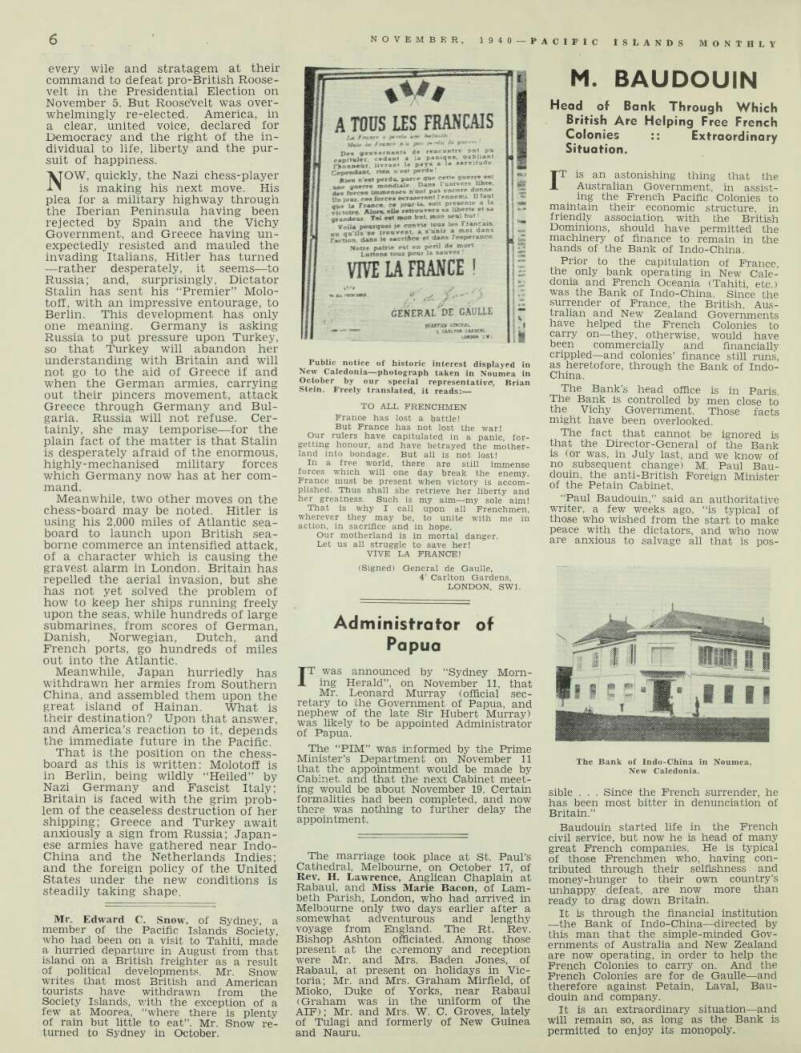
Public notice of historic interest displayed in New Caledonia—photograph taken in Noumea in October by our special representative*, Brian Stein. Freely translated, it reads:—
To All Frenchmen
France has lost a battle!
But France has not lost the war!
Our rulers have capitulated in a panic, for getting honour, and have betrayed the mother land into bondage. But all is not lost!
In a free world, there are still immense forces which will one day break the enemy.
France must be present when victory is accom plished. Thus shall she retrieve her liberty and her greatness. Such is my aim—my sole aim!
That is why I call upon all Frenchmen, wherever they may be, to unite with me in action, in sacrifice and in hope.
Our motherland is in mortal danger.
Let us all struggle to save her!
Vive La France!
(Signed) General de Gaulle, 4 Carlton Gardens,