Organisations
pp. 48-50 · Read in the full issue
To Link Native Education With Mission
A New "Bureau of Missions and Colonial Planning"
By “Anthropos”
THERE recently has been set up at the University of Aberdeen a Bureau of Missions and Colonial Planning. The sponsors are Sir John Orr, Professor Lancelat Hogben, whose liberal outlook on the world of science is well-known through his popular publications, John Graham, Professor of Systematic Theol ogy at Aberdeen, and Dr. Ralph Pidding
ton, Sydney University graduate, who later worked with Firth and Malinowski at London, and who now holds the Reid Lectureship in Anthropology at Aberdeen.
The title “Bureau of Missions ana Colonial Planning”, impli Q s a recognition of the important role that missions must be expected to fill in any large-scale pro gramme of Colonial development; and this has particular significance for British Colonies, including those of the Pacific area, in view of the proposed £50,000,000 development scheme (which, by the way, has now passed all stages of the Com mons, notwithstanding the urgent claims of war).
It implies, also, a recognition of tne need for practical co-operation and mutual understanding between the sciences (such as medicine and agricul ture); social anthropology, both in the study and the field, and fnissiofiaries, if the interests of the natives are to be fully considered and their future develop ment arranged on scientific and co ordinated lines. That is to say, if the social, moral, material and economic as pects of native life are to be successfully and progressively adapted to the changed cultural conditions and environment which the pursuit of any large-scale Colonial developmental plan would assuredly bring about.
SUCH planned and progressive adapta tion is now, of course, the keynote of British Colonial policy. The alter native is to leave the natives severely alone, which is obviously impossible and economically impracticable, since the success of any development programme is necessarily dependent upon the extent of native participation—unless the devel opment is to be pursued solely through non-indigenous agencies, and is to be of a purely economic nature.
The aims and purpose of the Bureau are outlined in a brochure which has been sent to me. together with a sugges tive introductory paper, “Anthropology and the Future of Missions”, prepared conjointly by Dr. Piddington and Profes sor Graham.
The preamble to the brochure puts the general situation which is to be faced in the following way: “Missions already play an important part in Colonial affairs, control educational facilities, are pre-eminently interested in native affairs, possess the confidence of natives, have a unique knowledge of local conditions, and are increasingly willing to co-operate with scientists and with administrative agencies”.
To secure maximum effort, develop ment of missions must be studied as a special aspect of Colonial reconstruction.
Problems encountered by missionaries must receive detailed and sympathetic consideration, relevant knowledge must be collected and collated for their benefit, with a view to the formulation and carrying out of a constructive policy in such matters as nutrition, agriculture, health, education, and a comprehensive consideration of the problems of culture contact and change.
THE Bureau referred to proposes to take the initiative in certain of these matters, its field of activity to com prise:— (a) Collecting information from vari ous sources, and making it available in published form, and by means of lectures
and conferences in which missionaries and scientists will be brought together. (b) Obtaining from missionaries all over the Colonial world information re lative to the problems of culture-contact. (c) Securing co-operation between scientists, administrations and missions in the work and organising of the Bureau. (d> Conferring with mission organisa tions on matters of policy, guided by the common interests of missions and science, in connection with the formation 01 plans to cope with problems encountered by the different parties in the course of their native work.
THE paper of Piddington and Balfour on “Anthropology and the Future of Missions”, acknowledging that missions must play an important part in post-war colonial reconstruction, gets down to tin tacks in a very thorough way. There is space here to quote no more than a paragraph, for instance, dealing with the wide subject of education:— “In mission education, the effort to produce a literate Christian community has been largely directed toward enabling natives to read the Bible. In a properly re-orientated education, the abilitv to read will be emphasised as an indispen sible instillment by which native people will be enabled to brine the resources of European scientific knowledge to the solution of their material and social problems in Christian terms; to combat disease; to eliminate malnutrition; to promote on a large scale economic ana social well-being, which will foster decent human relations; and to train
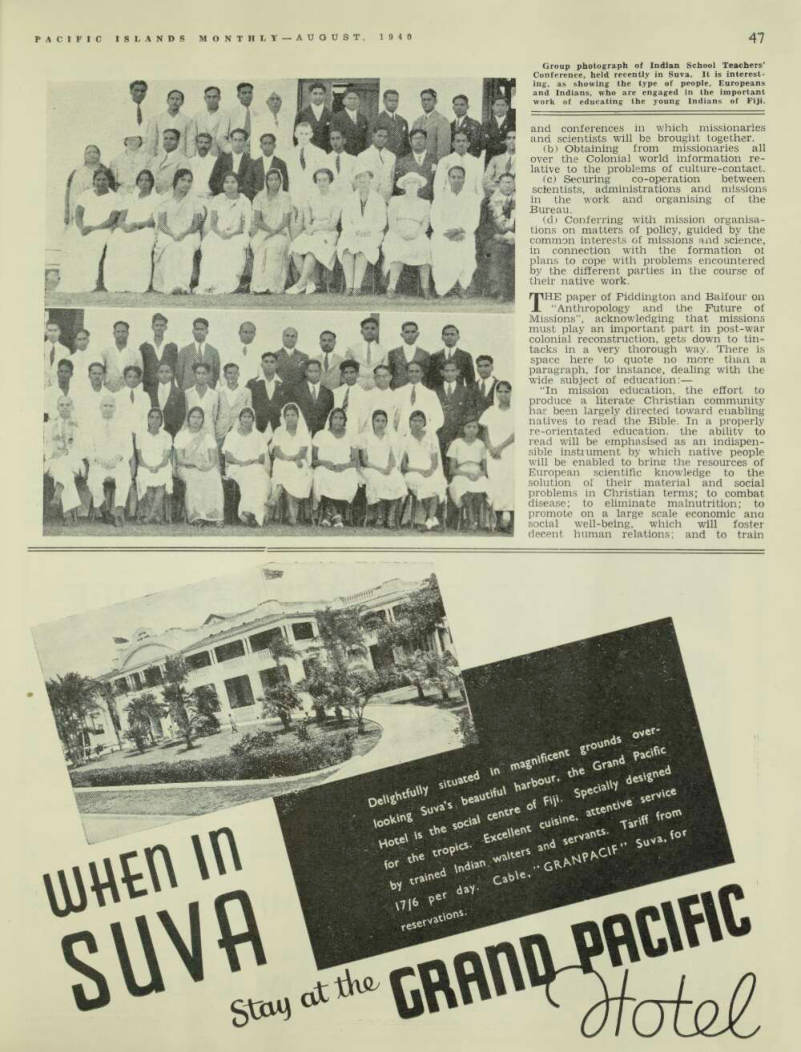
Group photograph of Indian School Teachers’
Conference, held recently in Suva. It is interest ing, as showing the type of people, Europeans and Indians, who are engaged in the important work of educating the young Indians of Fiji.
native leaders in their social responsibili ties.”
These are the immediate tasks; and education, adapted to local requirements, must be the pronerlv-used instrument, for the encompassing of these; and the mis sions will be the chief educational agencies available for use to that end.
It is indeed a heavy responsibility; and there can be no doubt that the missions will welcome all the guidance the Bureau can provide (as well as mi the. practical and financial help the various Govern ments can supply)*in their efforts to mea sure up to that responsibility, IN such an adapted system of native education, such theoretical studies as dead languages, and “history as a se quence of political and military exploits centring round bloody tyrants and dis reputable monarchs”, will find no place; but be superseded by a broad programme, on the scholastic side, of locally-applied social studies and the development of vernacular literature. The training of native leaders and teachers must be remodelled to serve a wider social pur pose than that of conducting village church “schools”.
The fullest use must be made in native education of native tradition, music, arts and crafts, native peoples being gradually and progressively drawn into the wider stream of common human progress.
Educational policy will be considered against the background of the lives which the natives will have to live as adults under modern European-contact condi tions. It will not be such as to alienate the educated few from the interests of the people as a whole. Schools and other sides of mission work will be integrative rather than disruptive in their effects in the social lives of the natives.
The bibliographical references attached to this paper are in themselves evidence
of the wide field traversed by the authors.
They include the works of such well known specialists in African native affairs as Evans-Pritchard, Thurnwald and Malinowski (anthropology); Mumford (education); Huxley biology); Lucy Mair, Cullen Young and Lord Hailey (admini
stration) ; Westermann (linguistics);
Dougall, Oldham, Edwin Smith and Pere Dubois (missions); and in the Pacific field. references include Williams (Papua); Hogbin (Solomon Islands) and Groves (Education and Culture-Contact in the Western Pacific).
The writer, from a wide background of contact with both native affairs and missions in the Pacific, would strongly recommend the various missions to link up with the Bureau, and especially to secure copies of the paper of Piddington and Balfour. Nothing of the kind has been produced in such handy form before This will involve no cost at all. How the Bureau is financed I do not know; but apparently its services are available free to those interested. Enquiries should be addressed to Dr. Ralph Piddington, Marischal College. Aberdeen, Scotland.