An Islands
pp. 36-40 · Read in the full issue
Elopement
Remarkable Story of 28-Days' Wander in Central Pacific
By “Cloghogue”
The story of this remarkable voyage was first told, in rough outline, by a contributor, in the “P.1.M.” of July, 1935, In this article are published the details of the adventure, as, told by one of the principals.
SEVERAL of us were sitting on the verandah, discussing the primal migrations of the Polynesians to the myriad islands of the wide Pacific— a discussion provoked by the contents of a recent book on that subject—and the matter of carrying provisions for the longer journeys was being argued, when we were joined by James Marsters, mate of the schooner “Tagua”.
He listened, for a while, to the vari ous theories advanced, and at last broke in, to say; “To my mind, provided coco nuts were available at that time on the scattered islands, as no doubt was the case, I can see no great difficulty in the matter of food supplies for the crews.
“I and a girl were lost on the Pacific once, for 28 days in a small boat, and coconuts were all we had with us. You must bear in mind that we hear nothing of those voyagers who disappeared at sea, only do we know of those who reached some haven. We two eventually got to land, practically none the worse for our experience.”
The following is his remarkable story, as he told it:— “ A S you know, I’m one of the Marsters family, from Palmerston Island, where, since 1862, from three women, the progeny of my grandfather, William Marsters, have peopled the hitherto uninhabited atoll.
“William Marsters was from England, and knew a lot. One of the basic rules laid down by him was that the progeny of each wife should remain a separate clan, and that cousins from the same clan should not marry. You see, his three wives were two sisters, and a cousin.
“I start my tale by telling you this, because this rule was the seed from which grew the subsequent events.
“There are three clans on the island.
One is from Sara, the sole legitimate wife; one from her sister, TePou; while the third is from their cousin, Matavei.
“I fell in love with my cousin, TePou (named after her grandmother), and we wished to marry. I was from the same grandmother, but had been adopted in infancy, according to native custom, by the Sara family. I had been a sailor on Islands schooners for several years, and did not understand the reason why we should not marry; and being at home for short periods at intervals, I was impatient of delay in setting up a home for myself.
“When the elders of the families knew our desire, they would not allow us to marry. The fact that I had been adopted and reared by the Sara Clan made no difference, they said —we were too near to each other, in blood.
“Well, we two did not concur, and made up our minds to clear off from Palmerston, at the first chance, and go to our relatives in Penrhyn Island.
Marsters’ three wives came from that island. Our idea was that, if we lay out of sight there for some time, the
objections and difficulties would blow over. Time works that way.
“In May, 1920, the Tiare Taporo’ (Bloom of the Lime Tree) called at Palmerston on her way to Penrhyn, and was to visit Suwarrow on the trip. We joined the vessel. Suwarrow, as you know! is uninhabited, and was on lease to Captain Harris, recently dead. It has a magnificent lagoon and good entrances.
It is valuable for its pearl-shell, and is well planted with coconuts. Formerly it was held by Lever’s, the soap people.
“We called at Suwarrow, and reached Penrhyn about the beginning of June.
There, we made our home with friends at Omoka settlement, on the western side of Penrhyn atoll. To our disgust, we found that our relatives in Penrhyn had the same absurd (to us) ideas about our marrying as had our people in Palmerston: they even considered us almost as brother and sister. You know the natives words for cousins and sibs are the same. had not been long in Omoka W when we became close friends with another young couple in love, named Samuela and Urau. They, also, were prevented from marrying by domestic difficulties, somewhat similar to ours.
“We discussed these matters many times; and, finally, Samuela suggested, as a solution, that the four of us—he and his girl, I and mine—should run away and make a home in Suwarrow (which I had described to him), and stay there, out of sight and mind, until the schooner next visited that island, probably a year afterwards. By that time, events might have so shaped themselves that there would be no clouds in the sky and our marriages be permitted. You know how fond these people are of grandchildren.
“Samuela knew I had been a sailor for some years, and he had an exag gerated and unlimited faith in my abili ties and experience. I may say I shared his high opinion of myself, and could not imagine the least difficulty in the matter. I believed I carried a mental map of the island-studded seas, and could steer by the stars and sun, and knew the winds and currents at the particular seasons.
"AN the very early morning—about V/ 2 a.m. —of Monday, August 9, 1920, we quietly took a boat be longing to Captain Harris. It was tied up to the wharf, inside the lagoon, at Omoka. It was 24 feet long by 7 feet 6 inches beam, open, and rigged with jib and mainsail; these, and the rudder, were in place, but no oars were aboard.
However, at the moment, we thought that deficiency of little account, as we were sailing to Suwarrow, and would not need oars.
“We got aboard, cast off, hoisted the sails and proceeded to the nearby motu of Marokai, where the leper settlement is. There we took aboard, as provisions for the voyage, about 250 coconuts. We next went on to the small islet, or motu, of Tokerau, on the side of the Sikirangi pass, through the reef. No one lived on this motu, but it had a fine well of fresh water, and such are rare on sandy atolls like Penrhyn. Here. I filled a 5gallon kerosene tin we had brought with us.
“Now, all complete, we sailed out through the Sikirangi pass on to the bosom of the great Pacific. Our adven ture was on its way.
“We had, with us, the clothing we sat in, the 250 coconuts, one 5-gallon tin of water, a sharpened hardwood stick (the “ko”) wherewith to husk the nuts, a piece of iron to break them, and a piece of pearlshell with which to scrape out the kernel, a mat whereon to sleep, and two pillows. Each girl had a few items of clothing, for changes, tied up in a small bundle.
“I had no compass, no chart, no sex tant, no watch, no knife, not even a match. Our secret start allowed us no opportunity to bring luggage. However, what I lacked in outfit, was more than offset by my supreme self-confidence and the optimism of youth. Not for a moment did I doubt my ability to make Suwarrow in a few days. The sun, moon and stars were sufficient for my guid ance, 1 1 considered.
“Yct our equipment and provisions would have been ample had we reached Suwarrow in the time I anticipated. I was sorry I had not brought a large
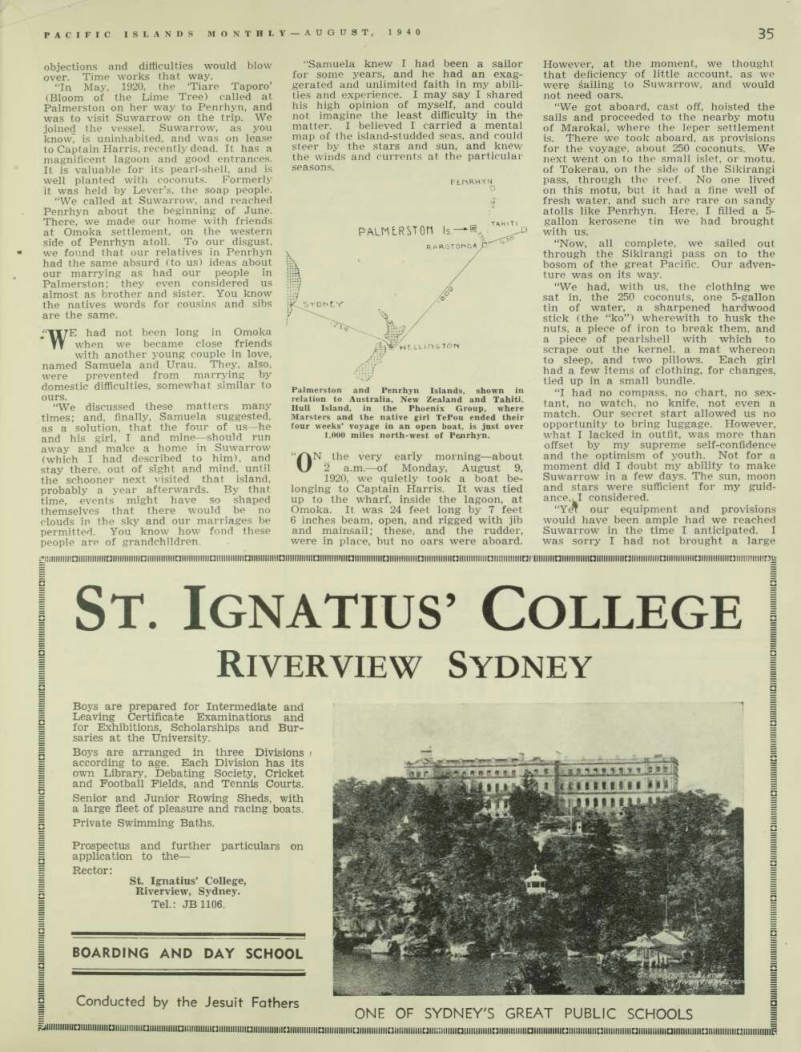
Palmerston and Penrhyn Islands, shown in relation to Australia, New Zealand and Tahiti.
Hull Island, in the Phoenix Group, where Marsters and the native girl TePou ended their four weeks’ voyage in an open boat, is just over 1,000 miles north-west of Penrhyn.
knife, but to my mind then, save for that, we were efficiently provided for. As you know, living on these islands demands a minimum of accessories. The from &Fe availalsle “From Sikirangi pass we sailed around Penrhyn, on the western side, keeping about half a mile off the outer side of the reef. I was making for Taruia Ava from which I intended to set my course.
WE had just arrived opposite that pass, when Samuela and his girl
Urau, who had been quarrelling and grumbling between themselves for some time, without a word of warning jumped overboard and swam off for the shore, about a quarter-mile distant.
T << uil r Q prised . and thus > m y girl and af ? ai< * f 2? * wo could a rdly hope to handle the heavy boat ourselves, in bad weather, and keep a ludd'on fc f pp i the f- e fell u ? on a sudden feeling of loneliness, a dread all we islanders know.
“We therefore tried to make the land.
but the wind was against us. The boat was much too heavy, and we went farther and farther seaward, as the wind was off shore. Very soon, we were too far away to think of swimming, especially as the neighbourhood of Pen rhyn swarms with sharks of the worst kind.
“Ere long, I dropped the sails and let the boat drift. Hour after hour, we sat there under a glaring sun, despondently watching Penrhyn gradually fade from sight, until at last, in the sudden dark ness of the tropical nightfall, it dis appeared.
“No succeeding day of our long voy age seemed so painfully wearisome as this, the first of our adventure. We had not reconciled ourselves to circum stances, as we did later, through the passing days; and we had a feeling of irritation at the desertion of our partners.
“We went to sleep that night in the hope that daylight would reveal Pen rhyn in sight, and that we might be able to reach it.
“The morning came. We strained our eyes, looking for clouds, birds or palm tops that might give an indication of land. Not a sign of life or land in any direction. We were alone on the deep.
WITH the idea of reaching Manihiki or Rakahanga—or, if I should miss them, getting to Pukapuka—l hoisted the sails and let the boat run before the S.E. trade wind.
“For five weary, monotonous days we chased the setting sun, but never saw a sign of life or land. Even the great sea-birds, which give notice of land— though at a great distance sometimes — seemed to have deserted us. Nothing but the empty view of interminable rollers, and a cloudless blue sky around us.
“Certain, now, that I must have over run even Pukapuka, I turned and ran back into the sun, with a fading hope of making Penrhyn again or, possibly, Flint Island, to the south, if I missed Penrhyn.
“Seven more days, even more weary, passed on this tack, with never a sight of life, bird, fish, land or ship; under a burning sun; and our water, other than that in the coconuts, close to an end. Not a drop of rain had fallen since we started.
“We had begun to be careful in using the nuts, and now limited ourselves to three nuts each per day—one in the morning, one at mid-day and one at nightfall.
“Our experience is sure testimony to the food value of the coconut, if such be needed. We lived practically on them alone, and not too many either, for 28 days, yet so far as I know we lost neither weight nor energy as a conse auence. They were, I may say, our sole food, also drink for most of the time.
Moreover, when I started work at the end of that period I needed no special feeding to enable me to hold my own with other labourers.
“With such combined food and drink in non-perishable form, the ancient Polynesian adventurers in the Pacific were well equipped for those long-dis tance voyages between islands far apart, which seem so puzzling to-day—at least, that is how I see it.
YEARLY on the morning of Sunday, JE!i August 22 (I kept a tally of the days by marks made on the boat) our first visitor made an appearance.
“My girl TePou, lying asleep in the bottom of the boat, was awakened by something rubbing against it. On sit ting up and looking over the gunwale, she saw an immense blue shark, several
feet longer than our craft, swimming alongside in close touch with our timbers against which it rubbed every now and then. She woke me and, when I had had a look, we were content to sit very quiet, I can assure you. It was possibly 30 feet in length; one of the largest I’ve ever seen, and I’ve seen plenty. It was a visitor and the first life we had come across, but it was nevertheless not welcome.
“Finally, the shark bit at the rudder several times, but fortunately did not take a fancy to shake or otherwise play with the boat, as such sometimes do, with disastrous consequences to the occupants of boats, and canoes especially. After we had lived through a nervy half-hour or so, it swam off, to our relief.
“I now made up my mind to turn north, and try to make Malden Island.
Surely I must be somewhere in its neighbourhood, I believed, for I had seen no sign of expected islands to the south.
As a fact,, I was completely lost. Vanity alone was the parent of any idea of locality I imagined I had. You will understand I did not want to encourage in my inner consciousness the disturbing idea that I was ‘all at sea’.
“I don’t know about such things; but, as some of the old people have since told me, it might be that the shark was sent to bite the rudder to show us that we should change our direction. At any rate, I thought it meant something like that, “It was mid-day on Sunday when I altered course to the north. Three days after that, a booby bird alighted on the main boom and disgorged two flying fish. This visitor, unlike the preceding one, was welcome. The fish we ate raw, a change from the taste of coconut,
which was beginning to pall. The bird I caught, and held until next morning.
But, as we had no means of making a fire to cook it, I let it go—reluctantly, I may add.
“By this time, we had got into a mood where we seldom spoke. We just lay half dozing and let time and tide do their best, or worst. We still had a measure of hope left, but it had dwindied to minuteness, and we were reconciled to whatever fate might bring us.
“Our fresh water was finished. We were reduced to a daily allowance of what was contained in our ration of three nuts, a little more than a pint, and had begun to feel the discomfort of this meagre supply in the tropic heat.
Then, for the first time since we embarked, rain came on. I was able to catch sufficient in the jibsail to fill our kerosene tin once again.
“TOREE nights later TePou woke to X. tell me there was something in the boat, making a peculiar noise. I was a little alarmed, lest it might be water leaking through an opening about the water line. It was a dark night, but, feeling about, I came on a fish (a Ra’i) which somehow had got into the boat and was jumping about.
“This was another welcome visitor.
Being of a respectable size, it made a most satisfying and tasty meal for us in the morning. I have eaten many of these fish, but I never have had one that tasted as good as that one did.
“Four more scorching days. Our water was again exhausted when we were caught in a heavy gale. Wind and rain beat us and drenched us for two days and nights, without a let-up. This was the most uncomfortable and miserable experience of our whole adventure. We
were forced to sit up, sleepless, baling and holding the boat ‘head on to the seas’. It was impossible to lie down, as the waves were breaking over us con stantly. But we were able to fill our kerosene tin with drinking water, “Several more days passed—nothing to see, nothing to do, nothing to talk about, Our tin of water was again finished, and we had but 60 coconuts left, when by the first dim light of dawn, we de scried the tops of palms above the far horizon, away up in the wind. We must have come close to the island in the dark, and had night lasted another half hour we must have passed on, unaware that we had been near land, “It was a close call; for on the course we were then running, there was no more land before the Gilberts, many hundreds of miles westward, “T T was the morning of the 23th day 1 out from Penrhyn, September 6. I turned the boat and made for the island, our hearts singing with thanks and gladness.
“When close to the island, we saw a crowd of naked men running about the beach, with nothing on save girdles of Ti leaves (Ti is one of the Dracoena.) “At an utter loss as to our locality, we imagined at first that we had run into one of the cannibal islands of the Solomons or New Hebrides, and I was just preparing to put about and make away again when we discerned a white man coming through the palms. This meant safety, so I again made for the shore.
“The white man was an American, Mr. Felhall. With his native overseer, both well armed, they put off in a boat He hailed me and asked if I spoke Eng lish. You can imagine that it was diffi
cult to tell what I was, with 28 days’ whiskers and dirt on my face, unkempt and half-dressed. I assured him I could.
“He enquired who we were, where from, how many days out, and so on. I gave him full details, but he seemed to disbelieve us, and asked if he could do anything for us. As it looked for the moment that we were unwelcome, I replied, ‘Fill us up with coconuts and we’ll go on our way.’
“At this, he asked if he might come alongside. Our boats got together and a few minutes’ conversation dispelled all suspicions. He then suggested that we go ashore and I join his working party until an opportunity came of get ting away for home. I was only too pleased to comply. I had had enough of the sea.
r[E_ island proved to be Hull Island, one of the Phoenix Group, owned by Britain, and known to the natives of the Ellice Group as Holona.
Usually, the island is uninhabited; but, fortunately for us, there was a working party of native boys there, in charge of Mr. Felhall, clearing, planting and mak ing copra for the lessee of the island, a Captain Allen.
“We found on the island, besides Mr.
Felhall and his wife, a half-caste Samoan-Chinese from Apia, named Alo bara, 26 men and four women, with a few children, from the Ellice and Toke
lau Groups.
“I remained there, working, for nine months. Then we left for Funafuti, in the Ellice group, in a boat belonging to the firm of Captain Allen. It was a craft similar to mine. There were seven
of us on the trip—Mr. and Mrs. Felhall, TePou and me, and three labour boys, as crew. We made Funafuti in five days, without trouble.
“I left my boat at Hull Island, with the intention of recovering it later.
“Always accompanied by TePou, I engaged at Funafuti as sailor on the ‘Talofa’, one of Allen’s boats, after wards transferring to the ‘Dawn’. After four months, I got back to Hull Island, to find that, in my absence, six of the Tokelau boys had annexed my boat and sailed off with it for Nukunono. After wards, I learned they arrived safely, but I never recovered the boat.
“On the ‘Dawn’, I went from Hull to Sydney Island; thence to Nukunono; thence to Pago Pago, and from there to Apia. At Apia, I joined the Union Steam Ship Co.’s steamer ‘Tofua’ and, calling at Fiji, Niue and Niuafoou (Tin can Island) we eventually got to New Zealand. From there, the ‘Marama’ brought us back to Rarotonga, where we arrived on January 12, 1922—20 months after our elopement from Palm erston.
“The girl was with me throughout.
Never were we separated for a day, throughout that 20-months’ period. But I regret to say that, after our arrival in Rarotonga, we quarrelled, and she left me and married a man named Poata, from Manihiki Island.”