Rarotonga
p. 35 · Read in the full issue
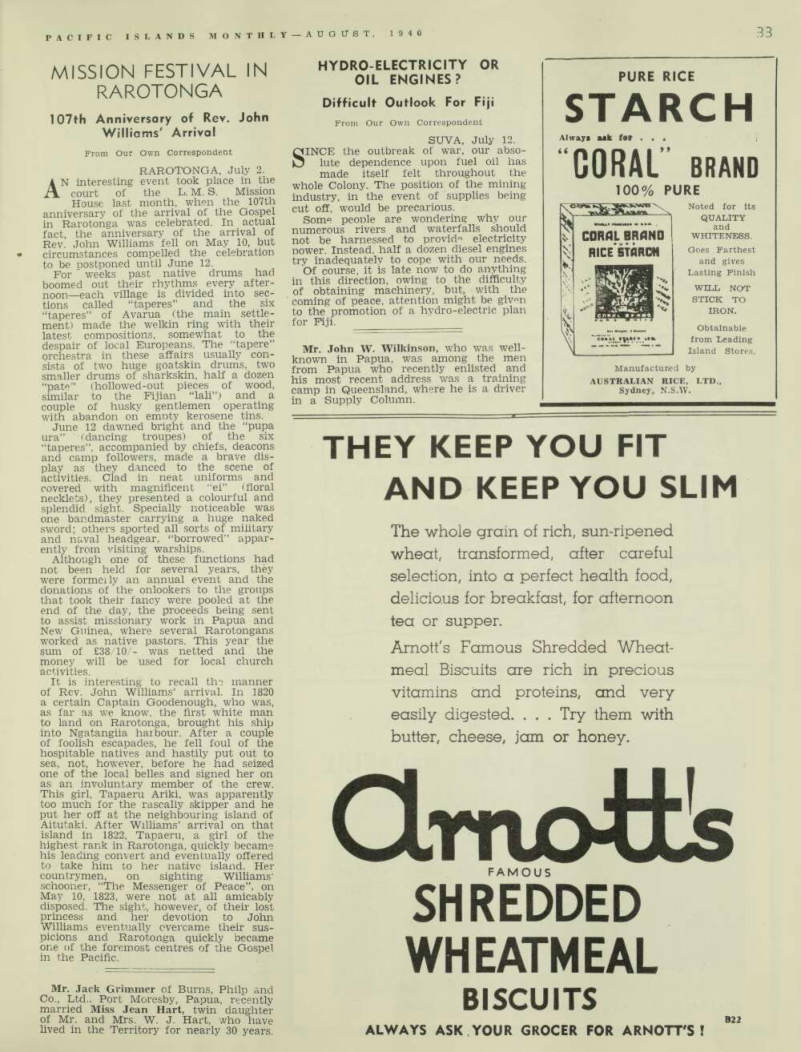
Mission Festival In
107th Anniversary of Rev. John Williams' Arrival
Prom Our Own Correspondent
Rarotonga, July 2.
AN interesting event took place in the court of the L. M. S. Mission House last month, when the 107th anniversary of the arrival of the Gospel in Rarotonga was celebrated. In actual fact, the anniversary of the arrival of Rev. John Williams fell on May 10, but circumstances compelled the celebration to be postponed until June 12.
For ' weeks past native drums had boomed out their rhythms every after noon—each village is divided into sec tions called “taperes” and the six “taperes” of Avarua (the main settle ment) made the welkin ring with their latest compositions, somewhat to the despair of local Europeans. The “tapere” orchestra in these affairs usually con sists of two huge goatskin drums, two smaller drums of sharkskin, half a dozen “pate’' (hollowed-out pieces of wood, similar to the Fijian “lali") and a couple of husky gentlemen operating with abandon on empty kerosene tins.
June 12 dawned bright and the “pupa ura” (dancing troupes) of the six “taperes”. accompanied by chiefs, deacons and camp followers, made a brave dis play as they danced to the scene of activities. Clad in neat uniforms and covered with magnificent “ei” (floral necklets), they presented a colourful and splendid sight. Specially noticeable was one bandmaster carrying a huge naked sword; others sported all sorts of military and naval headgear, “borrowed” appar ently from visiting warships.
Although one of these functions had not been held for several years, they were formerly an annual event and the donations of the onlookers to the groups that took their fancy were pooled at the end of the day, the proceeds being sent to assist missionary work in Papua and New Guinea, where several Rarotongans worked as native pastors. This year the sum of £3B/10/- was netted and the money will be used for local church activities.
It is interesting to recall the manner of Rev. John Williams’ arrival. In 1820 a certain Captain Goodenough, who was, as far as we know, the first white man to land on Rarotonga, brought his ship into Ngatangiia harbour. After a couple of foolish escapades, he fell foul of the hospitable natives and hastily put out to sea, not, however, before he had seized one of the local belles and signed her on as an involuntary member of the crew.
This girl, Tapaeru Ariki, was apparently too much for the rascally skipper and he put her off at the neighbouring island of Aitutaki. After Williams’ arrival on that island in 1822, Tapaeru, a girl of the highest rank in Rarotonga, quickly became his leading convert and eventually offered to take him to her native island. Her countrymen, on sighting Williams’ schooner, “The Messenger of Peace”, on May 10, 1823, were not at all amicably disposed. The sight, however, of their lost princess and her devotion to John Williams eventually overcame their sus picions and Rarotonga quickly became one of the foremost centres of the Gospel in the Pacific.
Mr. Jack Grimmer of Burns, Philn and Co., Ltd., Port Moresby, Papua, recently married Miss Jean Hart, twin daughter of Mr. and Mrs. W. J. Hart, who have lived in the Territory for nearly 30 years.