How Airmen Found
pp. 26-48 · Read in the full issue
Wau
Dramatic Story of Beginning of Aerial Transport in New Guinea
ON April 17, 1927, a little De Havilland aeroplane landed on a roughly cleared piece of land at Wau, New Guinea. It had just completed the first flight from Lae, some 50 miles away, on the coast, over indescribably broken, jungle-clad country. This was the fore runner of what became the greatest aerial transport service in the world.
Three men took part in that flight— the pilot, Captain E. A. Mustard, his mechanic, A. W. D. Mullins, and the guide, R. B. (“Jack”) Lewers. This service, inaugurated by Guinea Gold, N.L., shortly afterwards became Guinea Airways Ltd.
To commemorate the part he played in this epoch-making trip, a presentation
was made to Mr. Lewers in Sydney recently by the directors of Guinea Gold.
It bears the following inscription;— “Presented to Mr. R. B. Lewers by the directors of Guinea Gold (N.L.) in re cognition of his valuable services as guide on the first flight on April 18, 1927, of the Company’s aeroplane from the Coast of the Mandated Territory of New Guinea to the inland town of Wau.”
Mr. Lewers described the flight to the “P.1.M.”: — He left Sydney on the old “Montoro”, in 1926 and, with “Bill” MacGregor, proceeded to Aitape, where they re cruited 42 native labourers. Mr. Lewers then took his “boys” to Salamaua, which at that time comprised a couple of stores and Government offices, with a line of native huts running along both sides of the little sandy isthmus. A short time later he made his first trek from the coast to Edie Creek. It was only after seven days of winding up and down mountain ranges, in and around rivers and creeks, with native carriers slipping and sliding in the mud under their 50 lb. packs', that Mr.
Lewers saw Wau settlement.
Only two or three white men were there. The bulk of the mining was being done at Edie Creek, 3,000 feet higher up, and Wau was only a resting-place before the last 12 miles to Edie Creek.
Only 12 miles, but it meant a full day’s heart-breaking climb.
Finally, Mr. Lewers commenced opera tions on the goldfield, but he soon found that the greatest problem was supplies.
Not only was transport very expensive, but exasperating, for no sooner was the miner on good ground than he had to interrupt operations and make a trip down the tortuous trail to Salamaua for fresh supplies.
Cecil J. Levien was then working on a plan to transport supplies from the
coest by aeroplanes.
Some scoffed, but Levien argued that the only alternative was a road, and this might take years to build, and would almost cer tainly need con stant repair against tropical downpours and ever - shifting country. He also pointed out that dredging machin ery could be flown over the mountains
(Article Continued on Page 44.)
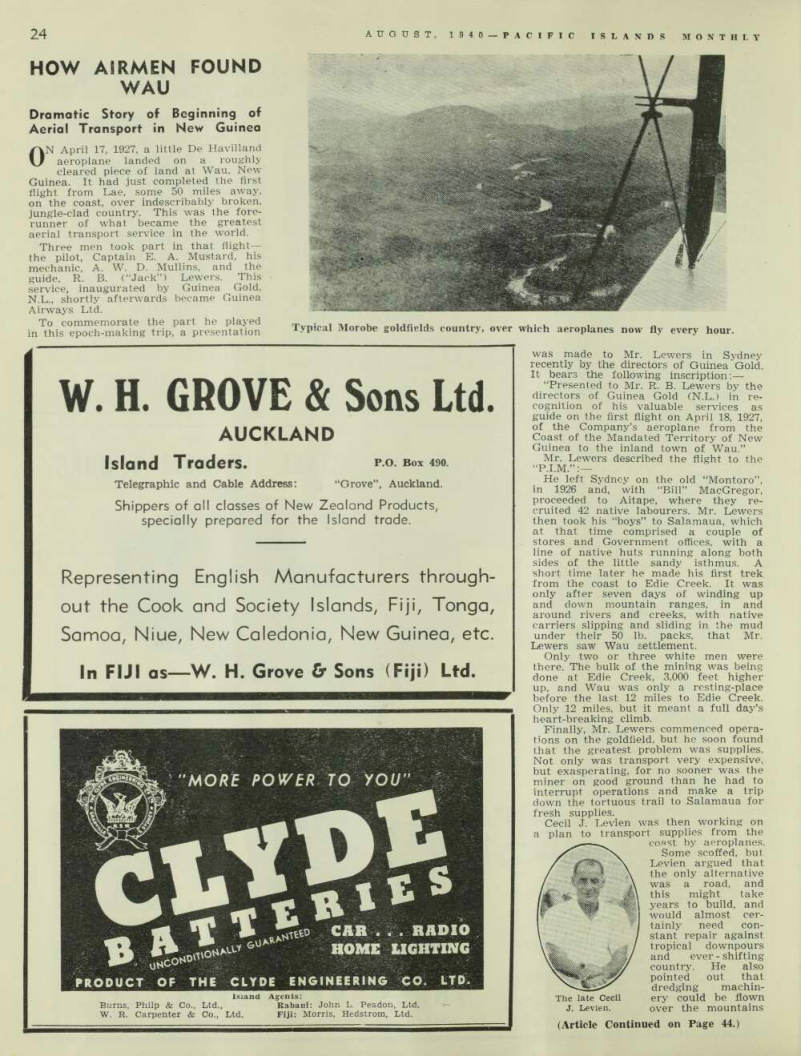
Typical Morobe goldfields country, over which aeroplanes now fly every hour
The late Cecil J. Levien.
rE following Fiji residents left Suva recently to join up for active ser vice overseas (announces the “Fiji Times’')
Commander W, Burrows (District Ad ministration); Lieutenant M. L. Bernac chi (Acting A.D.C. to the Governor); T.
Allan (Suva); W. J. Blanch (who served with the Fiji Contingent in the last war); C. A. Browne (Suva); O. M.
Browne (Suva); J. H. Broomham (Suva); H. B. Bossley (Nadi); G. A.
Crapp (Suva branch of the Bank of N.S.W.); O. L. Freeman (Rewa); E.
Frost (Suva); A. R. McGowan (“Fiji Times”); E. V. Spaeth (Taveuni); R. H.
Strachan (Suva branch of the Bank of N.S.W.); H. W. Williams (Williams & Gosling Ltd., Suva); E. B. Williams (Tailevu); M. J. White (Suva).
in sections, and could profitably work the deposits of lower value.
With his associates, Levien formed Guinea Gold N.L., and the executives of the company in Adelaide purchased a De Havilland plane and shipped it to Rabaul. There it was assembled, and, on March 31, 1927, Mustard and Mullins flew along the coast of New Britain and landed on a small clearing at Lae, some 25 miles north of Salamaua. But the greatest task had yet to be tackled— that of finding a small township in an incredible maze of mountains, gorges and jungle. Visibility was limited by rain and mist, and there were no aero dromes where a pilot could bring his machine down if anything went wrong.
The only bare places were the Kunai patches on the tops of the razorbacks.
Despite all this, and many solemn predictions of disaster, Levien and Co. went ahead with their plans.
Early in April, Mr. Lewers was at Edie Creek and, together with several other men from the goldfield, he accepted the invitation of Mr. H. S.
Holgarth, manager for Guinea Gold at Lae, to spend Easter week-end with him as his guest—this despite the fact that it would take more than a week to get to the coast!
On April 14 —Good Friday-Mustard
and Mullins, at Lae, said they were ready. Levien had prepared a small section of ground at Wau by burning off the long Kunai grass and filling in
the pot-holes. Mr. Holgarth volunteered to guide them, and that morning the three men took off. Their plan was to fly up the Markham River until they reached the Bulolo River, and then fol low it up to Wau.
The plane was away only three hours, but it was a lifetime to the anxious little party at Lae. Suddenly, the drone of an engine was heard and the De Havilland appeared out of the clouds and landed on Lae aerodrome. Crest fallen, the intrepid little party of avia tors reported that they had been unable to find their objective.
The following day the three men again set out, determined to get to Wau via the Markham and Bulolo valleys, but again they returned—unsuccessful.
Shortly after breakfast on April 17, Lewers was talking to Mustard, and Mustard suddenly said: “I say, Jack, do you think you could find Wau from the air?”
“Oh, yes, I think so,” replied Lewers.
“Not by following the Markham, but by going straight up over the mountains from Salamaua. I have travelled that track many times, and I know most of the landmarks.”
“But do you think you could find it from the air. It looks quite different from up there, you know,” said Mustard.
“Well, I will try,” said Lewers. And
Mr. C. J.
Levien’s First Camp, in the Jungle, near Wau.
so preparations were immediately made, the weather being favourable to flying.
Later in the morning, Mustard and Mullins, accompanied by Lewers, took off from Lae and made for Salamaua, across the corner created by Huon Gulf.
“Here, I picked up the trail from Salamaua to Edie Creek, which looked like a thread of cotton, from the air,” said Mr. Lewers, “and soon I saw the rest-house at the end of the first day’s march, just out of Salamaua. After several more minutes’ flight we reached the highest point in the range we had to fly over—6,2oo feet—and just then I saw the fourth day rest house. It had a galvanised iron roof and was known as House Copper.
“Then I lost the track. I knew that the mountains were very high, here, and I shouted to Mustard to take the plane higher. He could not hear me, above the roar of the engine, so I scribbled a note on a piece of paper, and passed it to him, in the front cockpit.
“We then rose up into the clouds for what seemed like an endless period and I was getting pretty worried. I was beginning to think that it looked like the end of successful flying in this part of New Guinea, when, all of a sudden, the clouds in front of us parted, and through a gap in the mist I saw the tops of some pine trees. By some instinct, I knew they were the ones next to the Bulolo River, which I had passed so many times going to and from the coast.
“When we arrived over the river, Mustard looked round and waved his arm inquiringly. His lips moved in a question ‘Up or down?’ I was doubt ful; but, again, some instinct helped me, and I waved him down.
“He turned the plane to the left and, after several minutes’ flying, during which I scanned every bit of country on either side of the river, I saw a small triangular clearing in the jungle, with a few grass huts near it. It was Wau.
“I signalled to Mustard that I could see our goal. He seemed doubtful.
Apparently, he could not see the huts, and thought the patch of clear ground was like so many others he had seen.
On my repeated assuring gestures, how ever, he brought the machine down into that deep valley between the mountains, in wide circles, looking back every now and again, still with a doubtful expres sion on his face.
“I pointed down, and then he saw the huts and the hospital, which seemed about as big as one’s fingernail.
“As we turned over the river, to land from the north, I remembered that there was a considerable amount of long grass on that end of the field. But, fortunately, the undercarriage did not catch as it swept through the grass, and we landed on the burned-grass section of the improvised aerodrome.
“There were only three white men and a crowd of natives at Wau, and these gathered excitedly around the plane to greet us. Dr. Lambert, who was known as the ‘Lik Lik Doctor’, or assistant doctor, smilingly welcomed us.
Mr. Coldham, then manager of Guinea Gold, was there, and another white man. I don’t remember Levien being there. I think he was then walking down to the coast, to find out what had happened to us. They had been expect ing the plane for some time, and had been lighting signal fires for days.
“We had lunch with Doctor Lambert, Mr. Coldham and the other man and, after an hour or two, took off for Lae again. This time, we followed the Bulolo and Watut Rivers to their junc tion with the Markham, and then flew down the Markham Valley to Lae.
“There was much jubilation in Lae, at our success, and, that night, all the white men in the township assembled to celebrate the occasion. The following were present: H. S. Holgarth (Guinea Airways manger at Lae), E. A. Mustard and A. W. D. Mullins, “Tom” Bayliss (then agent of Guinea Gold at Sala maua), A. L. Simpson (miner, from Edie Creek), E. Broughton Jensen (an engineer who was in New Guinea on behalf of Guinea Gold), P. D. McKenzie (Government doctor at Salamaua), Edgar Betts (wireless operator from Salamaua), Fred Biggs (a miner) and myself.”
Mr. Lewers discounts the belief that the flight was made on April 18—it was on April 17. During the “celebration”, all those present signed a Guinea Gold letterhead, and this was dated April 17, and is in the possession of Mr. Lewers to-day.
“Nobody thought at that time that a service had been started which, in a few years, would grow into the largest aerial transport company in the world,” concluded Mr. Lewers.
Mr. H. Hodgson, who has manager of Morris, Hedstrom’s Suva branch since 1931, has been transferred to Tavua. Mr, G. Snow, of Taveuni, will replace Mr.
Hodgson.
The Dutch East Indies came within the sterling group on July 22, and thus trade between the great Dutch colony and Australia was much simplified. This trade has grown enormously in recent years—from £4,390,327 worth of imports, from the East Indies to Australia, in 1934-5, to £7,119,785 in 1938-39. Last year, Australia imported from the East Indies petroleum spirit worth £3,608,691, and tea worth £1,564,387.
Mr. and Mrs. McPhee have left the district of Navua, Fiji, where he was manager of the Morris. Hedstrom, Ltd. branch for many years, and have now taken up residence at Levuka.