Extraordinary Results of the French Capitulation
pp. 24-25 · Read in the full issue
New Caledonia Being Run As An
Independent Country
STUDENTS of national and political economics will be interested in the history of events in the French Colony of New Caledonia, when that community found itself suddenly cut off completely from the Mother Country by the capitulation of France, in June, to the German hordes.
In ordinary circumstances, New Cale donia is administered by a Governor (ap pointed by the French Colonial Office) and officials under his command; and while the country is generally self-sup porting, its finances were controlled from Paris.
The Colony, which has a population of 27,000 Europeans and about 54,000 natives, exports nickel, chrome, deer and cattle hides and coffee. In the past, most of its exports went to France, but a large pro portion of its imports have been bought in Australia.
It is a country of considerable economic importance. It has agricultural and pastoral industries, and great wealth in minerals —especially nickel and chrome.
For that reason it has had a good deal of attention in recent years from Japanese investors and industrialists.
In June, when France capitulated to Germany, while Britain maintained her mastery over sea communications. New Caledonia found herself cut off entirely from France and thrown upon her own resources.
Details have been supplied to the “P.1.M.” by Mr. Nicolas Hagen, of Noumea, who in August made one of his periodical visits to Sydney. rpHE first effect was seen in the collapse X of the currency. Nominally, 140
francs will purchase £1 Australian and that has been the basis of trading between the two countries for a consid erable time. But in June no one wanted French francs —they could not be sold at any price—and it was no use the mer chants in New Caledonia offering to Australia their ordinary currency where with to purchase from Australia tne foodstuffs which were urgently needed.
For a while, the situation was chaotic.
Its solution was made easier by the fact that the principal banking institution in
New Caledonia, the Bank of Indo-Chine, is autonomous in New Caledonia—al though its headquarters are in Paris — and it issues a special bank note for use in New Caledonia. The situation was taken in hand by the Government of New Caledonia and the Bank of Indo-Chine, acting independently of France and other French Colonies, and an appeal for assistance was made to the Common wealth Government. As a result of this, Australia agreed to buy from New Cale donia a certain large proportion of the nickel and chrome which New Caledonia customarily exports; and, with the credits thereby established, New Cale donia was able to buy from Australia various foodstuffs needed by the com munity. In other words, a simple system of barter was established, controlled by
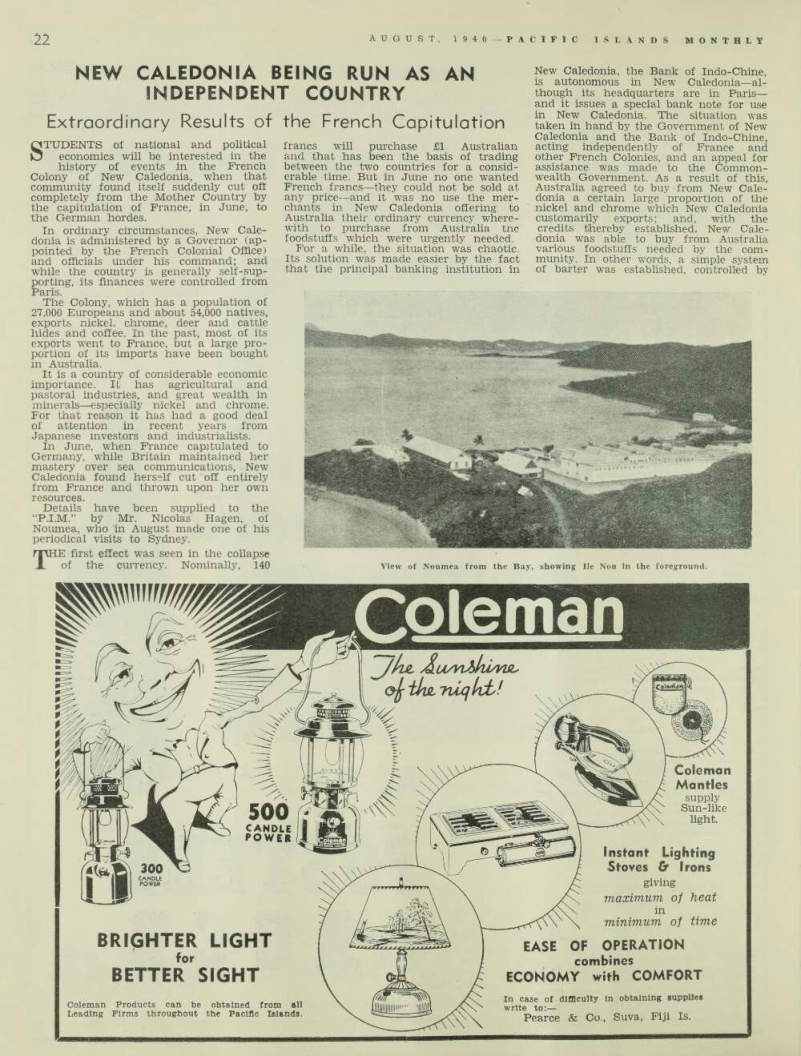
View of Noumea from the Bay, showing He Nou in the foreground.
the two Governments interested and the Bank of Indo-Chine.
So long as there is a market for New Caledonia products, this system can be carried on indefinitely, and New Cale donia can support itself. But Australia cannot buy anything like all the metal output of the Colony, and a market has also to be found for the other main New Caledonian products—namely, 80,000 deer hides a year, and a large quantity of coffee. These are eminently market able products—but their market dep°nds to a considerable degree upon sufficient shipping being available.
MEANWHILE, pending the operation oi this system of bart°ring, the Euro pean population of New Caledonia has been placed upon strict rations.
These in some directions were severe— half pound of butt°r per head per month, two boxes of matches per head per month, 3 lb. of sugar per head per month, quarter pint of oil per head per month —but, generally, there is plenty of food of the home-grown varieties, and New Caledonia has large herds of cattle and deer.
This sudden economic isolation of New Caledonia has had curious results. For instance, the various ships owned in and operated from New Caledonia have had to re-arrange their insurance. Usually their insurance was held in Prance —now it has been transferred, on what is understood to be quite satisfactory terms, to Australian insurance offices.
The Bank of Indo-Chine has had some difficult problems to handle, but it has succeeded fairly well in stabilising ex change at the former rate —namely, 140 francs to £1 Australian, It is reported in August that francs, which had been quite unsaleable in June, are now negoti able on a satisfactory basis.
Many companies, with headquarters in France, have substantial investments in New Caledonia. Their position is obscure and difficult. Obviously, if New Cale donia, by sheer force of present circum stances, comes into the British bloc of trading countries, there will be no trans fer of money from New Caledonia to Prance for the benefit of the Germans.
Therefore, any profits made by the French-owned companies in New Cale donia will have to remain in New Cale donia for the present—and, probably, per manently, for the ultimate benefit of the Colony.
There have been no indications that Great Britain or Australia have designs on New Caledonia—other than their de finite wish that New Caledonia shall not be held by any Power potentially danger ous to Australia, or to British interests.
Australian trading interests in New Caledonia already are substantial and, in the natural order of things, it would not be surprising if New Caledonia entered the British Commonwealth of Nations. That would seem to be a natural development. But Japan has displayed extraordinary sensitiveness in relation to the future of these Pacific territories; and it is just possible that Japan may regard New Caledonia as in the same category as the Dutch East Indies.
JAPAN apparently will do nothing so long as the Dutch East Indies, and New Caledonia and French Indo china remain nominally independent (although the home countries of eacn are in German occupation) and so long as the Japanese are permitted to trade freely with those territories; but, if it is proposed to transfer any of those terri tories from one country to another, there may be trouble with Japan, on the grounds that the Japanese, as a matter of definite policy, object to any alteration of the status quo in the Pacific.
However, the people of New Caledonia seem to be prepared to carry on quite
cheerfully under the present conditions, for an indefinite period. They have no reason to worry, so long as they can find a market for their principal products.