Embezzlement Case
pp. 28-31 · Read in the full issue

Sensational Judgment In Tongan
Chief Justice Outspoken Concerning Private Life of Minister
WHAT probably is one of the most scandalous “sensations” the Govern ment of Tonga ever has known oc curred in recent months, when an educated young Tongan, Uliti Balu, employed in the Tongan Treasury, was found to have embezzled £1,292 and was sentenced to ten years’ imprisonment.
The crime was bad enough, but the sensational character of the affair de veloped when the recently-appointed Chief Justice of Tonga, Judge W. H.
Stuart, held that the Minister for Fin ance and hqad of the Treasury, Mr. W. G.
Bagnall, was blameworthy to a serious degree in connection with Uliti’s miscon duct.
The Chief Justice and Mr. Bagnall are the two principal Europeans connected with the Tongan Government; and it is evident that both are men of consider able force of character. The inquiries made by the Chief Justice in the course of the hearing of the charge against Uliti led him to investigate both the offi cial conduct and the private life of the Minister, and the latter’s private rela tionship with Uliti; Mr. Bagnall appears to have resented this investigation, and to have defied the Chief Justice. Finally, on May 5, the Chief Justice read in his Court a judgment of 47 foolscap pages, wherein he not only dealt with the crime of Uliti, but reviewed the conduct of the Finance Minister, and denounced his con duct in most scathing terms.
Some indication of the character of this
judgment was given, in our June issue, when a summary was published. Since then, we have obtained a complete copy of the document. It has the following startling features; The Chief Justice suspects that about £5OO of the money stolen by Uliti has been hidden away some where.
He finds that the Finance Minister was engaged in an intrigue with a young woman, Fanny Ramsay; and Fanny Ramsay is a cousin of the wife of Uliti. He also points out that there are peculiar circumstances con nected with the removal of Fanny Ramsay’s luggage from Nukualofa, when she left the kingdom.
As is reported elsewhere, a motion based upon this judgment, and directed against Mr, Bagnall, has been presented for consideration by the Tongan Parlia ment.
From other sources, it appears that the battle between the Chief Justice and the Finance Minister has extended right through Government circles in Tonga, and probably will be settled finally by the High Commissioner for the Western Pacific.
The judgment of the Chief Justice is far too long for reproduction here; but the following extracts show the nature of it, and the manner in which the Chief Justice dealt with the conduct of Mr.
Bagnall.
Minister’S “Privilege”
UNDER the circumstances the Court was entitled to expect and did ex pect full and eager assistance from the Head of the Department. This ex pectation was entirely negatived. The Treasurer, called by the Court to answer obvious questions (some it is true, after the statement made by Inspector Toga, necessarily of a personal character) throughout displayed an attitude most unlike that of a reasonable man. At an early stage in his evidence, he attempted to avail himself of every privilege that by any stretch of the imagination could be dragged in to prevent proper information being at the disposal of the Court . . .
“One serious problem arises for con sideration, so serious that this judgment of the Court will be sent to the Queen of Tonga for consideration. That problem is to what extent the ends of justice can be defeated by deliberate sheltering be hind privilege from questions which to the ordinary mind and to the mind of the Court can militate in no way against the ‘public interests’. It is clear that to avail oneself of privilege without just or reasonable cause would constitute an abuse of privilege amounting to gross misconduct on the part of the official concerned . . .
Minister’S Private Life
TITHE Court finds as facts: — A 1. That the Treasurer (married and aged 58) had as mistress in 1938 and part of 1939 a woman who was a cousin of accused’s wife and who lived in the house of accused’s father-in-law. The woman, Fanny Ramsay, is aged 24, accord ing to the Police. 2. That the Treasurer used the accused (Uliti) as a go-between or pander. 3. That the accused took full advan tage of this. The Court finds as a proba bility that silver was exported from this country by accused with or without con federates.
“The Court comes to the conclusions that:— 1. Such relationship of the Treasurer and his subordinate is one that should not be tolerated in any country or ser vice whatsoever. 2. That to use a subordinate as a go between is inconsistant with discharging the duties of the Head of a Department. 3. That whatever the Treasurer knew about the accused, the accused knew too much about the Treasurer to be in any imminent danger of discovery from that source. 4. The subordinate clearly had the whip-hand in the office. 5. The crime in this case should never have been investigated by one who was under so heavy a personal obligation to the accused. 6. That some money had gone out of the country. 7. That there is no information as to how; though Fanny Ramsay’s luggage is
by no means clear of suspicion, the Court is informed by the Police that enquiries through the Police at Fiji have been un productive. 8. On the evidence the Court cannot disassociate the Treasurer from the prob
able method in which silver was removed from the Treasury. . . .
Tongas Privy Councillor
THE Court is aware aliunde, from the fact that the Chief Justice is also a Privy Councillor of Tonga and a member of Cabinet, that in recent years there has been no Auditor-General in Tonga and for that matter only a Chief Justice who owed his nomination to a Privy Council on which the Treasurer at the time was the only European.
“The Treasurer appears to have reigned supreme in more Departments of the State than his own, with regrettable results.
The Treasurer obviously resented through out this trial that a Chief Justice could or dared ask him questions.
“Up to a few months ago the Auditor
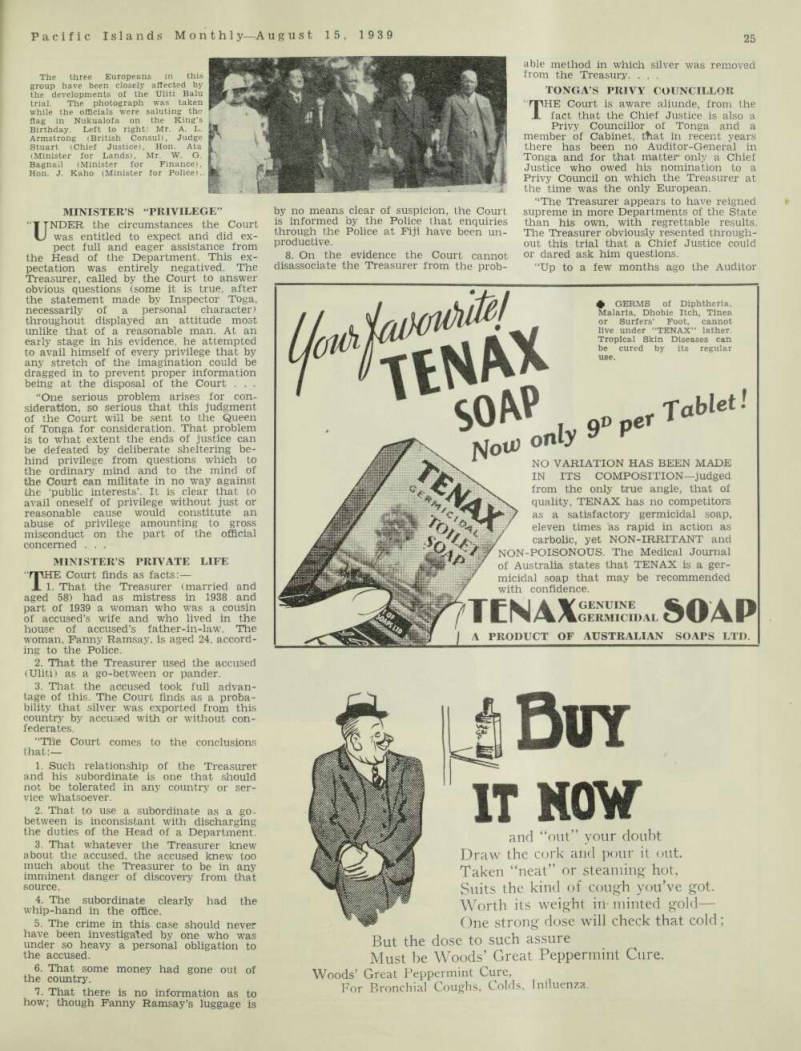
The three Europeans in this group have been closely affected by the developments of the Uliti Balu trial. The photograph was taken while the officials were saluting the flag in Nukualofa on the King’s Birthday. Left to right: Mr. A. L.
Armstrong (British Consul), Judge Stuart (Chief Justice). Hon. Ata (Minister for Lands), Mr. W. G.
Bagnail (Minister for Finance), Hon. J. Kaho (Minister for Police).
was a Treasury subordinate. What would have happened to him if he had dared to query the Treasurer’s methods? With out doubt he would have felt the Trea surer’s displeasure. This relation between Finance and Audit is most undesirable “The last question put by the Court re quires an answer. Ts the whole sum of £1,292/18/- Tonga’s loss?’ Approximately £5O may be recovered from the accused.
But there is no reason why the remainder of the money should not be recovered from the Treasurer. He is ‘pecuniarily’ liable . .
Scathing Conclusion
ADDRESSING the prisoner, the Chief Justice said: — “The Court has found that the Trea surer knew you were a suspicious char acter, and yet made you more than a friend.
“The Court finds as a fact that the Treasurer’s incompetence and his failure to enforce the regulations and provide the most modest of checks made the way easy for you.
“The Court must add its deep regrets that a young Tongan of brilliant parts should have sunk so low. The function of Europeans in Tonga, protected as they are by the Treaty with Great Britain, should be to help all concerned by pre cept and example. The Treasurer has set an example of personal immorality that while it differs in incidence from your weakness of peculation and drunkenness, is in no ways less offensive to God and man.
“It is abominable that such an example should have been set you, and I trust that this is a precedent of misbehaviour both by Departmental Head and by sub ordinate that will not be followed”