Japan’S Contact With Hawaii
pp. 16-18 · Read in the full issue
How U.S.A. Intelligence Service Watches Activities of Japanese Tankers
By John Williams
Honolulu, July 15.
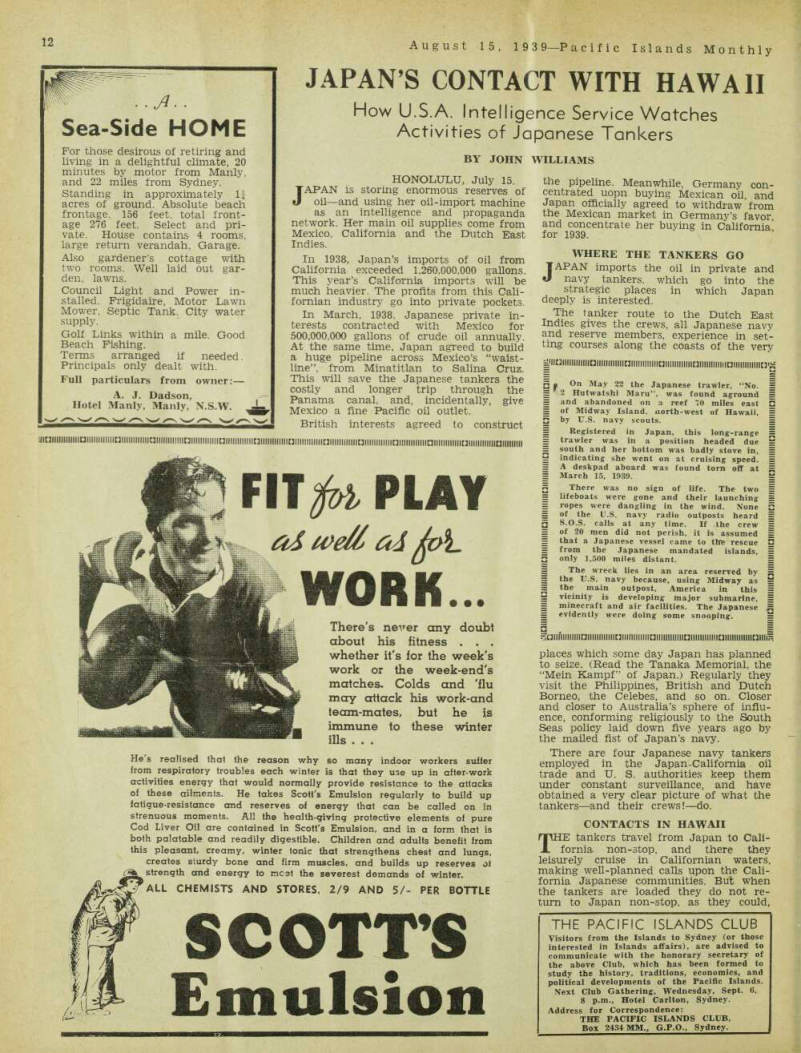
JAPAN is storing enormous reserves of oil—and using her oil-import machine as an intelligence and propaganda network. Her main oil supplies come from Mexico, California and the Dutch East Indies.
In 1938, Japan’s imports of oil from California exceeded 1,260,000,000 gallons.
This year’s California imports will be much heavier. The profits from this Cali fornian industry go into private pockets.
In March, 1938. Japanese private in terests contracted with Mexico for 500,000,000 gallons of crude oil annually.
At the same time, Japan agreed to build a huge pipeline across Mexico’s “waist line”, from Minatitlan to Salina Cruz.
This will save the Japanese tankers the costly and longer trip through the Panama canal, and, incidentally, give Mexico a fine Pacific oil outlet.
British interests agreed to construct
the pipeline. Meanwhile, Germany con centrated uopn buying Mexican oil, and Japan officially agreed to withdraw from the Mexican market in Germany’s favor, and concentrate her buying in California for 1939.
Where The Tankers Go
JAPAN imports the oil in private and navy tankers, which go into the strategic places in which Japan deeply is interested.
The tanker route to the Dutch East Indies gives the crews, all Japanese navy and reserve members, experience in set ting courses along the coasts of the very
places which some day Japan has planned to seize. (Read the Tanaka Memorial, the “Mein Kampf’’ of Japan.) Regularly they visit the Philippines, British and Dutch Borneo, the Celebes, and so on. Closer and closer to Australia’s sphere of influ ence, conforming religiously to the South Seas policy laid down five years ago by the mailed fist of Japan’s navy.
There are four Japanese navy tankers employed in the Japan-Califomia oil trade and U. S. authorities keep them under constant surveillance, and have obtained a very clear picture of what the tankers —and their crews! —do.
Contacts In Hawaii
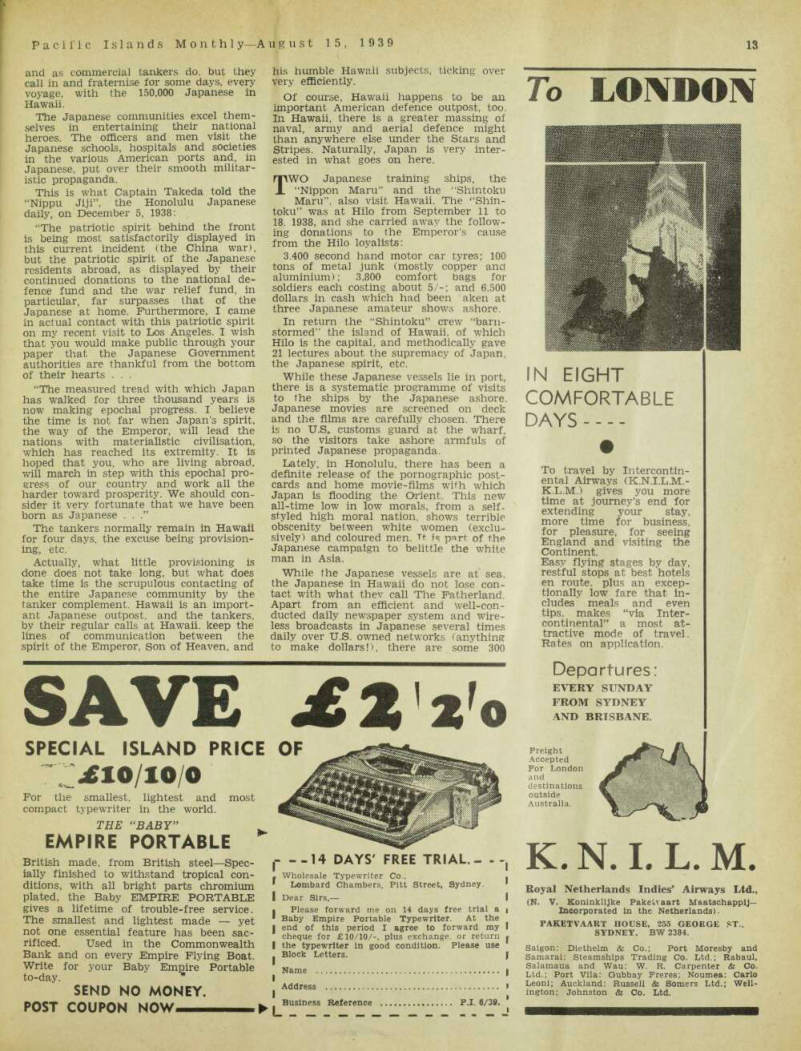
THE tankers travel from Japan to Cali fornia non-stop, and there they leisurely cruise in Californian waters, making well-planned calls upon the Cali fornia Japanese communities. But when the tankers are loaded they do not re turn to Japan non-stop, as they could,
and as commercial tankers do. but they call in and fraternise for some days, every voyage, with the 150,000 Japanese in Hawaii.
The Japanese communities excel them selves in entertaining their national heroes. The officers and men visit the Japanese schools, hospitals and societies in the various American ports and, in Japanese, put over their smooth militar istic propaganda.
This is what Captain Takeda told the “Nippu Jiji”, the Honolulu Japanese daily, on December 5, 1938: “The patriotic spirit behind the front is being most satisfactorily displayed in this current incident (the China war), but the patriotic spirit of the Japanese residents abroad, as displayed by their continued donations to the national de fence fund and the war relief fund, in particular, far surpasses that of the Japanese at home. Furthermore, I came in actual contact with this patriotic spirit on my recent visit to Los Angeles. I wish that you would make public through your paper that the Japanese Government authorities are thankful from the bottom of their hearts . . .
“The measured tread with which Japan has walked for three thousand years is now making epochal progress. I believe the time is not far when Japan’s spirit, the way of the Emperor, will lead the nations with materialistic civilisation, which has reached its extremity. It is hoped that you, who are living abroad, will march in step with this epochal pro gress of our country and work all the harder toward prosperity. We should con sider it very fortunate that we have been bom as Japanese . . .”
The tankers normally remain in Hawaii for four days, the excuse being provision ing, etc.
Actually, what little provisioning is done does not take long, but what does take time is the scrupulous contacting of the entire Japanese community by the tanker complement. Hawaii is an import ant Japanese outpost, and the tankers, by their regular calls at Hawaii, keep the lines of communication between the spirit of the Emperor, son of Heaven, and
his humble Hawaii subjects, ticking over very efficiently.
Of course, Hawaii happens to be an important American defence outpost, too.
In Hawaii, there is a greater massing of naval, army and aerial defence might than anywhere else under the Stars and Stripes. Naturally, Japan is very inter ested in what goes on here, TWO Japanese training ships, the “Nippon Maru” and the “Shintoku Maru”, also visit Hawaii. The “Shin toku’’ was at Hilo from September 11 to 18. 1938, and she carried away the follow ing donations to the Emperor’s cause from the Hilo loyalists; 3.400 second hand motor car tyres; 100 tons of metal junk (mostly copper ana aluminium); 3,800 comfort bags for soldiers each costing about 5/-; and 6.500 dollars in cash which had been aken at three Japanese amateur shows ashore.
In return the “Shintoku” crew “barn stormed” the island of Hawaii, of which Hilo is the capital, and methodically gave 21 lectures about the supremacy of Japan, the Japanese spirit, etc.
While these Japanese vessels lie in port, there is a systematic programme of visits to the ships by the Japanese ashore.
Japanese movies are screened on deck and the films are carefully chosen. There is no U.S, customs guard at the wharf, so the visitors take ashore armfuls of printed Japanese propaganda.
Lately, in Honolulu, there has been a definite release of the pornographic post cards and home movie-films with which Japan is flooding the Orient. This new all-time low in low morals, from a self styled high moral nation, shows terrible obscenity between white women (exclu sively) and coloured men. Tt is part of the Japanese campaign to belittle the white man in Asia.
While the Japanese vessels are at sea. the Japanese in Hawaii do not lose con tact with what thev call The Fatherland.
Apart from an efficient and well-con ducted daily newspaper system and wire less broadcasts in Japanese several times daily over U.S. owned networks (anything to make dollars!), there are some 300
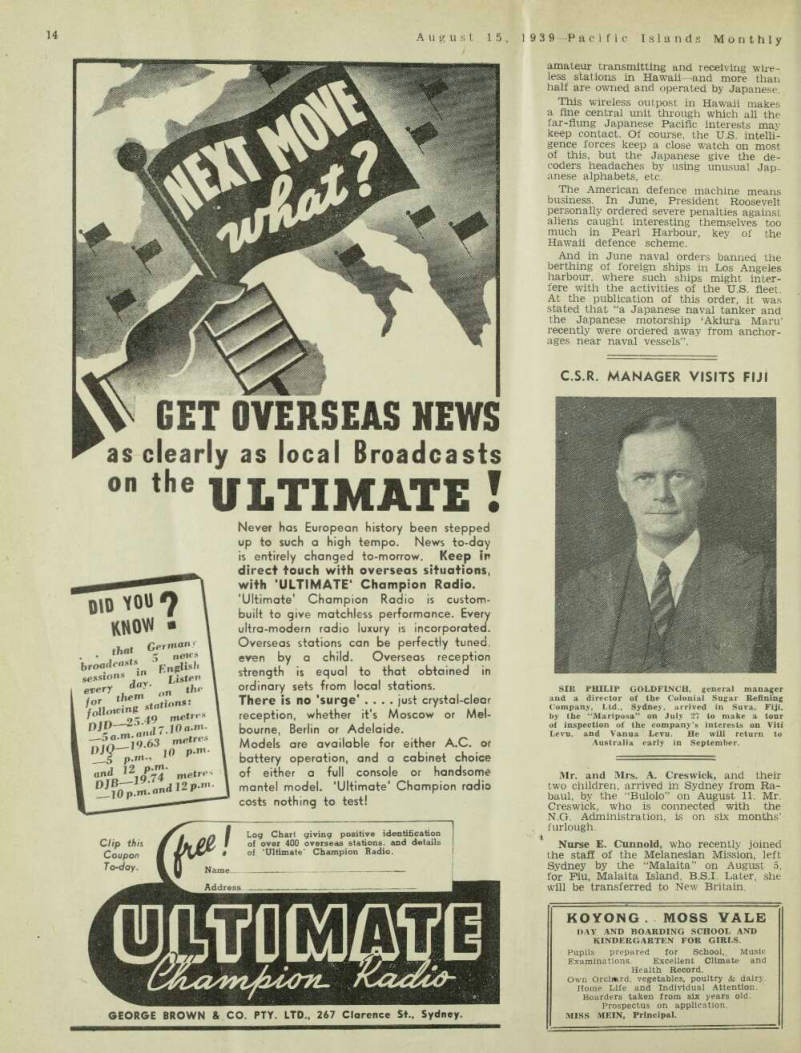
amateur transmitting and receiving wire less stations in Hawaii—and more than half are owned and operated by Japanese.
This wireless outpost in Hawaii makes a fine central unit through which all the far-flung Japanese Pacific interests may keep contact. Of course, the U.S. intelli gence forces keep a close watch on most of this, but the Japanese give the de coders headaches by using unusual Jap anese alphabets, etc.
The American defence machine means business. In June, President Roosevelt personally ordered severe penalties against aliens caught interesting themselves too much in Pearl Harbour, key of the Hawaii defence scheme.
And in June naval orders banned the berthing of foreign ships in Los Angeles harbour, where such ships might inter fere with the activities of the U.S. fleet.
At the publication of this order, it was stated that “a Japanese naval tanker and the Japanese motorship ‘Akiura Maru’ recently were ordered away from anchor ages near naval vessels”.