Samarai
pp. 44-47 · Read in the full issue
Memories Of Old
By “Wakilobo Of Vilirupu”
NO. 2.
Papuan Pioneers
THE Whitten brothers take their place as real pioneers, and few if any of the miners were not grub-staked by them. Their help to the men on the Yodda, later the Lakekamu, must al ways be remembered by all mining men.
Their grub-staking was done consistently.
I am certain they had little fear that the money would not be repaid. Their boats helped the miners, especially the “Kaiora”, the “Bulldog”.
I wonder if Charlie Whitehead and Gunderson are still alive. Their stories of the gold rushes would be worth tell ing. One of the episodes of Charlie’s life may be given here.
In between times he had a schooner, which carried about 20 tons, and some times he would lift that weight of kumara from the N.E. coast for Port Moresby, selling them at from £4 to £6 per ton.
After the sale, there would be the usual binge in Tom McCrann’s, but Charlie al ways managed to hold on to the major portion of the proceeds. One trip, how ever, there were more “free” drinkers than usual, and Charlie counted up his cash with a few misgivings—although, deep down, he did not really mind the loss of a few pounds, so long as those who drank his health could carry their liquor. Dur ing his soliloquy he heard rasping throat noises, as though someone was trying to be very sick and on looking up, saw Hughie Jones, the hunchback, vomiting violently over the rail. This so incensed Charlie that he rose up like thunder and yelled at the top of his voice, “You so and-so little runt, there goes four tons of the finest sweet potatoes ever grown in New Guinea.”
The two Auerbach lads, Teddy and George, were good side wingers, and their presence in Samarai was always the signal for a few real hectic days—and nights, too, sometimes. Teddy would get one over the seven and paint the settle ment red, but George always appeared to be able to carry his liquor. Another Trobriands visitor was Jimmy Delaney, and he took life very seriously, too. His end was disastrous—that is, if what I heard was true. His launch caught fire, and he and someone else on board were burned to death.
Nick The Greek
THERE was also Nick the Greek, whose daughter, Marion, was mandated to the Ramsays; and a tough guy he was. Poker was his pet hobby, and many a game have I had with him, and others, at “Billy the Cook’s” place. I learned a lot of good points from him. One night we were playing, and the party com prised old Mr. Cox, the gentleman with a Solomon beard, a Customs official called Day. a man from Giligili, whose name I forget (but who died several years ago), Nick the Greek, and myself. Nick did not have a single hand of any use. But he just sat tight, and played right through until 2 a.m„ and was just as even-tem pered as though he had won a packet.
Another individual who used to have Samarai by the ears was called Mouldy Mike. He was the most “ornery son of a gun” ever filled a Government job, and
he certainly was able to keep everyone on the island in a state of expectancy. He had a rough time at Mrs. Wisdell’s. and we did almost everything t 9 induce him to leave. We put birdlime into his warm shaving water, put same onto his chair, tried to scare him in various ways-but to no avail. He hung on, and was always on the, look out for someone to hand a 5,1 When" 5 Mrs, Wisdell married Rupert Nugent Leslie, she omitted to change her name as licensee over the doorway of the hotel. Old Mouldy was nosing around, and decided to issue a summons. He oke e what OU Ws fntentlons Anyway". piece of paper printed by hand, so that taken back, when he was ready to hand over the summons, and I am certain he got hauled over the coals by both Higginson
and Mair McAlpine, the R.M. and A.R.M.
respectively.
After that episode it was decided to sen d Mouldy to Kulamadau, and he accordingly joined the “Morinda”. To the sur p ris e of everyone, he was still on board th / boat on her return to Samarai. No one on the island would give him shelter, so he was for ced to return to Samarai. n e 'nfviston * f afas reco iiect he was located at Mosquito Is- , nd T think Laurence Henderson was
£ £ day™ I am 1
Anywayj Mouldy had quite a district to afvSon^was 6 the MombSl® Plantetton, jovial man> ’ w h ose hospitality was famous MouMy in me course of hls Patrol, had to stop off at Nicholls place, and, of course, as Nicholls had not heard of Mouldy’s adventures in Samarai.
he gave the man welcome, and did his best in the food J ll 6 -
6 prepared 7 for^him J asd
what had SuCh’won de“ul nf c] Jit was a’ Iteelnana ™*n t^ k s^ ld f lt * replied he jjjjy h ?S a RLradise Wrd could tastl thmk a Paradlse mrd could ta,ste Next day, when Mouldy was leaving, he handed Nicholls a note, that he would be charged with having prohibited birds, ro wit. a Paradise bird, in his possession!
Along The Coast
U ®T nor . th of the . Momblrl estate, is f he Woma”Th S e P S aw” The Chignell reproduced me p lctU re m his book. “An Outpost in Papua”. It shows a large hefty native, dressed in the native fashion, with a 7
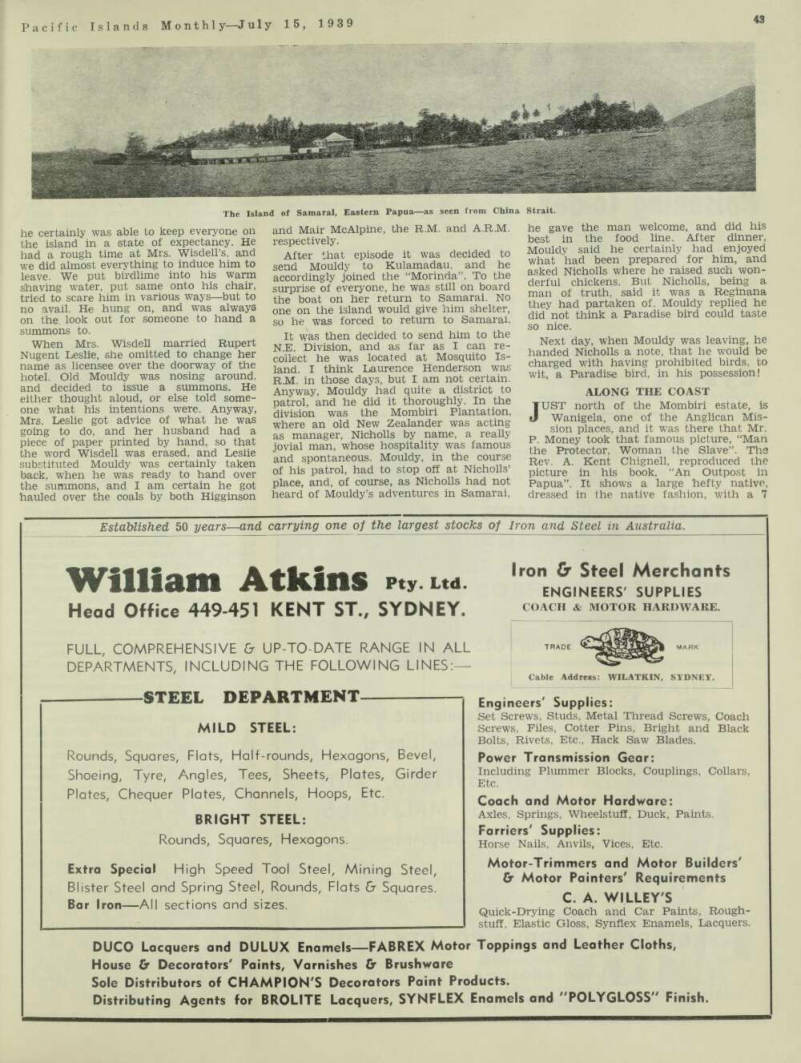
The Island of Samara!, Eastern Papua—as seen from China Strait.
ft. spear, strutting along the beach, fol lowed by his spouse, with a 100 lb. bag of garden produce in her net bag, and the latest of their offsprings, another 30 lb. weight, perched on the top of the bag.
She is bent almost double, whilst His Nibs carries only the spear.
Tufi (Cape Nelson) was a great spot, and some of the best B.N.G. Magistrates graduated there. Monckton, Griffin, Man ning, McDonald, Charles Theodore Wurth and a very huge man with a Ger man name were also located there. The latter was so fat that he could only walk with difficulty, and once, when the resi dence was struck by lightning, and set on fire,, he had to roll himself off his lounge chair, and off the verandah, to escape being burned alive. He was suffering from acute rheumatism at the time, so the pain, added to his bulk, made life any thing but pleasant. After his retirement, he was brought back to take part in a case against Joubert for alleged illegal recruiting.
It was also at Cape Nelson that one, Ryan, tried to hogtie Captain Griffin, for having some plumes in his possession; but Griffin used the overland route bo report himself, and the report which Ryan had made, did not reach Moresby until three or four weeks after Griffin’s state ment.
Ryan was a brave and fearless man, but he seemed to think that his job was that of a village cop—a case a day, no matter how he got it. For a time, he had a pretty bad run in the Territory. I be lieve he was killed in the War, but the
last I saw of him, was when with Sidney Burrows, he was sent up the Fly to try and trap the Pryke brothers on that Sir Rupert Clarke expedition. What a fiasco that trip was—l mean, the Government side.
Samarai, being at the centre of the S.E., NF. and Eastern Division of the Terri tory, had more to keep it on the front pages than the capital. Here the N.D.L. boats called regularly, and the old S.S.
“John Williams” came for her regular trade trips. Mrs. Mahoney, the “Queen of Sudest” paid regular visits, also the Os borne brothers from Rossel Island, where the natives are small, and are the most cruel of all New Guineaites. Their methods of killing are gruesome in the extreme.
I wonder whether Bill Doig is still alive, and if he remembers the occasion we went up in behind Buna Bay to lift a Cornish
boiler. We had an auxiliary scow called the “Kaiora”, and had to carry the boiler and other equipment to the anchorage for loading onto the S.S.
“Moresby”. It rained the whole time, and the difficulties we were beset with were too many to mention. In addition the weather got under Bill’s skin, and he practically emptied a demijohn of Scotch before we started. The boiler lay at the top of the hill and our gear was only fit for handling cases. After hours of straining, we managed to get it to the water’s edge, only to discover there were no covers for the fire-box or man-hole, and Bill had to improvise stops for them.
Finally, we had it afloat, and then the long tow to the open sea started. The trip ended successfully, and I saw the same boiler set at Manu Manu sawmills, at the mouth of Galley Reach.
Famous Prospectors
ANOTHER great favorite of the early days was Fred Kruger. He did a bit of everything, especially mining, and I seem to remember he was usually lucky and was always ready to help a lame dog. His feeling for those whose luck was “agin” them was equalled only by those of the finest of the old school — Matt Crowe, and the Pryke brothers in cluded. What a fine gang Samarai sup ported—Matt Crowe, Frank and Jim Pryke, Les. Joubert, Joe Sloane, Peter Burke, Jimmy Wallace, etc. —and what adventures they had in their early days!
It was Matt who told me of the mistake old Armit made, when he attacked a group of natives in the N.D. The whole thing was a mistake from the start. But red lavas lavas are red lavas lavas, and Armit could not know that the boys he attacked had been given their cloth as a reward for work, whilst some other mining crowd had been attacked and the attackers got away with a number of bolts of lava lava cloth of turkey red.
Matt also liked to talk of his days on
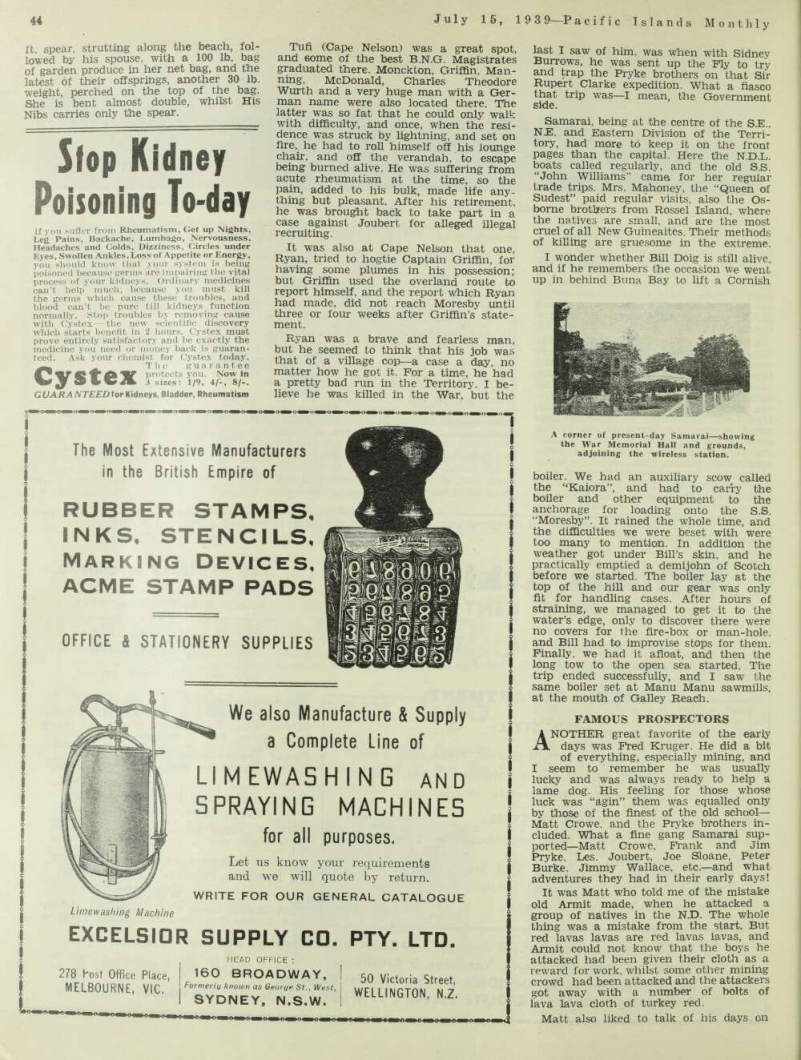
A corner of present-day Samarai—showing the War Memorial Hall and grounds, adjoining the wireless station.
trek, and his gentle manner, even when annoyed, made him one of the nicest men who ever “padded the hoof” for the elusive pennyweight. For his memory, as well as that of the Pryke brothers, I shall always have a very warm spot.