Ways Of Catching
pp. 40-41 · Read in the full issue
Flying Fish
By H. C. R.
THE method recorded in the of July, 1935, of the native method of catching flying fish on the N.E. coast of Papua, was interesting. Herewith is an account of the method I saw used in the Northern Gilbert Islands, where flying fish are caught on lines of human hair.
The natives fish in canoes, in pairs, working skilfully together. On arrival at the fishing grounds, about a mile and a half from shore, the canoes keep a dis tance of about twenty paces apart. Tney then keep a sharp look-out for sea birds —for the birds usually follow the schools of flying fish, preying on them, as the fish rise from the water, pursued beneath by one or other of the deep-sea big game fish.
The flying fish has many enemies. Near the coasts are the bonito; in the open sea the dolphin—one of the fastest fish in the sea, and, in its dying radiance of rainbow colours, one of the most beauti ful. Not alone these, but the marlins, the giant swordfish, the barracoota, leaping tuna and others of the surface feeders of the ocean. Such fish the native prefers to leave alone; for, apart from the dan ger they have no suitable tackle with which to handle these monsters.
The shark is caught in great numbers by these Islanders, but is much easier to deal with, and specially constructed canoes are used in its capture, as well as shark tackle made from strongly hand woven sennit (coir) lines. To noose a shark, is child’s play to a Gilbert Islander.
The sharks are cut up and dried and a considerable export is made to nearby Is lands.
Flying fish are caught in great numbers by day fishing and by torchlight fishing, at night. In torchlight fishing, two occu pants man the canoe, a navigator, and the fisherman, who stands in the bow, armed with a flaming torch of coconut leaves and his net. Two canoes fish to gether, and. as the fish rise, they are caught up in the net. Anything from one to a dozen hauls may be made.
To join in a torchlight fishing excur sion in the Gilbert Islands is a really thrilling affair. One needs to be able to swim, too, for the canoes frequently turn over without much warning. The natives just laugh, right the canoe by a clever manoeuvre of jerking out the water and climb in again. Only rarely do they lose a limb, in these manoeuvres.
The daylight method of catching flying fish is interesting. The canoes paddle out to the fishing grounds in the open sea, and watch for the birds. When following a school of fish, the birds scream excitedly, and at the same time indicate the dir ection in which the fish are travelling.
The canoes now steer to meet them, and proceed to lay out their lines. Coconut floats are used. The lot-eye is pierced, and a peg of hard-wood inserted. To this is attached a line of woven sennit, about six feet in length, and terminating in a length of finely-braided human hair.
To the hair is attached a curious hook (sometimes two hooks are used) but not quite the orthodox-fashioned hook as used by Walton or Zane Grey. The hook may be mother of pearl, or simply of wire, bent to an angle of twenty-five deg. —the wire being II inches in length. The hook is secured at its centre to the braided hair, and is baited with either a
small hermit crab, a piece of baby squid, or raw fish.
It sometimes happens that a dolphin makes short work of the captive flying fish, struggling with the coconut floats.
Then Oro-Tika, the god of fish, is ex horted to intercede, and the natives patiently await the coming of another school of flying fish.
The flying fish, when cured, equals the British herring. Flying fish, an inch in length, rise from the sea and fly some dis tance. In the Gilberts, I have weighed large specimens, at two pounds, and mea suring 18 inches in length. These fish cover a distance of about two hundred yards in the air according to wind, but they usually drop back as soon as their fins become dry. Flying fish keep to the open ocean and do not enter harbours.
Mr. and Mrs. Keith Burton, of Misi ma Island, Papua, received many con gratulations early in June, on the birth of a daughter. The child is the first white baby born on Misima Island.
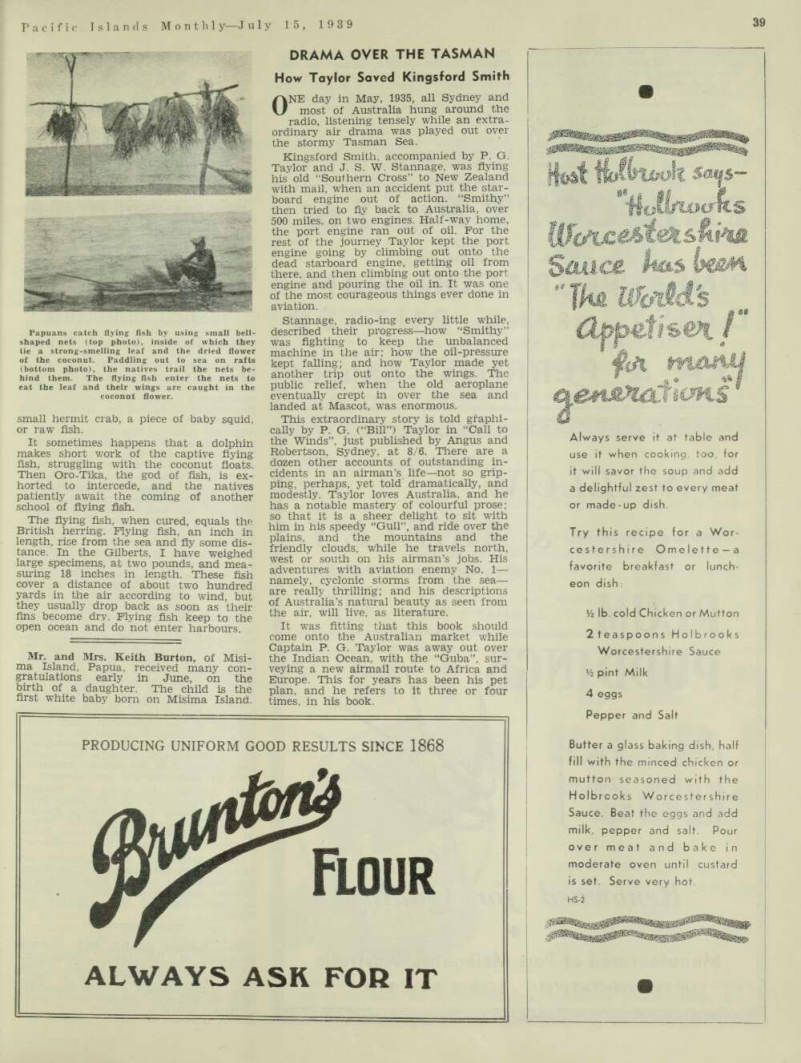
Papuans catch flying fish by using small bell shaped nets (top photo), inside of which they tie a strong-smelling leaf and the dried flower of the coconut. Paddling out to sea on rafts (bottom photo), the natives trail the nets be hind them. The flying fish enter the nets to eat the leaf and their wings are caught in the coconut flower.