Earthquake
pp. 30-32 · Read in the full issue
Disastrous B.S.I.
Loss of Life and Heavy Damage on Guadalcanal
FURTHER reports from the Solomon Islands indicate that the earth quake and subsequent tidal waves experienced on April 30 were probably the most severe the Protectorate l as felt.
At least 10 lives were lost on the Guad alcanal coast, mostly women and child ren. Many villages were completely de stroyed and food gardens on the coastal areas were demolished. Although the centre of the disturbance was in the Russell Group (Cape Marsh) and the ad jacent Guadalcanal coast, other parts of the Group were affected.
Lavoro Estate on Guadalcanal was the greatest sufferer, being practically wiped out. All the buildings have gone; the launch was carried 200 yards into the bush; and the motor truck twisted round a tree. Mr. L. G. Hanscombe, the manager, succeeded in reaching the safety of high land with his child, while his wife, as sisted by Mr. Jack Svensen followed. The latter were overtaken by tidal waves, the water passing over their heads several times as they clung to coconut trees. The water reached a height of 20 ft. up the hill at the back of the plantation.
Maravovo and Visale also suffered severely. At the Roman Catholic Mission at Visale the damage to buildings was extensive. The Bishop’s launch was hurled, from the slip.
At Lingatu (Cape Marsh), the bay emptied itself several times. In this area, West Bay and Yandina plantations were the worst sufferers.
Baby In A Tree Top!
On the Ysabel coast many native villages were submerged and the Mel anesian Mission at Mara na Tabu suffered considerable damage. A native woman, rushing to high land with her infant was overtaken by the tidal wave; the child was washed from her arms and she was taken to sea. Brought back by a subsequent wave, she located her baby by its crying, in the top of a tree!
A Marovo Lagoon resident reports that the shock there was severe, the waters rising about 6 ft. above high water mark.
The wharf at Segi was demolished; water tanks were damaged at the house; and a quantity of crockery and glassware was broken. Creaking timbers in the house added to the almost-deafening noise.
The Seventh Day Adventist Mission in the same area reports little damage at the Batuna Station. At Gatakai, near the entrance to the Lagoon, however, a native village was swept to sea and the water reached the flooring of Burns, Philp & Co.’s living quarters.
At Tulagi, the capital, the earthquake was slightly felt, but little damage was done. At Gavutu, headquarters of Levers’
P.P.P., Ltd., a launch was carried on to the wharf, and footpaths and roads were damaged.
On receipt of the news of the earth quake, the Acting Resident Commissioner (Mr. P. E. Johnson) despatched the Gov ernment vessel “Tulagi” to the stricken area, with Major G. E. D. Sandars (Dis trict Officer) and a doctor on board.
Missionary’S Experiences
MR. FRED. R. ISOM, printer at the Melanesian Mission Station at
Hautabu. Guadalcanal, writes under date May 7:— "During my 26 years’ experience In the Pacific. I have known nothing compar able with the disastrous earthquake and tidal wave that struck our place at 2 p.m. on Sunday, April 30. The actual earthquake was tremendous, the violent heaving and shaking must have lasted fully five minutes and many lesser shocks followed.
"Then came a tidal wave variously estimated to have been 20 to 30 ft. high.
We heard the roar and watched it come in over the reef and creep up the foot of our hill, then spread over the plantation inland for a long way. Down below, cow yard and bail were smashed, copra drier turned over, boat shed badly battered, and copra store lifted from its floor and dumped some yards back—still contain ing 20 bags of copra. A newly-erected heavy-duty bridge over the river was badly shaken, but it is still standing.
“In the dwelling house half our china was broken, and the furniture and every kind of household impedimenta littered the floor. Outside, all the seven water tanks were down, four of them squashed like concertinas. What a sight met our eyes in the printing room! Type cases upset everywhere, machines off their run ners, and thousands of sheets of unbound books scattered around the room. A con servative estimate of the damage here is over £275,
“I understand that nearly every native house from Visale back to Hautabu was washed away, as were also the houses for
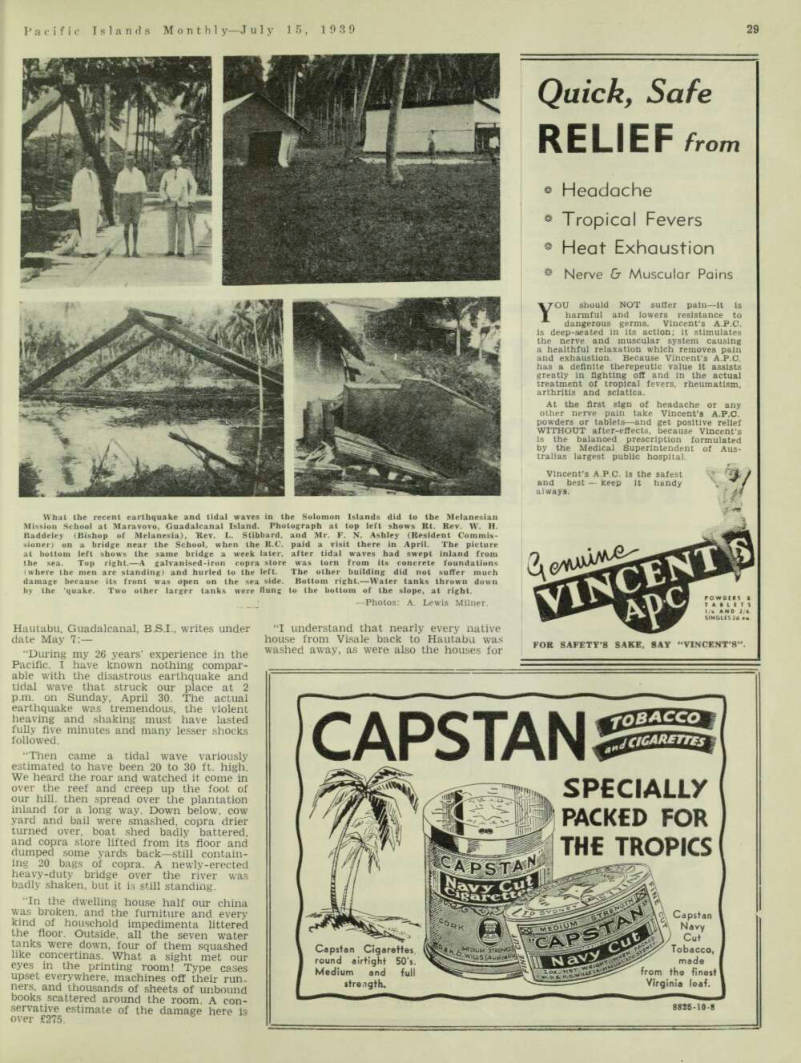
What the recent earthquake and tidal waves in the Solomon Islands did to the Melanesian Mission School at Maravovo, Guadalcanal Island. Photograph at top left shows Rt. Rev. W. H.
Baddeley (Bishop of Melanesia), Rev. L. Stibbard, and Mr. F. N. Ashley (Resident Commis sioner) on a bridge near the School, when the R.C. paid a visit there in April. The picture at bottom left shows the same bridge a week later, after tidal waves had swept inland from the sea. Top right.—A galvanised-iron copra store was torn from its concrete foundations (where the men are standing) and hurled to the left. The other building did not suffer much damage because its front was open on the sea side. Bottom right.—Water tanks thrown down by the quake. Two other larger tanks were flung to the bottom of the slope, at right.
Photos: A. Lewis Milner.
about 20 miles on the other side of us towards Wanderer Bay. At Naro, the next village to us, six natives were killed out right and three have since died.
“We are still getting a number of nasty shocks each day, but they are gradually easing.”
The work of rebuilding No. 2 jetty (usually known as Burns, Philp’s jetty) in Port Moresby Harbour, Papua, was commenced early in June.
The former French man-o-war “Eure”, whose last station was at Noumea, New Caledonia, and which had been a hulk in Auckland, N.Z., for some years, is now being broken up.
A team of Fijian Rugby Union foot ballers will make a tour of New Zealand between August 17 and September 21.