Japan’S Naval Spy System In
pp. 18-21 · Read in the full issue
The Pacific
The Real Purpose of the Wandering Trawlers
By John Williams—No. 3 Of Series
Honolulu, June 12.
fTIHERE is no need to exaggerate one A word about the spy web which Japan is casting across the Pacific. The facts are far stranger than any fiction.
Two Japanese official documents before me assert: (1) “We Japanese say that the Pacific Ocean and the Japan Sea are Japanese pastures . .
Japan means business. She regards America, particularly the alertness of the U.S. fleet, as the major handicap to her expansive dreams in the Pacific.
The facts deal with the new technique which Japan is using as an important part of her “tactical operations”.
Trawlers—But No Fish!
JAPAN is developing a widespread fleet of what she calls “trawlers”. To-day
(2) “ ... It is manifestly incumbent on the people to rise in perfect unity to ful fil the Holy Mission entrusted to the Nation—the construction of a New Order in East Asia . . . The mission of the Imperial Navy, to enable the Japanese people to achieve their glorious task, will be more important than ever. It must continue the present tactical operations J 9
they are to be seen in the following waters: Off the Siberian coast, in Alaska and then right down the North American west coast to Panama and even below the equator to South American ports. They snoop through the Hawaiian Islands and the waters of the outlying islands (John ston, Midway and Wake) which screen the Hawaii defence scheme.
The mandated islands are only 1,200
This drawing shows the notorious trawler, “Amano Maru” (see opposite page) in cross section!. One may see how a torpedo tube could be housed in the so-called bait tank over the stern, and mines could be set up in the so-called fish hatches, below the water line.
miles from potent Midway. The mandates have for these trawlers fine roosting and refuelling ports, which are called “com mercial'’ developments. America says the same thing about the warplane, submarine and destroyer facilities now under way at Midway, Wake and Johnston Islands.
These steel-hulled Japanese trawlers are super-North Sea type. Here are aver age specifications: 120 tons gross; range of 10,000 miles with 250 h.p. diesel engines, but range can be doubled by fill ing so-called bait wells, on each side of the trawlers, with fuel oil; they carry crew of 15 men; they are equipped with short wave radio. Sonic depth finders and electric deep-sea sounders.
Remarkable thing about some of these nomadic trawlers is that seldom is a fish seen in their holds by the observers of various Governments who have been justified in boarding them in coastal waters!
Above the stem is a large fish tank: it could house a torpedo tube. The spacious fish hatches below could be converted for mine-laying racks. (See illustration on previous page.) The officers and crews are Japanese navy reserves.
A Sinister Craft
IfNANNOUNCED, the “Amano Maru", / a fine example of these trawlers, called in at Honolulu on July 1 and 2. 1937. Her captain was a Danish citizen.
Christian S. Albertson, and under him he had a crew of 15, all Japanese. The “Amano Maru” sailed for Balboa. Cali fornia, and thence to Panama.
“P.1.M.” readers should read ‘‘Secret Armies”, a new book dealing with the new technique of Nazi warfare, and ex posing Hitler’s undeclared war on the Americas, which has just been published in New York. The author is John L.
Spivak, crack U.S. investigating news man.
Of the “Amano Maru”, Mr. Spivak writes: “ ... In 1937, Yoshitaro Amano, a Japanese millionaire who has far-flung interests all along the Pacific coasts of Central and South America, organised Amano Fisheries, Ltd. The ‘Amano Maru’ was the first of the fleet built in Japan.
It has an extremely secret Japanese in vention for detecting mines . . . On Octo ber 7, 1937, Yoshitaro Amano headed straight for the military zone off the Nicaraguan coast (just north of the Panama canal). He was arrested and charged with espionage . , . Result of this was that the Republic of Panama can celled the ‘Amano Maru’s’ registration . . .
The ‘Amano Maru’ thereupon sped for Punta Arenas, Costa Rica, nearer the canal. in which harbour lurk the Japanese ves sels prohibited from Panamanian waters.
To-day the ‘Amano Maru’ is a mystery ship . . ”
But I can tell a better story about an other Japanese trawler which has been observed in Alaskan, North American and Panama waters—the “Hachinohe Maru”.
Mysterious Wreck
FROM, February to May, 1938, the U.S.
Pacific fleet conducted annual war games which centred, naturally, around the “keystone” of the navy-army bases in Hawaii and rigidly tested the protective screen established about Wake, Midway and Johnston Islands to the w^est.
By a “coincidence”, the “Hachinohe Maru” happened to be in the vicinity and so closely engrossed in the movements of the U.S. fleet that she ran aground on
Ocean or Kure Island (near Midway) on February 18—unknown, of course, to the fleet It was not until March 16, however, that the Japanese Consul-General in Honolulu advised the American naval authorities about the wreck. Japan had despatched a rescue vessel, meanwhile, but it found the trawler deserted (so Japan said). American units inspected the wreck and superficially it looked as though the crew of 25 men might have been drowned in making their escape from the wreck on the exposed reef. No S.O.S. signals were heard by the U.S. fleet or shipping near the area.
But, again, the crew might have been
rescued by another Japanese trawler: after all, the closest port of the man dated isles is only 1,200 miles distant and “Hachinohe Maru " was well e( » ui PP ed wim raa , . , Now, if the “Hachmohe Maru s mission was honest, why was her wreck kept sec ret for so long, and why has the Hono lulu consulate made such efforts to hush every reference to the “disaster ’? Com mercial wrecks, according to international custom, are reported immediately. If she was a commercial vessel, what was she doing in U.S. territorial waters, off the trans-Pacific tracks usually used by com mercial ships?
Is it any wonder that America to-day
is pushing the establishment of an air and sea patrol base at Midway Island, which will take care of foreign wanderers near Ocean Island?
Incidentally, the “Hachinohe Maru” embarrassment was so well hushed (by Japan and America) that first announce ment of it was not made by the Hono lulu dailies until November 5, 1938, and then the facts were vague.
It is difficult to estimate just how many of these long-range, wasp-like trawlers Japan has sprinkled all over the Pacific.
But it is not difficult to imagine the men ace they will become in time of war.
Overnight, they can be converted into well-armed mine-layers, a menace to all the sealanes criss-crossing the Pacific.
They are constructed with 3-inch gun emplacements and machine gun stands.
Effective raiders,
Mother Ships For Trawlers
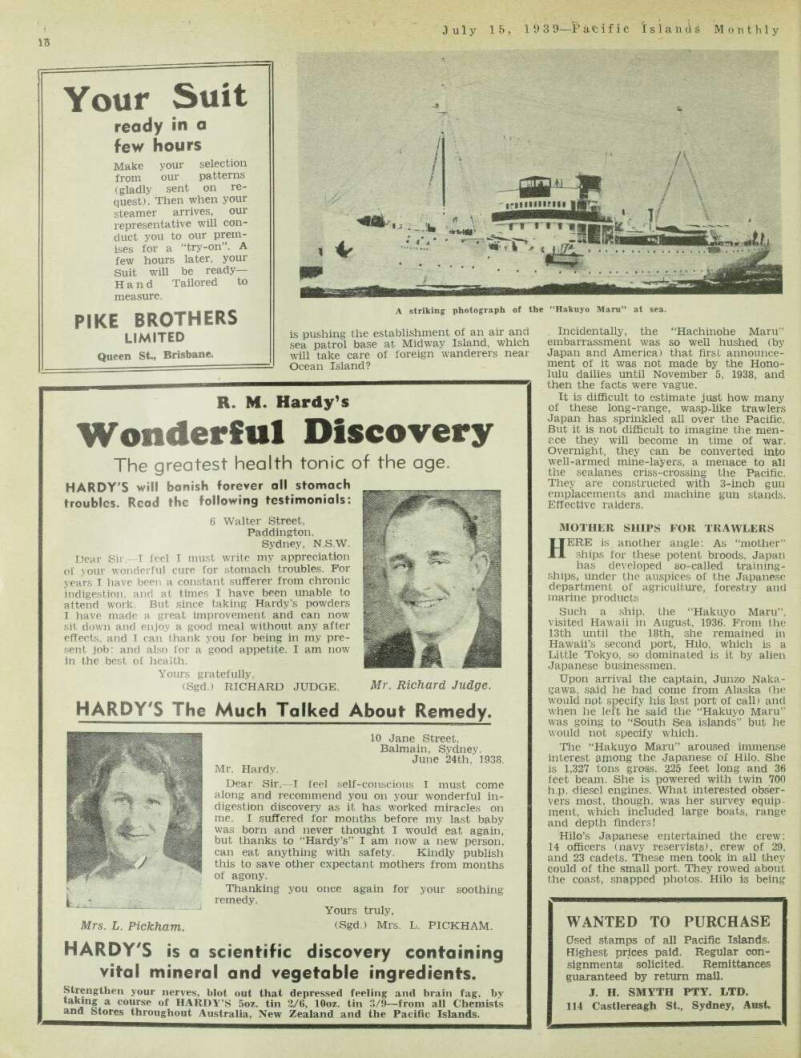
HERE is another angle: As “mother” ships for these potent broods. Japan has developed so-called training ships, under the auspices of the Japanese department of agriculture, forestry and marine products Such a ship, the “Hakuyo Maru”. visited Hawaii in August. 1936. From the 13th until the 18th, she remained in Hawaii’s second port, Hilo, which is a Little Tokyo, so dominated is it by alien Japanese businessmen.
Upon arrival the captain, Junzo Naka gawa. said he had come from Alaska (he would not specify his last port of call) and when he left he said the “Hakuyo Maru” was going to “South Sea islands” but he would not specify which.
The “Hakuyo Maru” aroused immense interest among the Japanese of Hilo. She is 1,327 tons gross, 225 feet long and 36 feet beam. She is powered with twin 700 h.p. diesel engines. What interested obser vers most, though, was her survey equip ment, which included large boats, range and depth finders I Hilo’s Japanese entertained the crew: 14 officers (navy reservists), crew of 29, and 23 cadets. These men took in all they could of the small port. They rowed about the coast, snapped photos. Hilo is being
A striking photograph of the “Hakuyo Maru” at sea.
improved, coincidently, for U.S. submar ine purposes!
“Snoopers” Annoy Americans
THE Japanese trawlers are a nightmare to the U.S. fleet. During the recent war games of the fleet in the Atlantic, trawlers rounded Cape Horn and made their way into West Indies ports from which they steamed out and shadowed the U.S. fleet’s movements.
What could America do about it? After all, they were on the high seas. But what would Japan do about American “snoopers” off Japan?
These trawlers mean business. I have seen them in Dutch Indies waters, even hovering near Singapore. By now they must have made their way into the waters of the Islands territories admini stered by Australia. The ports of the Japanese mandated islands give them a strategic central Pacific position from which to operate.
Inquisitive Sampans
mHE achievements cf the ocean-going i trawlers are supplemented by smaller Japanese fishing boats, usually called sampans, which confine their ac tivities to local waters.
For example, the California, Mexican and Central American coasts are dotted with them. In Hawaii, alone, there are some 800. This sounds too stupid to be true; but 18 of the Japanese-owned sam pans in Hawaii are permitted to fish within the potent Pearl Harbour navy base itself.
In 1938 when the Pacific fleet was hold ing its war games, a special proclamation was made to exclude these 18 sampans from the harbour from March 30 to May 1- Even though the navy patrols the har bour, every now and then these Japanese are caught out of bounds, fishing in special sections of the harbour which are called “secret”.
For a long time the navy did not think these local sampans could do much about the High Seas Fleet. But an American navy reserve officer caused a panic when he did this: The sampans are ocean-worthy boats.
He stated he could sneak into the fleet at sea under darkness and escape without being detected. Navy observers were placed aboard his sampan.
The Pacific fleet was approaching Hono lulu simulating war conditions. That is, lights out etc. This man cruised out 20 miles and located the battleships. He sneaked in between the flagship (the ex haust muffled under water) and inter cepted small visual signals. These he radioed to the defending army forces at Honolulu, and they flew out bombers, much to the chagrin of the admirals.
Next year, at the next war games, this navy reservist, who knows his coastal boats, repeated the trick.
Now the U.S. navy is watching the sam pans—and the trans-Pacific trawlers— closer than ever. The admirals are con scious now of what “mosquito” coastal craft can do! (Next month’s instalment will deal with unbelievable angles to the menace of Japanese navy tankers in the Pacific, the undercover work they do, how they act as secret links between the Japanese com munities outside Japan. In Honolulu, for example, they remain for several days each visit. What happens behind the scenes of these visits?) Mr. G. Washington, of W. R. Carpenter and Co., Ltd., Salamaua, New Guinea, is at present spending furlough in the East.