Is Banned
p. 55 · Read in the full issue
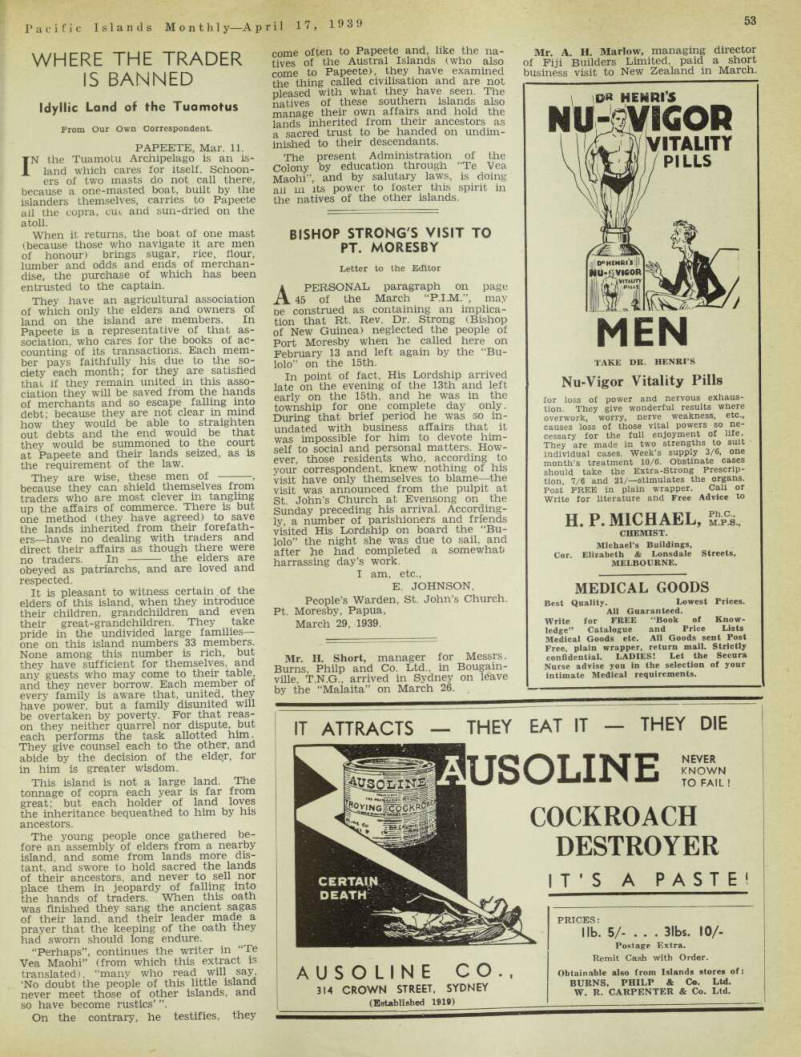
Where The Trader
Idyllic Land of the Tuamotus
Prom Our Own Correspondent.
Papeete, Mar. 11.
IN the Tuamolu Archipelago is an is land which cares for itself. Schoon ers of two masts do not call there, because a one-masted boat, built by the islanders themselves, carries to Papeete all the copra, cut and sun-dried on the atoll.
When it returns, the boat of one mast (because those who navigate it are men of honour) brings sugar, rice, flour, lumber and odds and ends of merchan dise, the purchase of which has been entrusted to the captain.
They have an agricultural association of which only the elders and owners of land on the island are members. In Papeete is a representative of that as sociation, who cares for the books of ac counting of its transactions. Each mem ber pays faithfully his due to the so ciety each month; for they are satisfied that if they remain united in this asso ciation they will be saved from the hands of merchants and so escape falling into debt; because they are not clear in mind how they would be able to straighten out debts and the end would be that they would be summoned to the court at Papeete and their lands seized, as is the requirement of the law.
They are wise, these men of , because they can shield themselves from traders who are most clever in tangling up the affairs of commerce. There is but one method (they have agreed) to save the lands inherited from their forefath ers—have no dealing with traders and direct their affairs as though there were no traders. In the elders are obeyed as patriarchs, and are loved and respected.
It is pleasant to witness certain of the elders of this island, when they introduce their children, grandchildren and even their great-grandchildren. They take pride in the undivided large families — one on this island numbers 33 members.
None among this number is rich, but they have sufficient for themselves, and any guests who may come to their table, and they never borrow. Each member of every family is aware that, united, they have power, but a family disunited will be overtaken by poverty. For that reas on they neither quarrel nor dispute, but each performs the task allotted him.
They give counsel each to the other, and abide by the decision of the elder, for in him is greater wisdom.
This island is not a large land. The tonnage of copra each year is far from great; but each holder of land loves the inheritance bequeathed to him by his ancestors.
The young people once gathered be fore an assembly of elders from a nearby island, and some from lands more dis tant, and swore to hold sacred the lands of their ancestors, and never to sell nor place them in jeopardy of falling into the hands of traders. When this oath was finished they sang the ancient sagas of their land, and their leader made a prayer that the keeping of the oath they had sworn should long endure.
“Perhaps”, continues the writer in “Te Vea Maohi” (from which this extract is translated), “many who read will say, ‘No doubt the people of this little island never meet those of other islands, and so have become rustics’ ”.
On the contrary, he testifies, they
come often to Papeete and, like the na tives of the Austral Islands (who also come to Papeete), they have examined the thing called civilisation and are not pleased with what they have seen. The natives of these southern islands also manage their own affairs and hold the lands inherited from their ancestors as a sacred trust to be handed on undim inished to their descendants.
The present Administration of the Colony by education through “Te Yea Maohi”, and by salutary laws, is doing ail m its power to foster this spirit in the natives of the other islands.