Top Hats"
p. 33 · Read in the full issue
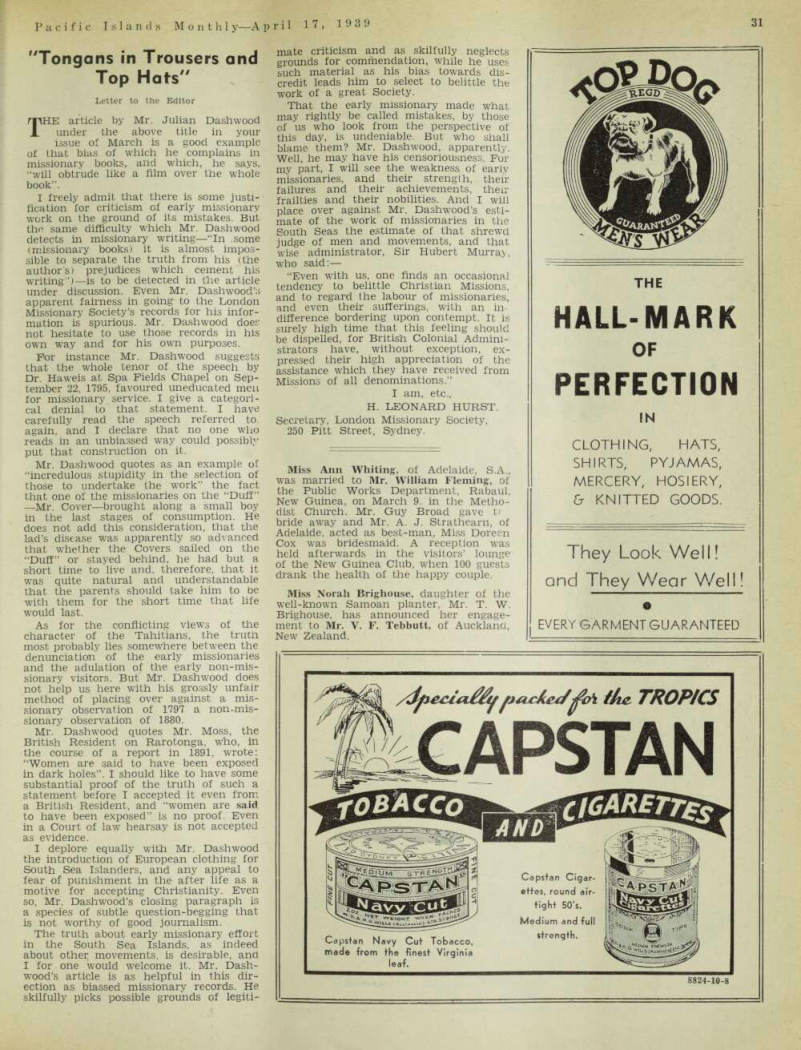
"Tongans in Trousers and Top Hats"
Letter to the Editor THE article by Mr. Julian Dashwood under the above title in your issue of March is a good example of that bias of which he complains in missionary books, and which, he says, “will obtrude like a film over the whole book”.
I freely admit that there is some justi fication for criticism of early missionary work on the ground of its mistakes. But the same difficulty which Mr. Dashwood detects in missionary writing—“ln some (missionary books) it is almost impos sible to separate the truth from his (the authors) prejudices which cement his writing ’)—is to be detected in the article under discussion. Even Mr. Dashwood’s apparent fairness in going to the London Missionary Society’s records for his infor mation is spurious. Mr. Dashwood does not hesitate to use those records in his own way and for his own purposes.
For instance Mr. Dashwood suggests that the whole tenor of the speech by Dr. Haweis at Spa Fields Chapel on Sep tember 22, 1795, favoured uneducated men for missionary service. I give a categori cal denial to that statement. I have carefully read the speech referred to again, and I declare that no one who reads in an unbiassed way could possibly put that construction on it.
Mr. Dashwood quotes as an example of “incredulous stupidity in the selection of those to undertake the work” the fact that one of the missionaries on the “Duff” —Mr. Cover—brought along a small boy in the last stages of consumption. He does not add this consideration, that the lad’s disease was apparently so advanced that whether the Covers sailed on the “Duff” or stayed behind, he had but a short time to live and, therefore, that it was quite natural and understandable that the parents should take him to be with them for the short time that life would last.
As for the conflicting views of the character of the Tahitians, the truth most probably lies somewhere between the denunciation of the early missionaries and the adulation of the early non-mis sionary visitors. But Mr. Dashwood does not help us here with his grossly unfair method of placing over against a mis sionary observation of 1797 a non-mis sionary observation of 1880.
Mr. Dashwood quotes Mr. Moss, the British Resident on Rarotonga, who, in the course of a report in 1891, wrote: “Women are said to have been exposed in dark holes”. I should like to have some substantial proof of the truth of such a statement before I accepted it even from a British Resident, and “women are said to have been exposed” is no proof. Even in a Court of law hearsay is not accepted as evidence.
I deplore equally with Mr. Dashwood the introduction of European clothing for South Sea Islanders, and any appeal to fear of punishment in the after life as a motive for accepting Christianity. Even so, Mr. Dashwood’s closing paragraph is a species of subtle question-begging that is not worthy of good journalism.
The truth about early missionary effort in the South Sea Islands, as indeed about other movements, is desirable, and I for one would welcome it. Mr. Dash wood’s article is as helpful in this dir ection as biassed missionary records. He skilfully picks possible grounds of legiti
mate criticism and as skilfully neglects grounds for commendation, while he uses such material as his bias towards dis credit leads him to select to belittle the work of a great Society.
That the early missionary made what may rightly be called mistakes, by those of us who look from the perspective of this day, is undeniable. But who shall blame them? Mr. Dashwood, apparently.
Well, he may have his censoriousness. Fur my part, I will see the weakness of early missionaries, and their strength, their failures and their achievements, then’ frailties and their nobilities. And I will place over against Mr. Dashwood's esti mate of the work of missionaries in the South Seas the estimate of that shrewd judge of men and movements, and that wise administrator, Sir Hubert Murray, who said: — “Even with us, one finds an occasional tendency to belittle Christian Missions, and to regard the labour of missionaries, and even their sufferings, with an in difference bordering upon contempt. It is surely high time that this feeling should be dispelled, for British Colonial Admini strators have, without exception, ex pressed their high appreciation of the assistance which they have received from Missions of all denominations.”
I am, etc.,
H. Leonard Hurst.
Secretary, London Missionary Society, 250 Pitt Street, Sydney.
Miss Ann Whiting, of Adelaide, S.A., was married to Mr. William Fleming, of the Public Works Department, Rabaul, New Guinea, on March 9. in the Metho dist Church. Mr. Guy Broad gave t> bride away and Mr. A. J. Strathearn, of Adelaide, acted as best-man. Miss Doreen Cox was bridesmaid. A reception was held afterwards in the visitors’ lounge of the New Guinea Club, when 100 guests drank the health of the happy couple.
Miss Norah Brighouse, daughter of the well-known Samoan planter, Mr. T. W.
Brighouse, has announced her engage ment to Mr. V. F. Tebbutt, of Auckland, New Zealand.