N. Guinea
p. 31 · Read in the full issue
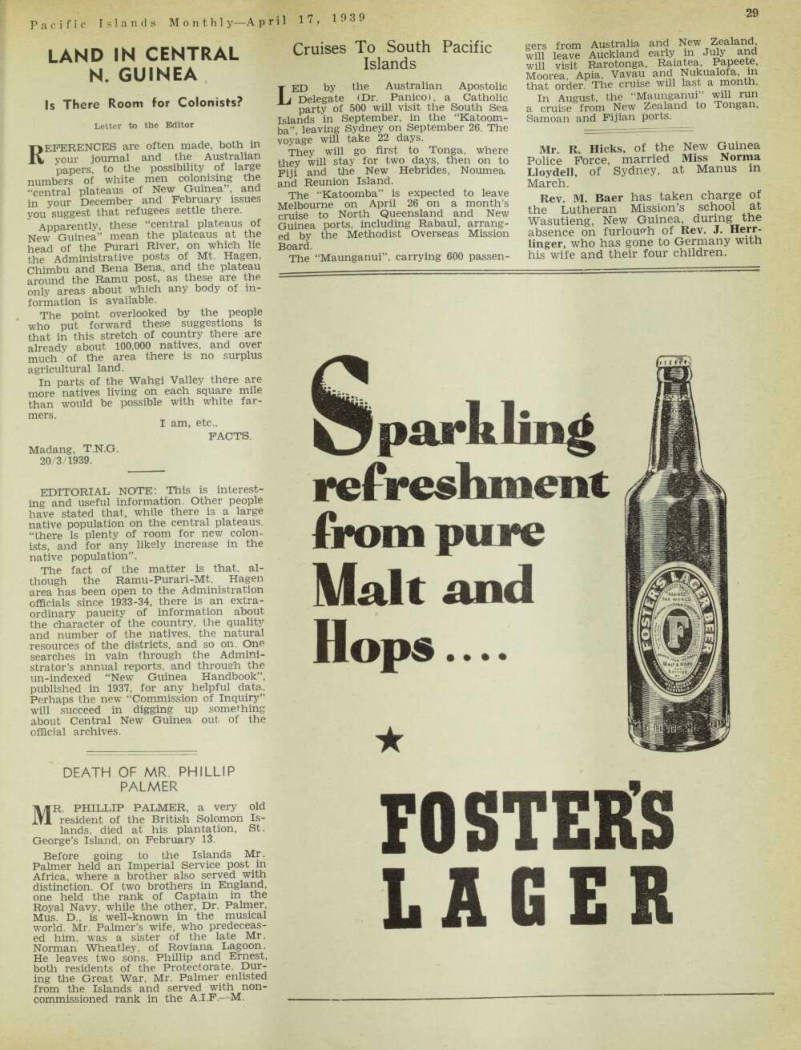
land in central
Is There Room for Colonists?
Letter to the Editor REFERENCES are often made, both in your journal and the Australian papers, to the possibility of large numbers of white men colonising the “central plateaus of New Guinea”, and in your December and February issues you suggest that refugees settle there.
Apparently, these “central plateaus of New Guinea” mean the plateaus at the head of the Purari River, on which lie the Administrative posts of Mt. Hagen, Chimbu and Bena Bena, and the plateau around the Ramu post, as these are the only areas about which any body of in formation is available.
The point overlooked by the people who put forward these suggestions is that in this stretch of country there are already about 100,000 natives, and over much of the area there is no surplus
agricultural land.
In parts of the Wahgi Valley there are more natives living on each square mile than would be possible with white far mers.
I am, etc.,
Facts.
Madang, T.N.G. 20/3/1939.
EDITORIAL NOTE: This is interest ing and useful information. Other people have stated that, while there is a large native population on the central plateaus, “there is plenty of room for new colon ists, and for any likely increase in the
native population”.
The fact of the matter is that, al though the Ramu-Purari-Mt. Hagen area has been open to the Administration officials since 1933-34, there is an extra ordinary paucity of information about the character of the country, the quality and number of the natives, the natural resources of the districts, and so on. One searches in vain through the Admini strator’s annual reports, and through the un-indexed “New Guinea Handbook”, published in 1937, for any helpful data.
Perhaps the new “Commission of Inquiry” will succeed in digging up something about Central New Guinea out of the official archives.