A Survivor's Story
pp. 20-22 · Read in the full issue
How "Calliope" Escaped
HERE is the story of how H.M.S. “Cal liope” escaped from the cyclone, as told to the “New Zealand Herald” by Mr. R. Jeffers, of Auckland. Mr. Jeff ers was a signal-boy aboard the “Calli ope” at the time. The “Calliope” is still alive—she is in use on the Mersey, in England, as a training ship for ca dets.
“At 4 o’clock in the morning”, Mr.
Jeffers said, “the wind suddenly veered round into the harbour, causing an ex traordinarily heavy sea. When daylight broke we found that the German gun boat ‘Eber’ and a number of small craft were missing from their anchorages. The ‘Eber’ had dragged her anchors and foundered on the reef with a loss of seven officers and 73 others.
“The seas continued to increase in fury.
We had a succession of narrow escapes as other ships got into difficulties. The German gunboat ‘Olga’ dragged her an chors, went ahead under her engines, and before anything could be done bore down on us, raking our starboard side.
Under the impact the foreyard was sprung and all the ship’s boats were car ried away.
American Ship S Fate
“About this time we noticed that the American ship ‘Nipsic’ had run aground.
Shortly afterward the American war ship ‘Vandalia’ dragged her anchors and came down on us, dragging across our bows. The ‘Calliope’s’ jib-boom entered her quarter galley and broke off, to-
gether with portion of the figurehead.
The ‘Vandalia’ then pulled away, drifted inshore and went down close to the beach with the loss of four officers and 43 men. The German vessel ‘Adler’, which also dragged her anchors, turned over on the reef and two officers and 23 men were drowned”.
It was immediately after this that Captain Kane decided to steam for the open sea. He said afterward that two courses lay open to him —an attempt to reach safety outside the turmoil of the
harbour or an effort to beach his ship on a sandy place where the rescue of those on board would be comparatively easy. He slipped his cables and called for every ounce of steam and every re volution of the screw.
Fight For The Open Sea
The “Calliope” made it, although at one time it seemed certain that she would be flung against the American warship “Trenton”. Even when this was avoided the crews of both ships stood with bated
breath until the “Calliope” went past, and then cheered each other.
“I wonder”, said Captain Kane in Syd ney, later, “how the machinery and the rudder stood it. It was as pretty a thing and as lucky an escape as could well be imagined”.
For 24 hours the “Calliope” steamed seaward and made no more than 26 miles in the whole time. When it was consid ered safe to re-enter Apia, on the fol lowing Tuesday, the “Calliope” steamed in again and obtained some coal. She then went to Sydney for docking and re pairs and after that left for England, where she eventually arrived in April, 1890, and paid off finally on May 1.
She was then transferred to reserve.
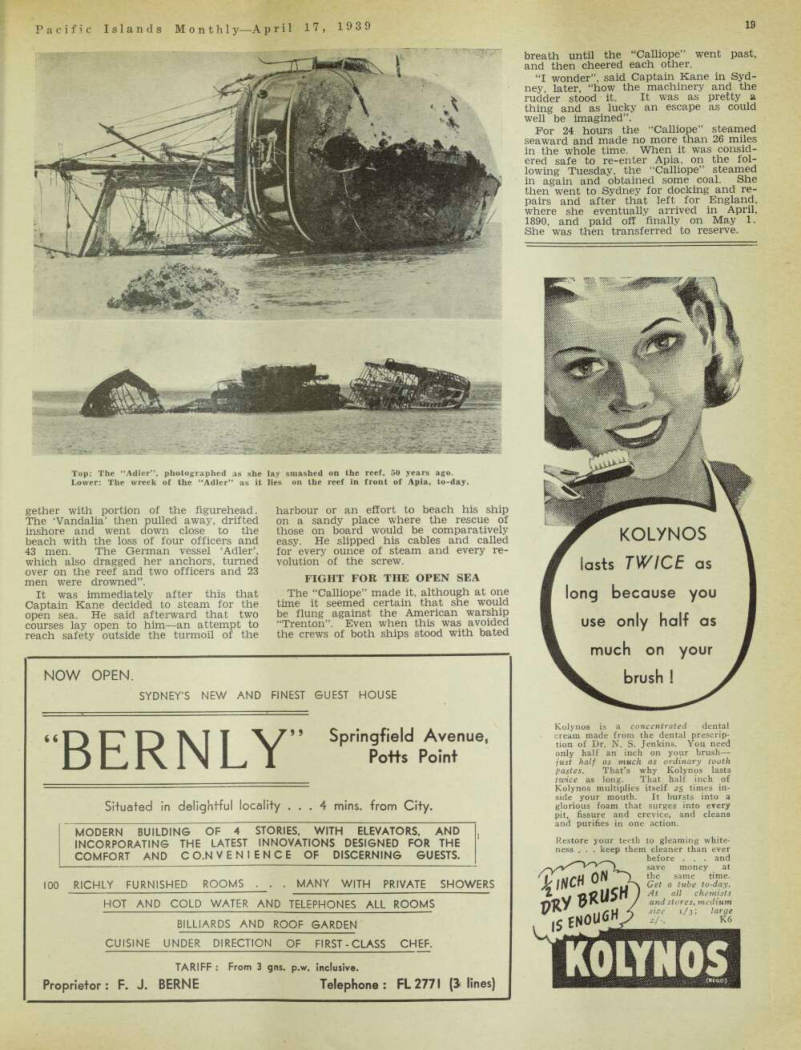
Top: The “Adler”, photographed as she lay smashed on the reef, 50 years ago.
Lower: The wreck of the “Adler” as it lies on the reef in front of Apia, to-day.
Mr. David Stewart, sales manager for Messrs. Holbrooks (Australasia), Ltd., will leave by the “Macdhui” on May 13, on his periodical visit to the principal cen tres in Papua and New Guinea.
Mr. G. Roberts, of Salamaua, arrived in Melbourne from New Guinea by the March “Neptuna” to join his wife on furlough. He is a member of the staff of Burns, Philp and Co. Ltd.
Mr. William Holland, Inspector of Po lice for Tavua and Ba districts, Fiji, is at present en route to England on leave.
Mr. Frank A. Waterman, who recent ly rejoined the Commonwealth Public Service after being Chief Accountant at Nauru for 14 years, has been appointed Commonwealth Auditor in New Guinea.