Bitoi Route Selected After Long
p. 16 · Read in the full issue
Morobe Road Bitoi Route Selected After Long Fight
AFTER an intensive campaign in Syd ney and Canberra by Mr. H. T. Allan, president of the New Guinea Mining Association, the Australian Prime Min ister, on March 30, announced that the Wau-Salamaua road would be built, by the Bitoi route, at a cost of between £lBO,OOO and £200,000.
Mr. Allan was faced in February with
a blank wall of Ministerial muddling and ineptitude. The road was promised in July, 1938; but, up to mid-March, noth ing had been done. The Territories Min ister, Mr. Harrison, had nothing to do with it. For some reason, this road mat ter had been left in the hands of the former Minister, Mr. Hughes; and, when it comes to talking a great deal, and doing nothing, Mr. Hughes wins a blue ribbon.
Mr. Allan appealed to Ministers, and got nowhere: he saw the newspapers and secured publicity for his shocking treat ment, but apparently achieved nothing; and finally, at the end of March, he ad
dressed to all Federal members an “open letter”, in which he dealt with the sub ject with the gloves off, and appealed for their aid.
This brought quick results, as stated above. Cabinet, of course, will say in dignantly that Mr. Allan’s activities did not influence its announcement. Morobe readers can accept our assurance that if Mr. Allan had not been on the job, the politicians would gladly have forgotten the Wau-Salamaua road.
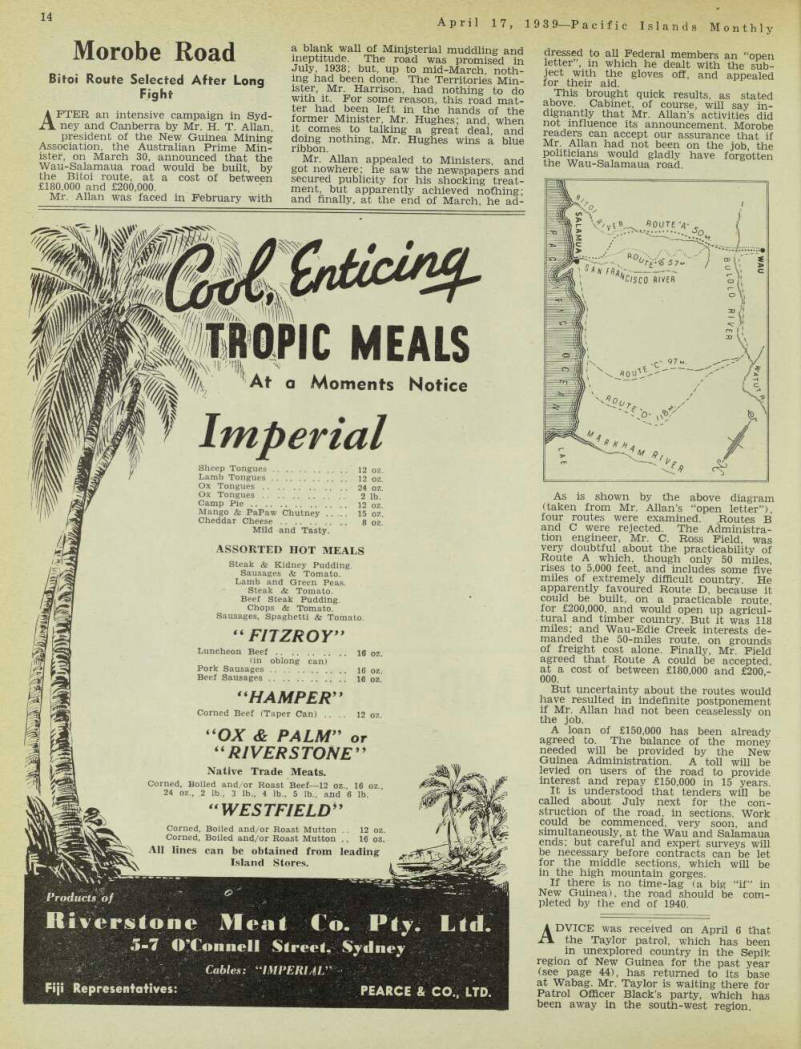
As is shown by the above diagram (taken from Mr. Allan’s “open letter”), four routes were examined. Routes B and C were rejected. The Administra tion engineer, Mr. C. Ross Field, was very doubtful about the practicability of Route A which, though only 50 miles, rises to 5,000 feet, and includes some five miles of extremely difficult country. He apparently favoured Route D, because it could be built, on a practicable route, for £200,000, and would open up agricul tural and timber country. But it was 118 miles; and Wau-Edie Creek interests de manded the 50-miles route, on grounds of freight cost alone. Finally, Mr. Field agreed that Route A could be accepted, at a cost of between £lBO,OOO and £200.- 000.
But uncertainty about the routes would have resulted in indefinite postponement if Mr. Allan had not been ceaselessly on the job.
A loan of £150,000 has been already agreed to. The balance of the money needed will be provided by the New Guinea Administration. A toll will be levied on users of the road to provide interest and repay £150,000 in 15 years.
It is understood that tenders will be called about July next for the con struction of the road, in sections. Work could be commenced, very soon, and simultaneously, at the Wau and Salamaua ends; but careful and expert surveys will be necessary before contracts can be let for the middle sections, which will be in the high mountain gorges.
If there is no time-lag (a big “if” in New Guinea), the road should be com pleted by the end of 1940.
ADVICE was received on April 6 that the Taylor patrol, which has been in unexplored country in the Sepik region of New Guinea for the past year (see page 44), has returned to its base at Wabag. Mr. Taylor is waiting there for Patrol Officer Black’s party, which has been away in the south-west region.