"Bounty's" Lost
pp. 48-50 · Read in the full issue
Anchor
Interesting Relic In Tohiti
By W. W. Bolton, M.A.
IIfHEN in 1789, Fletcher Christian and »» his fellow mutineers brought the Bounty” back to Tahiti, he sought the same spot for anchorage as Bligh had used when loading his cargo of bread fruit trees. This was not at Matavai Bay proper, but its western arm, Papaoa, where an extensive valley runs down from the hills at the back to the sea.
He had no intention of stopping long —he was all for hiding from the long arm of the law and, having secured sufficient supplies and watei}, he at tempted to weigh anchor. But the “Bounty” had grounded on a sunken reef, of which there are plenty to this day thereabouts. There was nothing for it but to use his spare anchor as a kedge, to haul her off. This was successful, but the kedge was held fast by the coral it had bitten into, and there was no hope of its release.
There was but one thing to do—to cut the cable and leave the anchor behind.
This was done and the “Bounty” passed out of the picture But the incident was not forgotten by the natives.
Time and again, as the years rolled on, an effort was made to get that anchor, but the grip held fast. One generation
followed another, and the story of the lost anchor of the “Bounty” passed on down, with the resolve of the district of Arue that some day it should be re covered. Nigh 50 years ago, when the present Chief of Arue was a strenuous young lad, there was a call for yet an other attempt.
To the joy of the neighbourhood the long-fast grip had loosened. It was not wholly unexpected, as to them it was only a question of time, for they had seen in other cases the strong corrosive action of coral on iron. The flukes of one arm so long held fast were gone; there was left but the point. This they easily withdrew, and dragged the weighty anchor to the edge of the lagoon, leaving it for a time on the fringing reef, in shallow water.
Some years later, the relic was drawn
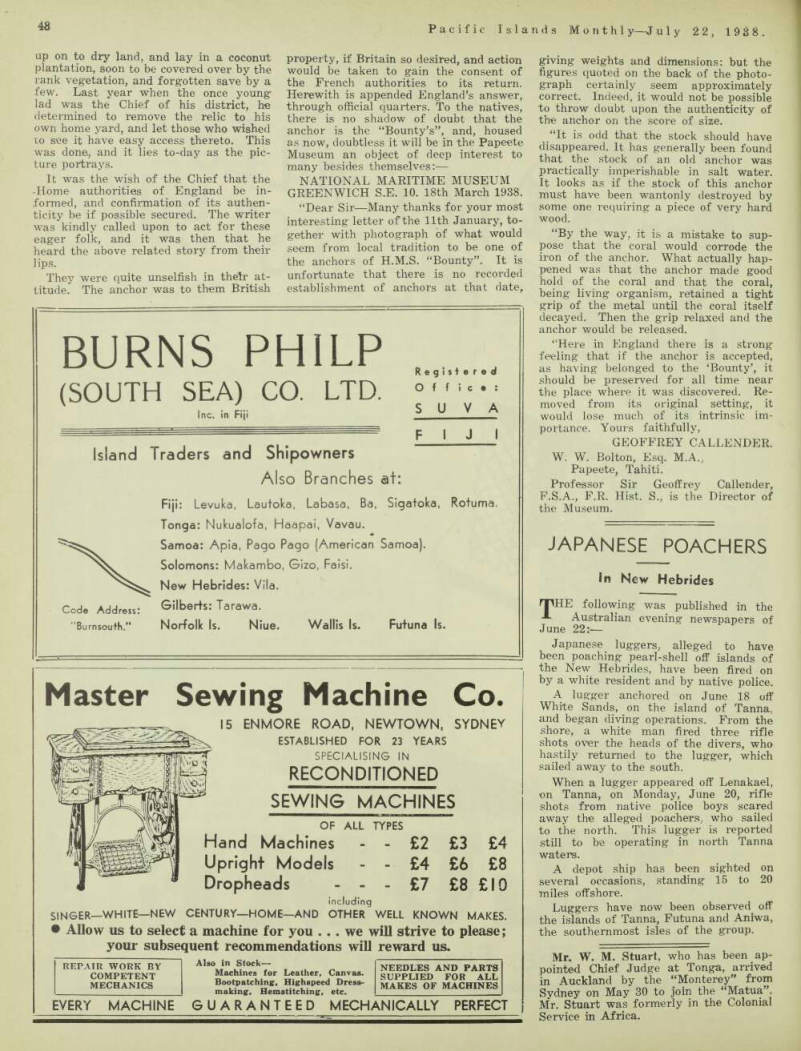
The anchor, as it is to-day.
up on to dry land, and lay in a coconut plantation, soon to be covered over by the rank vegetation, and forgotten save by a few. Last year when the once young lad was the Chief of his district, he determined to remove the relic to his own home yard, and let those who wished to see it have easy access thereto. This was done, and it lies to-day as the picture portrays.
It was the wish of the Chief that the -Home authorities of England be informed, and confirmation of its authenticity be if possible secured. The writer was kindly called upon to act for these eager folk, and it was then that he heard the above related story from their lips.
They were quite unselfish in their attitude. The anchor was to them British
property, if Britain so desired, and action would be taken to gain the consent of the French authorities to its return, Herewith is appended England’s answer, through official quarters. To the natives, there is no shadow of doubt that the anchor is the “Bounty’s”, and, housed as now, doubtless it will be in the Papeete Museum an object of deep interest to many besides themselves: —
National Maritime Museum
GREENWICH S.E. 10. 18th March 1938. « Dear sir M any thanks for your most , interesting letter of the 11th January, to gather with photograph of what would seem from local tradition to be one ot the anchors of H.M.S. “Bounty”. It is unfortunate that there is no recorded establishment of anchors at that date.
giving weights and dimensions: but the figures quoted on the back of the photo graph certainly seem approximately correct. Indeed, it would not be possible to throw doubt upon the authenticity of the anchor on the score of size.
“It is odd that the stock should have disappeared. It has generally been found that the stock of an old anchor was practically imperishable in salt water.
It looks as if the stock of this anchor must have been wantonly destroyed by some one requiring a piece of very hard wood.
“By the way, it is a mistake to sup pose that the coral would corrode the iron of the anchor. What actually hap pened was that the anchor made good hold of the coral and that the coral, being living organism, retained a tight grip of the metal until the coral itself decayed. Then the grip relaxed and the anchor would be released.
“Here in England there is a strong feeling that if the anchor is accepted, as having belonged to the ‘Bounty’, it should be preserved for all time near the place where it was discovered. Re moved from its original setting, it would lose much of its intrinsic im portance. Yours faithfully,
Geoffrey Callender.
W. W. Bolton, Esq. M.A., Papeete, Tahiti.
Professor Sir Geoffrey Callender, F.S.A., F.R. Hist. S., is the Director of the Museum.