Minister And New Guinea Administrator
pp. 43-44 · Read in the full issue
References In Open Letter to Members Of Australian Parliament
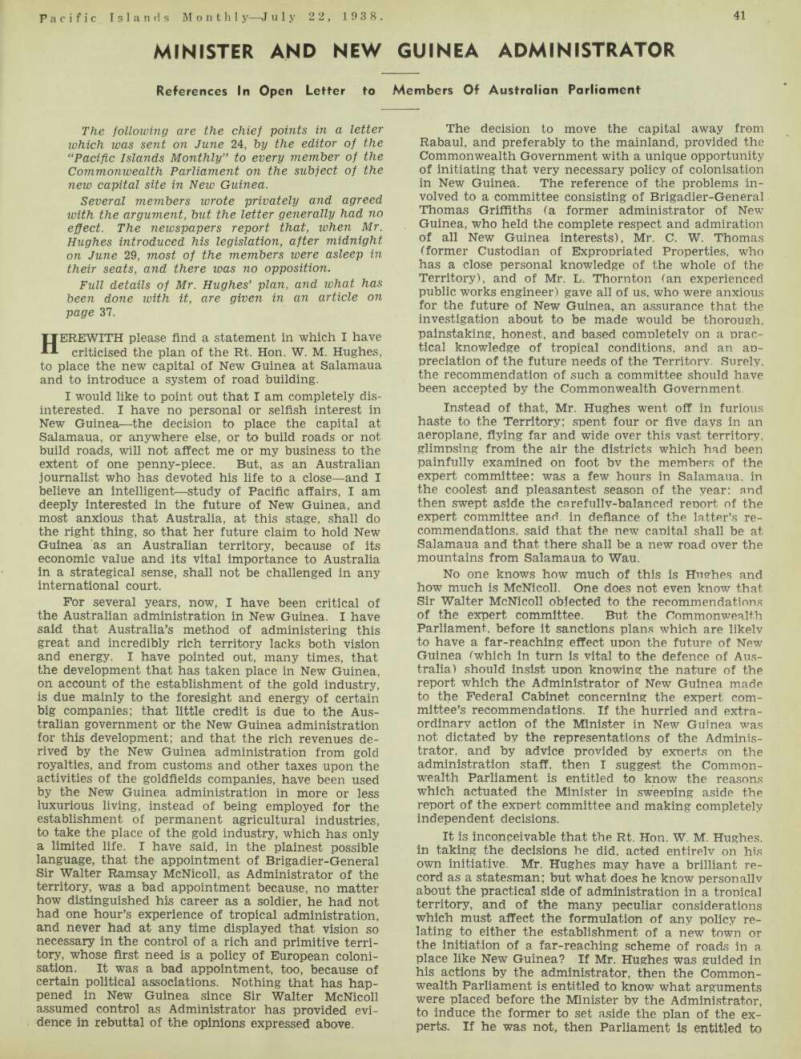
The following are the chief points in a letter which was sent on June 24, by the editor of the “Pacific Islands Monthly” to every member of the Commonwealth Parliament on the subject of the new capital site in New Guinea.
Several members wrote privately and agreed with the argument, but the letter generally had no effect. The newspapers report that, when Mr.
Hughes introduced his legislation, after midnight on June 29, most of the members were asleep in their seats, and there was no opposition.
Full details of Mr. Hughes’ plan, and what has been done with it, are given in an article on page 37.
HEREWITH please find a statement in which I have criticised the plan of the Rt. Hon. W. M. Hughes, to place the new capital of New Guinea at Salamaua and to introduce a system of road building.
I would like to point out that I am completely dis interested. I have no personal or selfish interest in New Guinea—the decision to place the capital at Salamaua, or anywhere else, or to build roads or not build roads, will not affect me or my business to the extent of one penny-piece. But, as an Australian journalist who has devoted his life to a close—and I believe an intelligent—study of Pacific affairs, I am deeply interested in the future of New Guinea, and most anxious that Australia, at this stage, shall do the right thing, so that her future claim to hold New Guinea as an Australian territory, because of its economic value and its vital importance to Australia in a strategical sense, shall not be challenged in any international court.
For several years, now, I have been critical of the Australian administration in New Guinea. I have said that Australia’s method of administering this great and incredibly rich territory lacks both vision and energy. I have pointed out, many times, that the development that has taken place in New Guinea, on account of the establishment of the gold industry, is due mainly to the foresight and energy of certain big companies; that little credit is due to the Aus tralian government or the New Guinea administration for this development: and that the rich revenues de rived by the New Guinea administration from gold royalties, and from customs and other taxes upon the activities of the goldfields companies, have been used by the New Guinea administration in more or less luxurious living, instead of being employed for the establishment of permanent agricultural industries, to take the place of the gold industry, which has only a limited life. I have said, in the plainest possible language, that the appointment of Brigadier-General Sir Walter Ramsay McNicoll, as Administrator of the territory, was a bad appointment because, no matter how distinguished his career as a soldier, he had not had one hour’s experience of tropical administration, and never had at any time displayed that vision so necessary in the control of a rich and primitive terri tory, whose first need is a policy of European coloni sation. It was a bad appointment, too, because of certain political associations. Nothing that has hap pened in New Guinea since Sir Walter McNicoll assumed control as Administrator has provided evi dence in rebuttal of the opinions expressed above.
The decision to move the capital away from Rabaul, and preferably to the mainland, provided the Commonwealth Government with a unique opportunity of initiating that very necessary policy of colonisation in New Guinea. The reference of the problems in volved to a committee consisting of Brigadier-General Thomas Griffiths (a former administrator of New Guinea, who held the complete respect and admiration of all New Guinea interests), Mr. C. W. Thomas (former Custodian of Expropriated Properties, who has a close personal knowledge of the whole of the Territory), and of Mr. L. Thornton (an experienced public works engineer) gave all of us, who were anxious for the future of New Guinea, an assurance that the investigation about to be made would be thorough, painstaking, honest, and based comnletely on a prac tical knowledge of tropical conditions, and an ap preciation of the future needs of the Territory. Surely, the recommendation of such a committee should have been accepted by the Commonwealth Government.
Instead of that, Mr. Hughes went off in furious haste to the Territory: spent four or five days in an aeroplane, flying far and wide over this vast territory, glimpsing from the air the districts which had been painfully examined on foot bv the members of the expert committee: was a few hours in Salamaua, in the coolest and pleasantest season of the year: and then swept aside the carefully-balanced report of the expert committee and. in defiance of the latter’s re commendations. said that the new capital shall be at Salamaua and that there shall be a new road over the mountains from Salamaua to Wau.
No one knows how much of this is Hughes and how much is McNicoll. One does not even know that Sir Walter McNicoll objected to the recommendations of the expert committee. But the Commonwealth Parliament, before it sanctions plans which are likely to have a far-reaching effect upon the future of New Guinea (which in turn is vital to the defence of Aus tralia) should insist upon knowing the nature of the report which the Administrator of New Guinea made to the Federal Cabinet concerning the expert com mittee’s recommendations. If the hurried and extra ordinary action of the Minister in New Guinea was not dictated by the representations of the Adminis trator. and by advice provided by experts on the administration staff, then I suggest the Common wealth Parliament is entitled to know the reasons which actuated the Minister in sweeping aside the report of the expert committee and making completely independent decisions.
It is inconceivable that the Rt. Hon. W. M. Hughes, in taking the decisions he did. acted entirelv on his own initiative. Mr. Hughes may have a brilliant re cord as a statesman: but what does he know personally about the practical side of administration in a tropical territory, and of the many peculiar considerations which must affect the formulation of any policy re lating to either the establishment of a new town or the initiation of a far-reaching scheme of roads in a place like New Guinea? If Mr. Hughes was guided in his actions by the administrator, then the Common wealth Parliament is entitled to know what arguments were placed before the Minister by the Administrator, to induce the former to set aside the plan of the ex perts. If he was not, then Parliament is entitled to
know that, so that. it may draw its own con clusions.
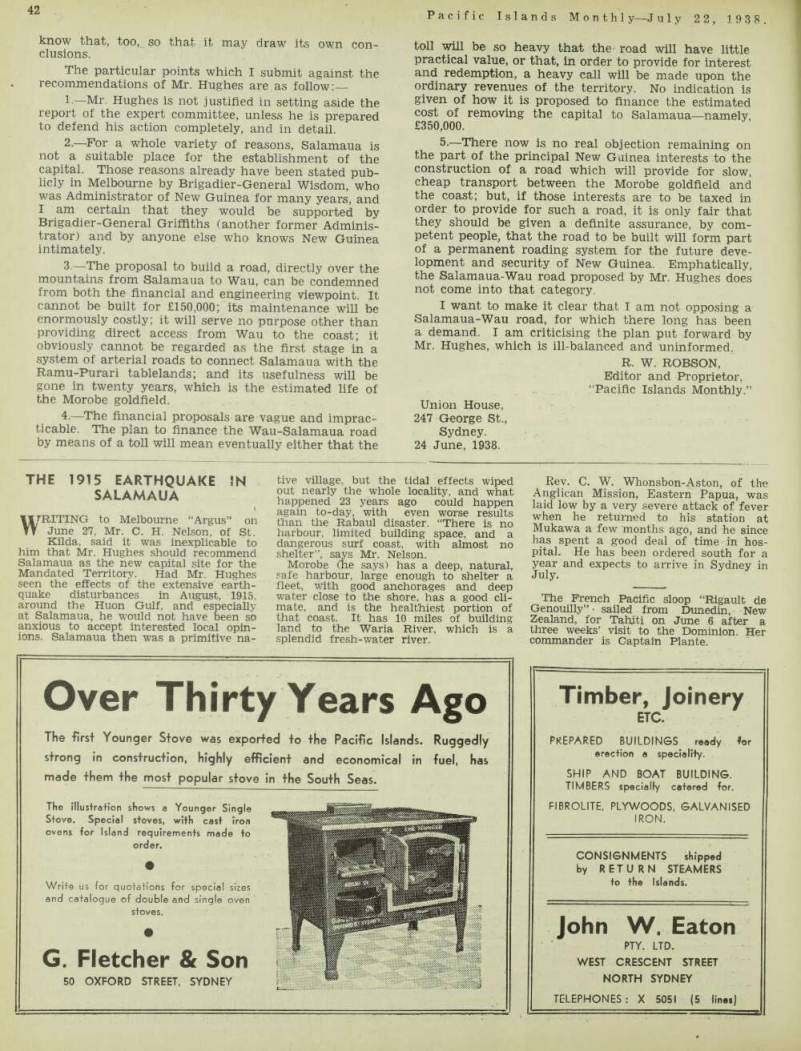
The particular points which I submit against the recommendations of Mr. Hughes are as follow: 1. Mr. Hughes is not justified in setting aside the report of the expert committee, unless he is prepared to defend his action completely, and in detail. 2. For a whole variety of reasons, Salamaua is not a suitable place for the establishment of the capital. Those reasons already have been stated pub licly in Melbourne by Brigadier-General Wisdom, who was Administrator of New Guinea for many years, and I am certain that they would be supported by Brigadier-General Griffiths (another former Adminis trator) and by anyone else who knows New Guinea intimately. 3—The proposal to build a road, directly over the mountains from Salamaua to Wau, can be condemned from both the financial and engineering viewpoint. It cannot be built for £150,000; its maintenance will be enormously costly; it will serve no purpose other than providing direct access from Wau to the coast; it obviously cannot be regarded as the first stage in a system of arterial roads to connect Salamaua with the Ramu-Purari tablelands; and its usefulness will be gone in twenty years, which is the estimated life of the Morobe goldfield. 4.—The financial proposals are vague and imprac ticable. The plan to finance the Wau-Salamaua road by means of a toll will mean eventually either that the
toll will be so heavy that the road will have little practical value, or that, in order to provide for interest and redemption, a heavy call will be made upon the ordinary revenues of the territory. No indication is given of how it is proposed to finance the estimated cost of removing the capital to Salamaua—namely, £350,000. 5-—There now is no real objection remaining on the part of the principal New Guinea interests to the construction of a road which will provide for slow, cheap transport between the Morobe goldfield and the coast; but, if those interests are to be taxed in order to provide for such a road, it is only fair that they should be given a definite assurance, by com petent people, that the road to be built will form part of a permanent reading system for the future deve lopment and security of New Guinea. Emphatically, the Salamaua-Wau road proposed by Mr. Hughes does not come into that category.
I want to make it clear that I am not opposing a Salamaua-Wau road, for which there long has been a demand. I am criticising the plan put forward by Mr. Hughes, which is ill-balanced and uninformed.
R. W. Robson,
Editor and Proprietor, “Pacific Islands Monthly,”
Union House, 247 George St., Sydney. 24 June, 1938.