Jack Hides
pp. 35-38 · Read in the full issue
Some Personal Memories Of A Remorkoble Mon
By R. W. Robson
ONE evening, at a kind of “conver sazione” in Sydney, I directed a friend’s attention to a young man who sat rather awkwardly in a big chair.
He balanced a cup of tea in one hand, a piece of cake in the other, his toes were drawn up under him in a correct position, he gazed wide-eyed and re spectfully attentive into the face of a chattering matron, and his voice was soft and gentle. He was tall, thin, pale, and very well-groomed.
“What do you think of him?” I asked my friend.
“Oh, pretty boy!” he said. “Quite a darling! Who is he?”
“Jack Hides”, I replied.
My friend gaped, and gobbled, and then went furiously into reverse. He said he could see great character in the lean jaw and the broad forehead. We had been discussing Hides only an hour earlier, and he, like thousands of others, had ex pressed outspoken admiration of Hides’s
courage, tenacity and endurance in bringing David Lyall out of the centre of New Guinea in August, 1937, through the mountains and the limestone gorges, down the Strickland, to Daru. He had expected to see a big, grim, husky fel low; and, like most people, was sur prised to meet a slim, gentle and some what dandified youth, and be told that this was the famous patrol-leader.
I MET Hides first in 1933, just after he had done some very notable work in Central Papua—he went right into the mountain strongholds of raiding tribes, seized and handcuffed the chiefs, and mardhed them out again—and I per suaded him to add the story of those exploits to some other writing he had done.
He then was extremely eager to un dertake exploring work in the interior of Central Papua, still quite unknown, and
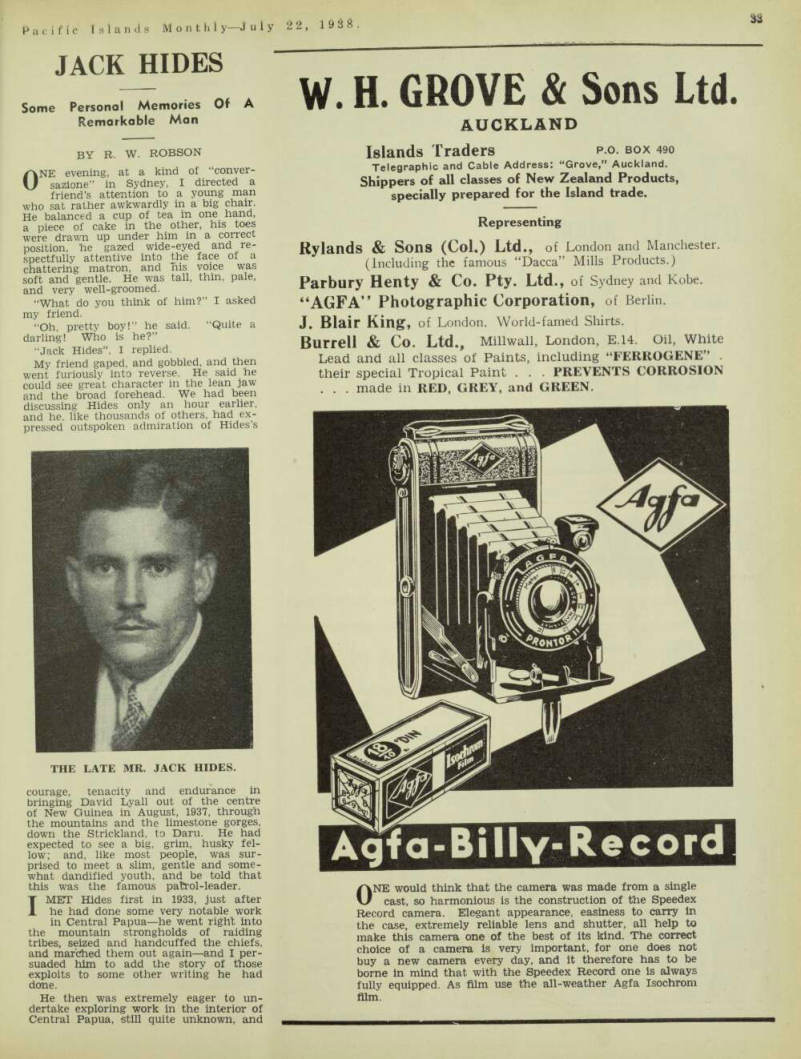
The Late Mr. Jack Hides.
he got his chance in 1934. Sir Hubert Murray sent Hides and O’Malley, with a detachment of native police, to see what kind of country lay beyond the Lime stone Barrier, around the headwaters of the Kikori and Purari. They were ab
sent for many months.
Meanwhile, I edited Jack’s manuscript, and sent the lot, in December, 1934, to London. Blackie accepted it immedi ately: and when Hides eventually came out of the unknown, onto the Kikori River, he was greeted with a copy of his first book, “Through Wildest Papua”, already selling well.
That successful Hides-OMalley patrol, which discovered the Tarafuroro and Wagafurari Valley systems, thickly po pulated, somehow gripped the public imagination, and Hides was lionised in Australia in an extraordinary fashion. He developed his gift for writing, and quick ly sold innumerable newspaper articles and another book, “Papuan Wonderland”.
But his journalistic activity embar rassed the Federal Ministers and Papuan administrators, who all were his good friends. Obviously, the material which he had gathered on a Government pa trol was the property of the Government, and should be published only with the consent of the Government. Some news papers paid Hides for exclusive articles and photos; and other newspapers howl ed to Canberra, protesting that they were entitled to share in material made available by the Government.
High officials acted quite properly in telling Hides that, in these things, he must display greater discretion; but Jack was convinced that jealousy had dictated these restrictions, and he believed he was being persecuted. Friction developed, and eventually he left the Papuan ser vice, about the middle of 1936.
THIS was a foolish move. Hides was a “Murray man”, by training, tem perament and conviction. His regard for Sir Herbert Murray ran through ad miration and veneration, almost to wor ship. His future as an administrative officer, with a unique knowledge of na tives and native psychology, was assured.
However, in characteristic fashion, he went his own way.
A group of prominent Sydney men, who admired his courage, character and achievements, formed Investors Ltd. for him; and, as the field officer of that company, Jack went back to Papua, with David Lyall, about September, 1936, to lead a very well equipped expedition on a search for a new goldfield. There seemed to be a good deal of muddling and waste, and some leading men in In vestors Ltd. got tired of it; but one of the biggest shareholders, Mr. J. R. Mc- Gregor, stood staunchly behind young Hides, and insisted that he get his chance to find a goldfield.
Eventually, the expedition reached the Upper Strickland; and, from there, by radio, both Hides and Lyall reported the existence of rich alluvial gold—apparent ly, an ideal dredging area, as the flats were accessible to water transport, via the Fly and Strickland Rivers. Because I knew the country and the conditions, I was asked by Investors Ltd. to go to Port Moresby, and assist them in get ting title to the gold-bearing area. I did this in April, 1937, and dredging claims over about 100 square miles even tually were granted.
Hides and Lyall were brought to Port Moresby in a Guinea Airways seaplane.
We made all arrangements with Hides by radio; Pilot Aubrey Koch flew out into the unmapped region; located Hides’s camp toy his smoke signals; and “landed” on a quiet stretch of river that had been cleared of snags and flagged.
I spent four days with Hides and Lyall in Port Moresby. They were thin, and bronzed, and had grown big dark beards.
They were merry, lovable fellows; and the rafters of the old Hotel Papua rang to mad and joyful sounds as they made wassail, to celebrate their brief escape from the loneliness of the distant jungle.
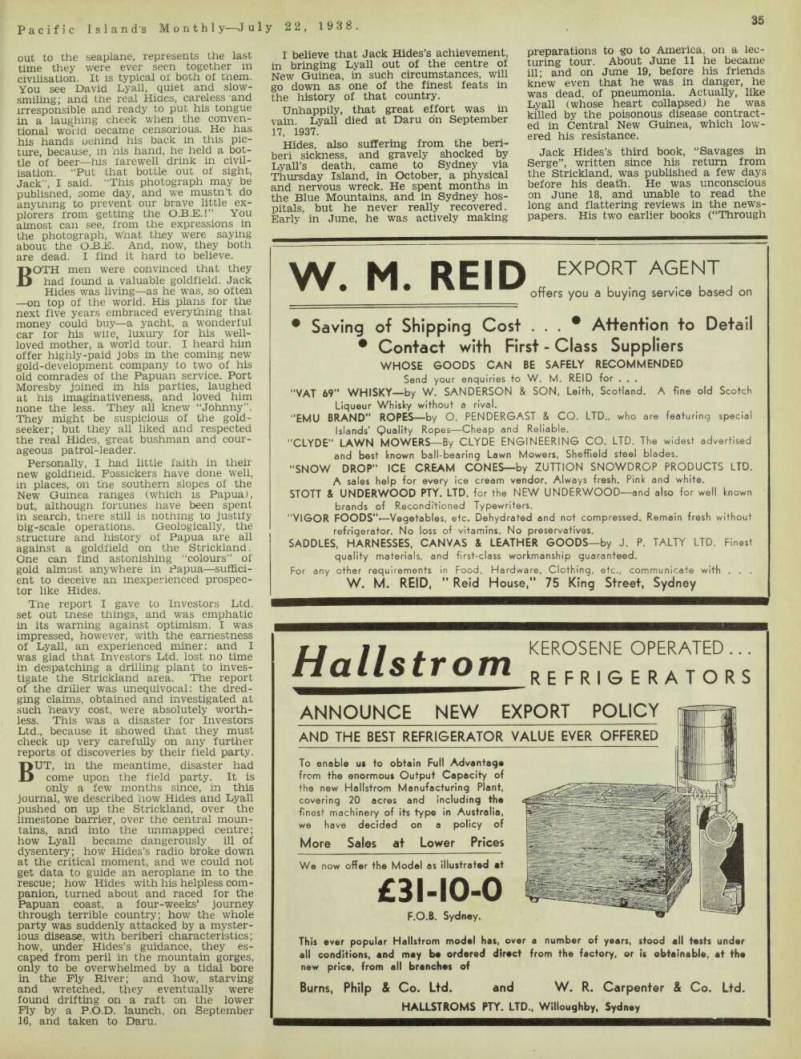
I saw them off in the dawn; and this photograph I took, just before they went
Hides and Lyall, just before leaving Port Moresby on their last expedition.
out to the seaplane, represents the last time they were ever seen together in civilisation. It is typical of both of them.
You see David Lyall, quiet and slow smiling; and the real Hides, careless and irresponsible and ready to put his tongue in a laughing cheek when the conven tional world oecame censorious. He has his hands uehind his back in this pic ture, because, in his hand, he held a bot tle of beer—his farewell drink in civil isation. “Put that bottle out of sight, Jack”, I said. “This photograph may be published, some day, and we mustn’t do anytmng to prevent our brave little ex plorers from getting the 0.8. E.!” You almost can see, from the expressions in the photograph, what they were saying about the 0.8. E. And, now, they both are dead. I find it hard to believe.
BOTH men were convinced that they had found a valuable goldfield. Jack Hides was living—as he was, so often —on top of the world. His plans for the next five years embraced everything that money could buy—a yacht, a wonderful car for his wife, luxury for his well loved mother, a world tour. I heard him offer highly-paid jobs in the coming new gold-development company to two of his old comrades of the Papuan service. Port Moresby joined in his parties, laughed at his imaginativeness, and loved him none the less. They all knew “Johnny”.
They might be suspicious of the gold seeker; but they all liked and respected the real Hides, great bushman and cour ageous patrol-leader.
Personally, I had little faith in their new goldfield. Fossickers have done well, in places, on the southern slopes of the New Guinea ranges (which is Papua), but, although fortunes have been spent in search, tnere still is nothing to justify big-scale operations. Geologically, the structure and history of Papua are all against a goldfield on the Strickland.
One can find astonishing “colours” of gold almost anywhere in Papua—suffici ent to deceive an inexperienced prospec tor like Hides.
The report I gave to Investors Ltd. set out these things, and was emphatic in its warning against optimism. I was impressed, however, with the earnestness of Lyall, an experienced miner: and I was glad that Investors Ltd. lost no time in despatching a drilling plant to inves tigate the Strickland area. The report of the driller was unequivocal; the dred ging claims, obtained and investigated at such heavy cost, were absolutely worth less. This was a disaster for Investors Ltd., because it showed that they must check up very carefully on any further reports of discoveries by their field party.
BUT, in the meantime, disaster had come upon the field party. It is only a few months since, in this journal, we described how Hides and Lyall pushed on up the Strickland, over the limestone barrier, over the central moun tains, and into the unmapped centre; how Lyall became dangerously ill of dysentery; how Hides’s radio broke down at the critical moment, and we could not get data to guide an aeroplane in to the rescue; how Hides with his helpless com panion, turned about and raced for the Papuan coast, a four-weeks’ journey through terrible country; how the whole party was suddenly attacked by a myster ious disease, with beriberi characteristics; how, under Hides’s guidance, they es caped from peril in the mountain gorges, only to be overwhelmed by a tidal bore in the Ply River; and how, starving and wretched, they eventually were found drifting on a raft on the lower Ply by a P.O.D. launch, on September 16, and taken to Daru.
I believe that Jack Hides’s achievement, in bringing Lyall out of the centre of New Guinea, in such circumstances, will go down as one of the finest feats in the history of that country.
TTr.hcnr.iiv that arpat pffort was in Unhappily, that great effort was m yam. Lyall died at Daru on September 17 > 1937 - , . .. . , Hides, also suffering from the benberi sickness, and gravely shocked by LyalTs death, came to Sydney via Thursday Island, in October, a physical and nervous wreck. He spent months in the Blue Mountains, and in Sydney hospitals, but he never really recovered.
Early in June, he was actively making
preparations to go to America on a lec turing tour. About June 11 he became ill; and on June 19, before his friends knew even that he was in danger, he was dead, of pneumonia. Actually, like Lyall (whose heart collapsed) he was k f lled by the poisonous disease contract ed Central New Guinea, which low ered his resistance. „ . , , , Jack Hides s third book, Savages m Serge”, written since his return from the Strickland, was published a few days before his death. He was unconscious on June 18, and unable to read the long and flattermg reviews in the news papers. His two earlier books ( Through
Wildest Papua’’, 1935; and “Papuan Won derland”, 1936) are still selling well, throughout the Anglo-American world.
THE sudden death and funeral of young Hides (he was accorded a.
Requiem Mass in St. Mary’s Cathe dral) were “front page news” in Syd ney. Somehow, he had captured the imagination of young Australia—he was a combination of national hero and legendary figure.
He told me only recently of how he took a taxi home one night, and then discovered that he had no money. The driver, grim and suspicious, demanded his name. When he replied, “Jack Hides”, the driver wanted to fight him, as an impudent cheat. But when he discovered that the thin young man in evening dress really was the famous explorer, the driver insisted on cancelling the bill.
He said he was honoured that Jack Hides had ridden in his car.
I never saw Jack in action; but they say that he was a doughty fist-fighter, and rather welcomed an all-in bout. One of his last encounters was in Samarai or Salamaua, in 1936. when he felt called upon to deal with a gentleman who had spoken slightingly of Sir Hubert Murray.
The battle was exceedingly bloody: but I gathered, afterwards, from a reticent but satisfied Jack, that right had triumphed. It is said, also, that when Errol Flynn, the film star, was growing
tobacco in Papua, he and Jack Hides had a magnificent fight and that Jack, under superior technique, bit the dust But I do not think that Hides and Flynn ever met. By the way, has anyone no ticed the remarkable facial resemblance between the two men?
Jack Hides had some maddening quali ties. He was a most irresponsible lad, and he never could keep an appointment!
But he was without guile—ne had the childlike simplicity of mind of the na tives, whom he understood so well and all the adulation he received in Aus tralia in 1935-36 had no effect what ever upon the size of his head.
Papua always will remember Jack Hides as one of the most distinguished of her sons (he was born there in 1906) —a superb bushman, a courageous and very successful patrol-leader, an accom plished writer, and a charming and at tractive young man. The sympathy of all Europeans in Papua will be extended to his mother (one of Papua’s pioneers) and to his young wife and child. News of his death will be received wilh dis may by the natives, who knew him so well and esteemed him so greatly.