M.P.'S Critical Of
pp. 11-17 · Read in the full issue
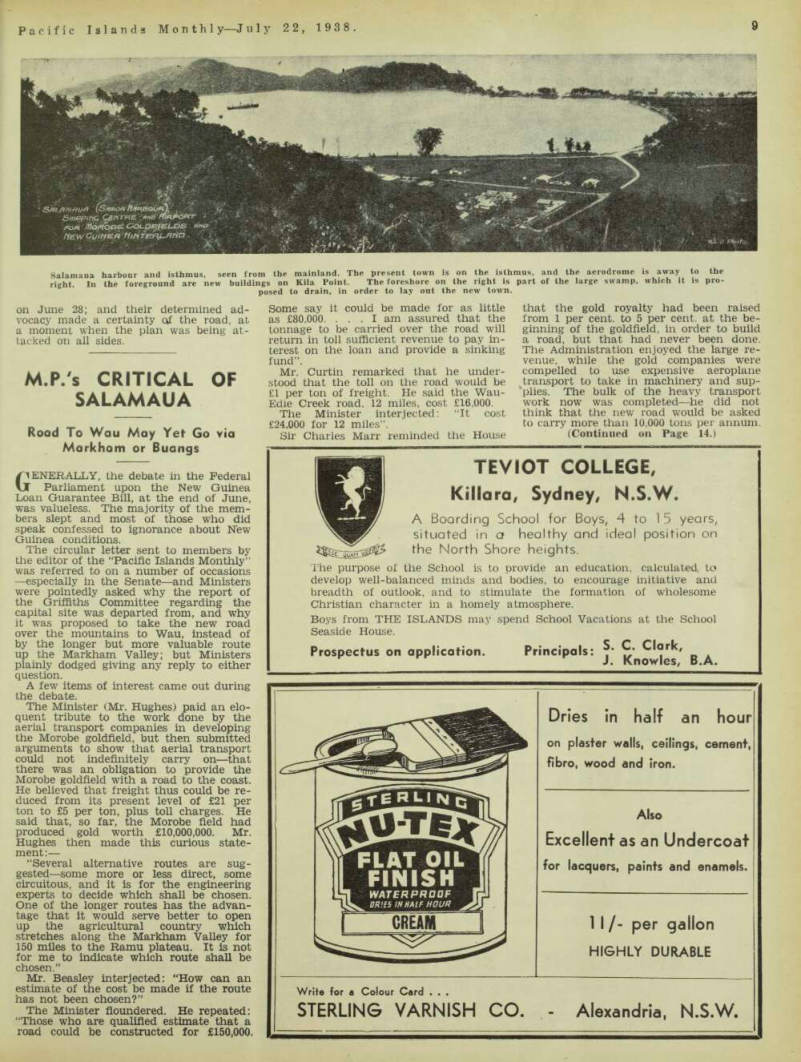
Salamaua
Rood To Wau May Yet Go via Markham or Buangs
GENERALLY, the debate in the Federal Parliament upon the New Guinea Loan Guarantee Bill, at the end of June, was valueless. The majority of the mem bers slept and most of those who did speak confessed to ignorance about New Guinea conditions.
The circular letter sent to members by the editor of the “Pacific Islands Monthly’’ was referred to on a number of occasions —especially in the Senate —and Ministers were pointedly asked why the report of the Griffiths Committee regarding the capital site was departed from, and why it was proposed to take the new road over the mountains to Wau, instead of by the longer but more valuable route up the Markham Valley; but Ministers plainly dodged giving any reply to either question.
A few items of interest came out during the debate.
The Minister (Mr. Hughes) paid an elo quent tribute to the work done by the aerial transport companies in developing the Morobe goldfield, but then submitted arguments to show that aerial transport could not indefinitely carry on—that there was an obligation to provide the Morobe goldfield with a road to the coast.
He believed that freight thus could be re duced from its present level of £2l per ton to £5 per ton, plus toll charges. He said that, so far, the Morobe field had produced gold worth £10,000,000. Mr.
Hughes then made this curious state ment:— “Several alternative routes are sug gested—some more or less direct, some circuitous, and it is for the engineering experts to decide which shall be chosen.
One of the longer routes has the advan tage that It would serve better to open up the agricultural country which stretches along the Markham Valley for 150 miles to the Ramu plateau. It is not for me to indicate which route shall be chosen.”
Mr. Beasley interjected: “How can an estimate of the cost be made if the route has not been chosen?”
The Minister floundered. He repeated: “Those who are qualified estimate that a road could be constructed for £150,000.
Some say it could be made for as little as £BO,OOO. ... I am assured that the tonnage to be carried over the road will return in toll sufficient revenue to pay interest on the loan and provide a sinking fund”.
Mr. Curtin remarked that he understood that the toll on the road would be £1 per ton of freight. He said the Wau- Edie Creek road, 12 miles, cost £16,000.
The Minister interjected: “It cost £24.000 for 12 miles”.
Sir Charles Marr reminded the House
that the gold royalty had been raised from 1 per cent, to 5 per cent, at the be ginning of the goldfield, in order to build a road, but that had never been done, The Administration enjoyed the large re venue, while the gold companies were compelled to use expensive aeroplane transport to take in machinery and sup ‘plies. The bulk of the heavy transport work now was completed—he did not think that the new road would be asked to carry more than 10,000 tons per annum. (Continued on Page 14.)
He questioned the construction estimate of £150.000.
Sir Charles Marr attacked the decision to place the capital at Salamaua. He urged that opportunity should have been taken to place the personnel of the Ad ministrative headquarters on the cool hill country. He defended the plan, under which it was proposed to place the capital near the Markham Valley, with a road running up the Markham Valley, con necting Salamaua and Lae with the Ramu tablelands, with a side road up to the Morobe goldfield. The grade would have been easier and the road would have had permanent value. He agreed that, while Salamaua had disadvantages as a place of residence, Lae lacked a sheltered har bour; but he pointed out that over 130,000
tons of mining machinery had been un loaded at Lae without accident or serious difficulty, and had been flown from there to the goldfield.
Sir Charles remarked on the agricul tural value of the Ramu-Purari table lands. He said that there is one man already established there with a cattle ranch from which he is supplying the goldfields with fresh meat. He also em phasised the great value of the timber in the interior districts of the mainland, both softwoods and hardwoods, and he commended a recent official decision to appoint forestry officers to survey the timber resources of the country. He urged a timber policy of conservation and re-afforestation. (It may be added, here, that it has been reported in Sydney that a strong group of Queensland timber interests has urged the Federal Government to construct the goldfields road, with a promise that the road will be freely used for developing the timber industry and bringing the timber out to the coast.) Interesting criticism of Mr. Hughes’ de cisions was offered by Mr. Hawker. He wanted to know why members had been given no prior opportunity of reading and studying the report of the Griffiths Com mittee, and no explanation of why that report had been thrown aside. He, how ever, had been able to examine the re port. and he found the following inter esting statement on page 26 thereof:— “The Administrator personally favours Salamaua as port and capital, or Sala maua as the port, and the capital at an inland site in one of the high river valleys”.
“The Administrator there referred to is General McNicoll,” said Mr. Hawker. “The opinion of any person who has had much contact with the residents of New Guinea
is that the opinion of General Griffiths would be much safer to follow than would be that of any other man who has been in charge there. ... I should very much like to hear the reason why the opinion of General Griffiths has been set aside and that of the present Adminis trator adopted.”
Mr. Hawker then gave, from official documents, a series of reasons why Sala maua should not be adopted—including the following: The site is subject to tidal waves; a tidal wave 30 ft. high swept that part of the coast in 1888; the dis trict around Salamaua, owing to the pre sence of extensive malarial swamps, has always been heavily infected with malaria of a particularly malignant type; there is not, in the immediate vicinity, land suitable for the building of the new town.
Mr. Hawker made the important point that the Griffiths Committee stated that “the mining community is quite favour able to Lae as the capital, provided a road is built to the coast at either Lae or Salamaua”. He urged that, before it was too late, the fullest consideration should be given to the alternative route to the goldfields, via the Markham Valley.
Various Labour members entered the debate, but they were mostly concerned in demanding guarantees from the Minister that the native labour engaged on the road would receive proper wages and conditions.
The Minister said that before the Loan Guarantee Bill could become operative it would have to be accepted in an ordin ance passed by the Legislative Council of New Guinea.
The debate in the Senate was much shorter, and more to the point. Senators generally urged that the Markham Valley route be closely considered before a final
decision was taken.
Senator Leckie asked this direct ques tion: “Once this Bill is passed, does it not become certain that the new capital of New Guinea will be at Salamaua, for the reason that the Government would not decide to incur this expenditure authorised by this Bill unless it had finally chosen Salamaua?”
Senator McLachlan (Minister in charge): “That is so.”
Senator Leckie thereupon proceeded to
attack the selection of Salamaua on the ground that the Government was making a grave mistake, both in the selection of the capital site and in constructing a road direct from Salamaua to Wau. He said that as a result of information received from people who had lived in New Guinea for many years he would oppose the Bill.
Senator Grant also opposed the Bill, on the ground that an important decision was being taken with undue haste and on wrong information.
The Minister acknowledged that there seemed to be a number of reasons against Salamaua; but, he said. Cabinet had sent Mr. Hughes personally to investigate, and that Minister had made certain decisions and recommendations.
In committee, Senator Johnston said “l do not think that the Minister dis closed whether the Government intends to consider the alternative route from Salamaua to Lae, and thence to Wau along the Markham River, or whether it has decided to adopt the direct route ”
The Minister: “The actual route has not yet been definitely determined. A survey is now being made by experienced surveyors.”