Fijian
pp. 58-60 · Read in the full issue
Passing of a Noted Fijian Chief Tokaiaigau, Centenarian, Goes to His Rest
By E. M. Pry.
ON February 25, in a brown peaceful village, nestling picturesquely at the foot of bush-clad hills on the island of Gau, there died the 100-years-old Fijian chief, Takaiaigau, As the last preparations were being quietly made to take the old chief to
his resting place, long drawn-out thun derous rolls were heard far away in the haze. All nature seemed to brood darkly before threatening to break into violent fury, for a storm was brewing. Outside the “bures” (houses) wisps of grey smoke curled upwards until beaten down again to lay like a pall over the stricken township.
The great funeral feast, to which most of the inhabitants of the island had contributed, was all in readiness.
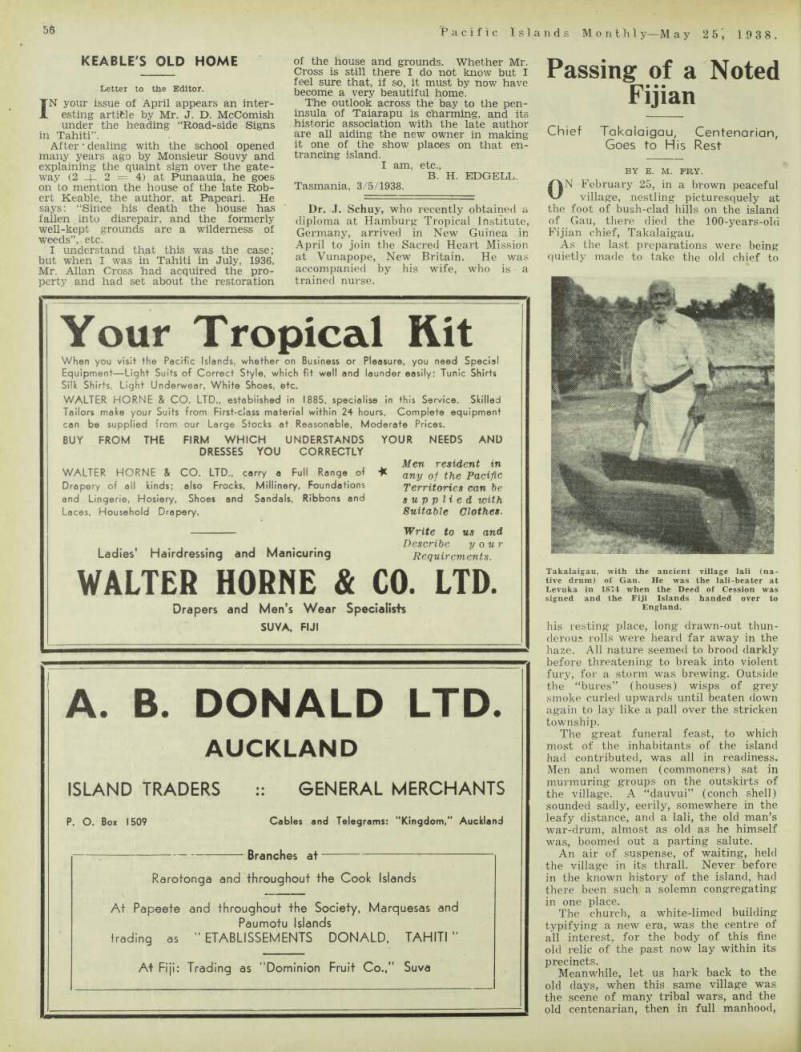
Men and women (commoners) sat in murmuring groups on the outskirts of the village. A “dauvui” (conch shell) sounded sadly, eerily, somewhere in the leafy distance, and a lali, the old man’s war-drum, almost as old as he himself was, boomed out a parting salute.
An air of suspense, of waiting, held the village in its thrall. Never before in the known history of the island, had there been such a solemn congregating in one place.
The church, a white-limed building typifying a new era, was the centre of all interest, for the body of this fine old relic of the past now lay within its precincts.
Meanwhile, let us hark back to the old days, when this same village was the scene of many tribal wars, and the old centenarian, then in full manhood,
Takalaigau, with the ancient village lali (na tive drum) of Gau. He was the lali-beater at Levuka in 1874 when the Deed of Cession was signed and the Fiji Islands handed over to England.
the prime mover of events. As a fierce warrior, he led willing followers against enemy neighbours, whom he finally conquered and so remained their recognised chief for the rest of his long, and ultimately peaceful life. Gone the way of all flesh were his boon con spirators in those savage times. Also, the peace-offering—a young girl in the agreement—who thus cemented that life-long allegiance from all subordinate tribes to ’one head chief.
Actively connected with outstanding events in the history of the Fiji Islands, Takalaigau, the last of her warriors, has also gone into the limbo of time.
No more will his stentorian voice be heat’d commanding this, and that; in citing the young generation to frenzied war-dance, then, in the common way of the aged, deploring that they lacked the vigour and artistry of their an
cestors, in the “good old days”.
In the church, the native missionary’s voice could be heard reading the first part of the familiar burial service. Then a deep silence as the cortege came into view outside. A cortege, distinguished by the presence of the District Com missioner (Commander Burrows), Ratu Edward Cakobau (one of the hereditary chiefs), and Mr. G A. Peck (police officer), whose official visit to the island co-incided with the date of the funeral.
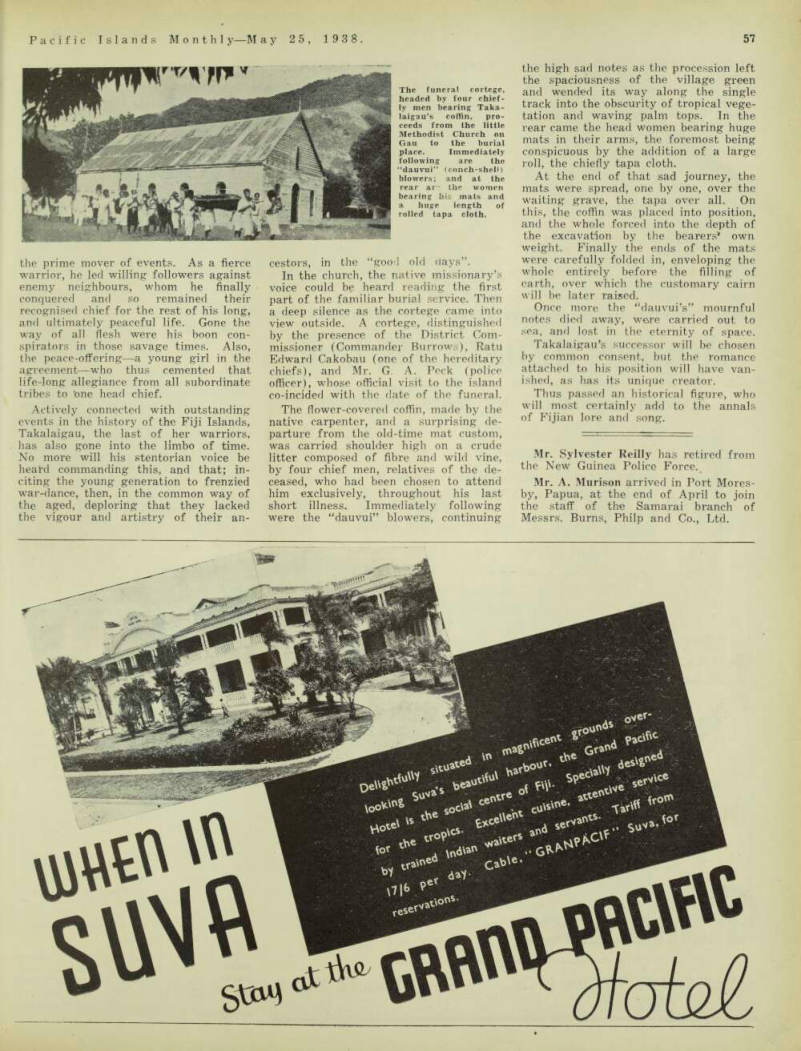
The flower-covered coffin, made by the native carpenter, and a surprising de parture from the old-time mat custom, was carried shoulder high on a crude litter composed of fibre and wild vine, by four chief men, relatives of the de ceased, who had been chosen to attend him exclusively, throughout his last short illness. Immediately following were the “dauvui” blowers, continuing
the high sad notes as the procession left the spaciousness of the village green and wended its way along the single track into the obscurity of tropical vege tation and waving palm tops. In the rear came the head women bearing huge mats in their arms, the foremost being conspicuous by the addition of a large roll, the chiefly tapa cloth.
At the end of that sad journey, the mats were spread, one by one, over the waiting grave, the tapa over all. On this, the coffin was placed into position, and the whole forced into the depth of the excavation by the bearers* own weight. Finally the ends of the mats were carefully folded in, enveloping the whole entirely before the filling of earth, over which the customary cairn will be later raised.
Once more the “dauvui’s” mournful notes died away, were carried out to sea, and lost in the eternity of space.
Takalaigau’s successor will be chosen by common consent, but the romance attached to his position will have van ished, as has its unique creator.
Thus passed an historical figure, who will most certainly add to the annals of Fijian lore and song.
Mr. Sylvester Reilly has retired from the New Guinea Police Force.
Mr. A. Murison arrived in Port Mores by, Papua, at the end of April to join the staff of the Samarai branch of Messrs. Burns, Philp and Co., Ltd.
The funeral cortege, headed by four chief ly men bearing Taka laigau’s coffin, pro ceeds from the little Methodist Church on Gau to the burial place. Immediately following are tho “dauvui” (conch-shell) blowers; and at the rear are the women bearing his mats and a huge length of rolled tapa cloth.
Mr. G. O. Higgins, general manager of Papua Oil Development Ltd., arrived in Australia early in May by the W.R.C.
Airlines plane from Port Moresby, on a short business visit, and returned a week later.
Rev. Dr. Thomas Macmillan, who re tired two years ago after a lifetime of missionary work in the Pacific for the Presbyterian Church, died at his home in Surrey Hills, Victoria, on May 10.
He was 70 years of age. Born in India and educated in Scotland, he went to the New Hebrides 41 years ago and laboured faithfully under the John G.
Paton Fund until he returned to Mel bourne in 1936. Dr. Macmillan is sur vived by a widow and four sons, one of whom is at present engaged in orni thological work in Noumea.