Adventurers Of Torres Strait
pp. 28-31 · Read in the full issue
Story of Deliverance Harry"-Murder of Penrose-How Dick Roche Disappeared-Mystery of Jackson's Death
BY C. R. SHELDON, OF DOBO, AROE ISLANDS.
ALTHOUGH this is a short account of men who pioneered and opened up portion of Dutch New Guinea, and shot Birds of Paradise there, I feel I am obliged also to relate the history of a pioneer who lived on Deliverance Island, because his life more or less depended and formed part of the lives of those pioneers of the Netherlands New Guinea.
Deliverance Island, which was dis covered and named by Captain Cook during his voyage of 1770, lies between Thursday Island, Australia, and New Guinea, and forms one of the boundary points of Australia. Very little is known about Deliverance Island. Cer tainly it received some prominence dur ing the war 1914-1918, on account of its close proximity to New Guinea, and the passages joining the Arafura Sea and the Coral Sea.
Deliverance Island is about 1000 kilo metres long by 400 kilometres wide, just a sandy stretch of land, low-lying and with practically no large trees, and is surrounded by sand-banks and coral reefs.
This island was uninhabited until, about 1893, a Danish sailor named Hen rick Enevold took up his abode there.
Very few people knew Henrick Enevold by that name, but he was widely known as “Deliverance Harry”, and until his death, it was generally thought he was a Frenchman.
Harry led a very lonely life, living chiefly on turtles, fish, wild birds, etc.
One of Harry’s best friends was the late Reg. Hockings, a pearler, of Thursday Island, and it was due to the late Mr.
Hockings’ forethought that about 200 coconut trees were planted on the island, as a stand-by, for water and food. De liverance Island is without water.
Again, Harry had to thank the late Mr.
Hockings for a 500 gallon galvanised iron tank and a galvanised iron house to act as a catchment for water.
Mr. Hockings did his utmost to per suade Harry to give up his life on De liverance, but Harry was “man-shy”, and much preferred to remain on his island with his dogs and cats.
Another great friend that Harry had was Dick Roche, of Merauke, a former shipmate, and in latter years Dick Roche made visits to Deliverance, on yearly trips to Thursday Island in his motor boat. It is only 187 miles from Merauke to Thursday Island.
During the South-east monsoons quite a number of pearling luggers from Thursday Island visited Deliverance Is land, taking shelter there during the strong blows, and to catch turtles, and hunt for their eggs. This was another source by which Harry received pro visions and heard all the doings of the outside world.
It was in November, 1928, when Dick Roche was on one of his periodical visits to Deliverance Island that he made a gruesome discovery. His friend Harry was dead, and had been dead for some time. Harry was discovered lying half inside and half outside the doorway of his hut, and the body was in a terrible condition. One of the arms was miss ing, being found some distance away from the body, and the body was muti lated in several places.
It is presumed that Harry hatl been too weak to recover after he had fallen in the doorway, and remained there until he died. Some time after his death, from what evidence was avail able, it appeared that Harry’s dogs had tried to drag the body away from the doorway. Dick Roche buried Harry on his little island and reported his death to the authorities at Thursday Island.
Such was the end of Henrick Enevold,
who for over 45 years knew of no other world than his own little island, and who, during his time there, befriended many a passing ship, and gave welcome to all.
Deliverance island is a wonder ful island for turtles, they come up on the beaches to lay their eggs, not creeping up in ones and twos, but in hundreds at a time. Further, they do not wait until the dead of night, but they come up any old time, as long as the water is fairly high.
In 1929, I was weather bound at De liverance Island on my way to Thurs day Island with Dick Roche, spending close on two weeks there. My children had great fun, riding the turtles down to the sea after they had finished laying their eggs.
A few Malay boys who were on the launch, instead of going to the bother of digging for these eggs, hit upon the novel idea of following the turtle to the place where she wanted to lay, and then placed their hats under the turtle and received the eggs direct from the turtle.
In 1929, Harry’s hut was still stand ing and it came in very handy for our forced stay at Deliverance Island. The water tank was more than acceptable, and after being cleaned out, it rained soon afterwards, so we had ample water for our needs.
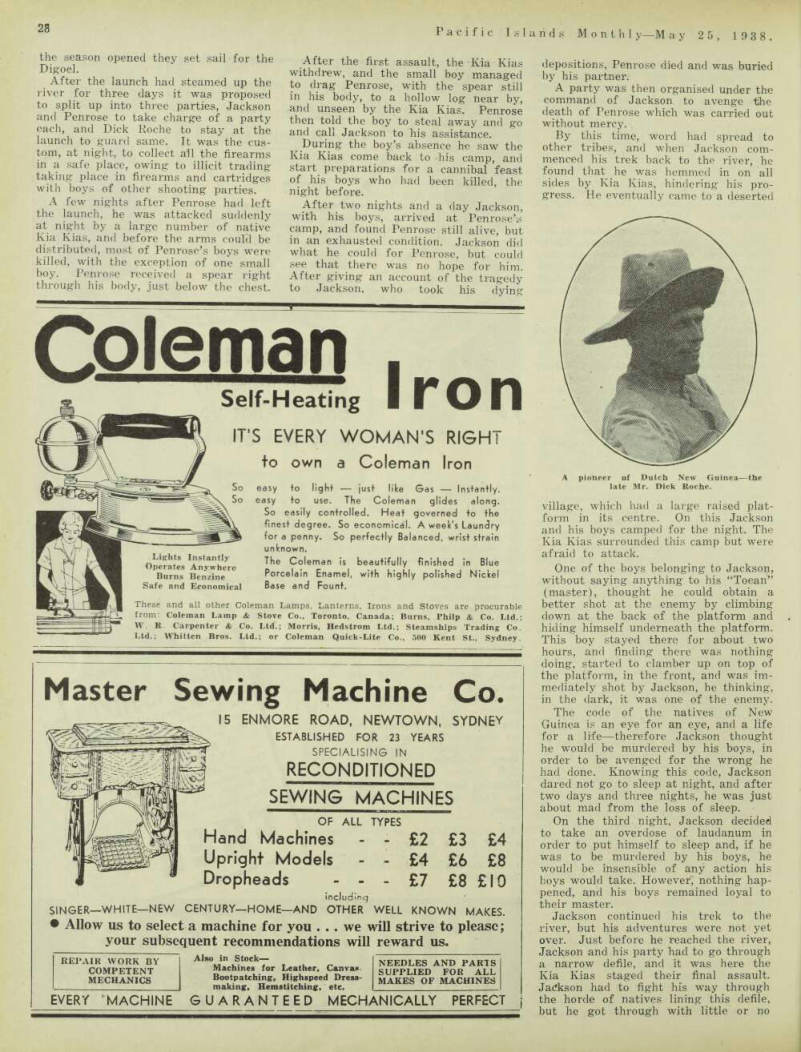
CLOSELY bound to Deliverance Is land was Dick Roche by his old shipmate Harry; but Roche—a New Zealander of Irish descent—was one of the pioneers of Netherlands New Guinea.
First in partnership with an Australian called Jackson, and later on joined by another Australian named Penrose, this trio formed the first expedition of white men as “bird shooters” for Birds of Paradise in Netherlands New Guinea.
They led the way, opened up new country, and others followed.
Every season this trio had to open up new hunting grounds, not because of the Birds of Paradise becoming shot out, or anything like that, but on account of Chinese shooting parties following in the wake of the Britishers, and shooting on, more or less, Roche and Co’s grounds. This necessitated the Britishers going every season further afield, breaking new ground, penetrat ing and exploring country where a white man had never been before. I refer mostly to the country surrounding the Eilander River and the upper portions of the Digoel River, where, in this dis trict in the years 1912-1916, the native Kia Kias were head hunters and canni bals, making immediate war, and hunting any strangers entering their country.
It may be a coincidence, but it is a fact, that these three pioneers met with peculiar deaths.
In the latter portion of 1912 Dick Roche and his party, consisting of Jack son, Penrose, and native boys (recruited from other portions of Netherlands New Guinea), sustained their first catas trophe. Earlier in that year, Roche had heard of new hunting grounds on the upper Digoel River, and as soon as
the season opened they set sail for the a?* ji i i i , , , ..
After the launch had steamed up the river for three days it was proposed to split up into three parties, Jackson and Penrose to take charge of a party each, and Dick Roche to stay at the launch to guard same. It was the custom, at night, to collect all the firearms in a safe place, owing to illicit trading taking place in firearms and cartridges with boys of other shooting parties. / eW after Penrose had left the launch, he was attacked suddenly at night by a large number of native Kia Kias, and before the arms could be distributed, most of Penrose’s boys were killed, with the exception of one small boy. Penrose received a spear right through his body, just below the chest.
After the first assault, the Kia Kias withdrew, and the small boy managed to drag Penrose, with the spear still in his body, to a hollow log near by, and unseen by the Kia Kias Penrose then told the boy to steal away and go and call Jackson to his assistance, During the boy’s absence he saw the Kia Kias come back to his camp and start preparations for a cannibal feast of his boys who had been killed, the night before.
After two nights and a day Jackson, with his boys, arrived at ' Penrose’s camp, and found Penrose still alive but in an exhausted condition. Jackson did what he could for Penrose, but could see that there was no hope for him After giving an account of the tragedy to Jackson, who took his dying
depositions, Penrose died and was buried by his partner.
A party was then organised under the command of Jackson to avenge the death of Penrose which was carried out without mercy.
By this time, word had spread to other tribes, and when Jackson com menced his trek back to the river, he found that he was hemmed in on all sides by Kia Kias, hindering his pro gress. He eventually came to a deserted
village, which had a large raised plat form in its centre. On this Jackson and his boys camped for the night. The Kia Kias surrounded this camp but were afraid to attack.
One of the boys belonging to Jackson, without saying anything to his “Toean” (master), thought he could obtain a better shot at the enemy by climbing down at the back of the platform and hiding himself underneath the platform.
This boy stayed there for about two hours, and finding there was nothing doing, started to clamber up on top of the platform, in the front, and was im mediately shot by Jackson, he thinking, in the dark, it was one of the enemy.
The code of the natives of New Guinea is an eye for an eye, and a life for a life —therefore Jackson thought he would be murdered by his boys, in order to be avenged for the wrong he had done. Knowing this code, Jackson dared not go to sleep at night, and after two days and three nights, he was just about mad from the loss of sleep.
On the third night, Jackson decided to take an overdose of laudanum in order to put himself to sleep and, if he was to be murdered by his boys, he w r ould be insensible of any action his boys would take. However, nothing hap pened, and his boys remained loyal to their master.
Jackson continued his trek to the river, but his adventures were not yet over. Just before he reached the river, Jackson and his party had to go through a narrow defile, and it was here the Kia Kias staged their final assault.
Jadcson had to fight his way through the horde of natives lining this defile, but he got through with little or no
A pioneer of Dutch New Guinea-the late Mr. Dick Roche.
casualties. He found Roche waiting at the launch and they immediately set sail for Merauke, where the murder of Penrose was reported to the Govern ment authorities. A party of soldiers immediately left for the scene of the tragedy, and many Kia Kias were killed.
The murderer was brought back to Merauke where he is still in captivity.
The body of Penrose was taken, to Merauke, where he was buried.
DICK ROCHE made numerous other expeditions, shooting Birds of Para dise, but when the Government closed the bird shooting and prohibited the ex portation of Birds of Paradise Roche and Jackson dissolved partnership.
Jackson went to British New Guinea, and Roche took up coconut planting about six miles from Merauke.
In order to increase his earnings, Roctie established a passenger service with his launch between Merauke and Thursday Island, and brought tourists and others across to Merauke. At one time he brought Captain Frank Hurley and his moving picture company, in order to “shoot” scenes for a moving picture, which required a true native setting.
In September, 1931, Roche proceeded to the Bian River, about 45 miles west of Merauke, in order to cut a new stern post for his launch “Somerset”. At that time, in Merauke, there was an Austra lian named Palmer, who had been given his parole by the Dutch authorities, as Palmer was “wanted” by the Austra lian police for stealing a motorboat from Cairns. Palmer accompanied Dick Roche to the B’’an River.
From the evidence supplied by Palmer, it appears that on the evening of September 15 Dick Roche was seen to step into one of the native dugouts and start paddling out to the centre of the river, using his hands as paddies.
A strong stream soon took the dugout out of sight, and from that day Dick Roche has not been heard of. His ulti mate fate has never been known.
Dick Roche, up to the time of his disappearance, was the best-informed man concerning conditions in his dis trict and did more exploring than any other European., I refer mostly to the country surrounding the Eilander River, Digoel River, and the Bensbach River.
He had many brushes with the Kia Kias, many narrow escapes from death at their hands, and, if his ex periences could have been written in book form, it would have made inter esting reading.
Jackson worked at many callings in British New Guinea, and eventually drifted to the New Guinea goldfields, where he met his death under peculiar circumstances. He was found out among the natives some distance from the gold diggings, shot through the head, and it was never proved whether he committed suicide, or was murdered by the natives.
The remarkable part about his death is that Jackson died within one week of the date when Dick Roche was reported missing.
Mrs. F. R. Croft left Sydney for New Guinea by W.R.C. Airlines plane on May 10 to visit her son, who is a patrol officer in the Morobe District.