American Naval Strength In
pp. 51-54 · Read in the full issue

The Pacific
Secret Ship and Aeroplane Manoeuvres on Enormous Scale
By John Williams
THE entire striking strength of America’s Pacific fleet—lss war ships, 600 warplanes and 80,000 officers and men—is being fully tested in Prob lem 19, this year’s war games which will not end until the first week of May.
Problem 19 is involving a new defence strategy which only a year ago had not been worked out in detail by America’s strategy board in Washington. It has caused the coining of a new term: aero naval strategy.
Work it out: More than 5,000 miles of sea separate California and Japan, traditional enemies, whose navies bristle before each other in much the same way as do the forts on the Franco-German frontier.
Few warships have a cruising range to make the round trip across this great ocean without refuelling. But between America and Japan there are lots of hitherto unimportant islands, many of which are admirably suited for conver sion into strategic air bases!
Consequently America is developing more than any other nation the per formances of navy patrol bombers, which to-day have such long range that America has shuffled the disposal of her surface ships and replaced the scouting advance tactics of destroyers with her latest high-speed bombers.
The destroyers, under the new strategy, keep in closer to the main fleet.
It is this new strategy which will be severely tested in this year’s war games.
America’s defence front against Japan is along a curving 5000 miles line that starts at the west tip of the Aleutian Islands (only 2000 miles from Tokio) down through the Hawaiian islands to American Samoa, which is adjacent to the territorial waters of British-owned
islands in the South Pacific Ocean.
The survey flights of Pan American Airways from Hawaii to Auckland
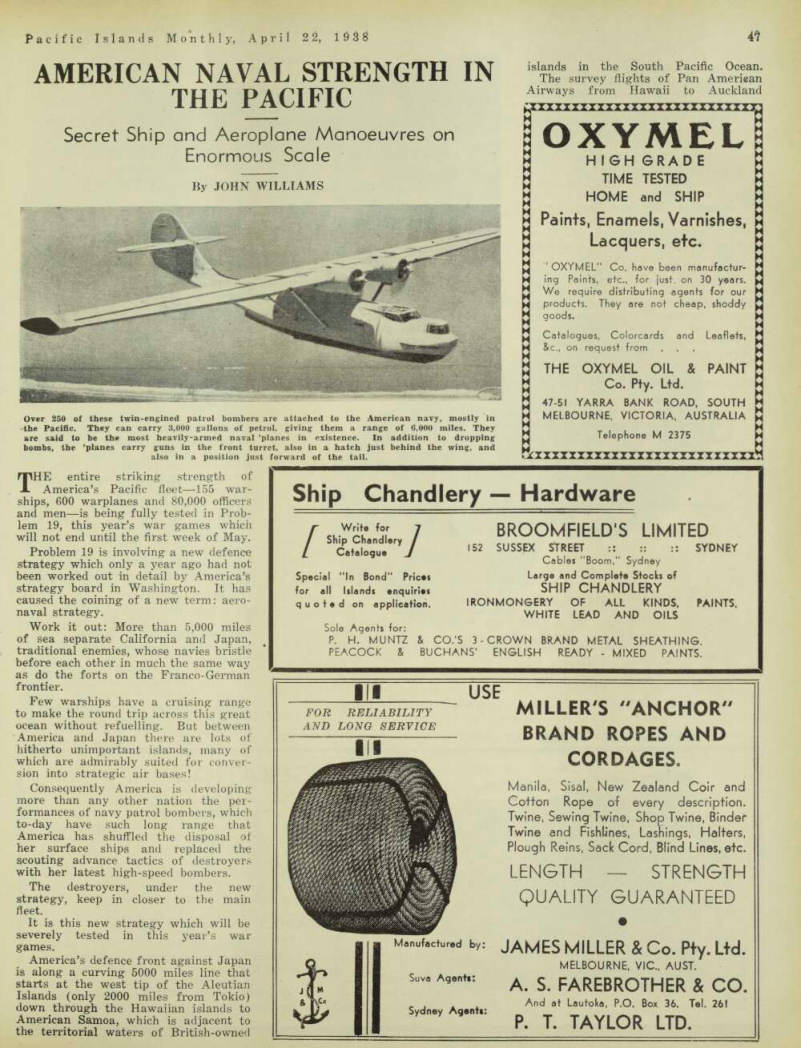
Over 250 of these twin-engined patrol bombers are attached to the American navy, mostly in the Pacific. They can carry 3,000 gallons of petrol, giving them a range of 6,000 miles. They are said to be the most heavily-armed naval ’planes in existence. In addition to dropping bombs, the ’planes carry guns in the front turret, also in a hatch just behind the wing, and also in a position just forward of the tail.
amply proved that Kingman’s Reef and Pago Pago, the landlocked harbour of American Samoa, are not ideally suited for all year operation of the latest (and contemplated) long range airboats.
John Bull and Uncle Sam swap tech nical details and it is obvious that, the better to protect their skins, their de fence plans in the Pacific must overlap and thus dovetail. If the two great white races can’t get together, what price the future of democracy?
Uncle Sam had been banking on Kingman’s Reef and Pago Pago, accord ing to ideas now some years old. How ever, aircraft have developed amazingly and they need more elbow room. So it was not surprising to observers that, in March, President Roosevelt (after two years’ dickering with the British Foreign Office), with one of his grand gestures, “annexed” Canton and Ender bury Islands in the Phoenix group, although for years these isles had been actively occupied and surveyed by Brit ish units!
Canton’s lagoon is fine for seaplanes, and Enderbury, with a little smoothing out, will make the finest natural air port for landplanes in the Pacific, so therefore Canton and Enderbury are the logical answer to Uncle Sam’s prayers for better bases than Pago Pago and Kingman’s Reef.
Thus, with Canton and Enderbury, Uncle Sam has more potent “teeth” in his front line against Japan. Another angle: John Bull was willing to let Uncle Sam have them because, to lighten the burden of defence costs and to greatly strengthen the united front against threats to democracy in the Pacific, it pays to toss a few islands into Samuel’s eager lap.
Naturally, the commercial airline aspects of the islands will be heavy pedalled by both nations in the same way as the same ballyhoo is used about Mid way and Wake Islands, the U.S. navy bases west of Hawaii.
Months before the actual tactics of Problem 19 were commenced, the U.S. navy, without much ado, set about sprinkling assignments of its latest patrol bombers at bases from Panama and the Mexican border right around to the Aleutian Islands. This involved long mass flights, during which world records were established for such move ments.
For example, squadron flights were made from San Diego to Panama (3080 miles nonstop) and to Hawaii (2500 miles nonstop). The new twin-engined sky cruisers demonstrated without the slightest fault or hitch, through fine and bad weather, a new power in guard ing remote frontiers, reducing great Pacific distances to mere 20-hour flights! These results will make the Aleutians and the new air bases being developed at Wake, Midway and John
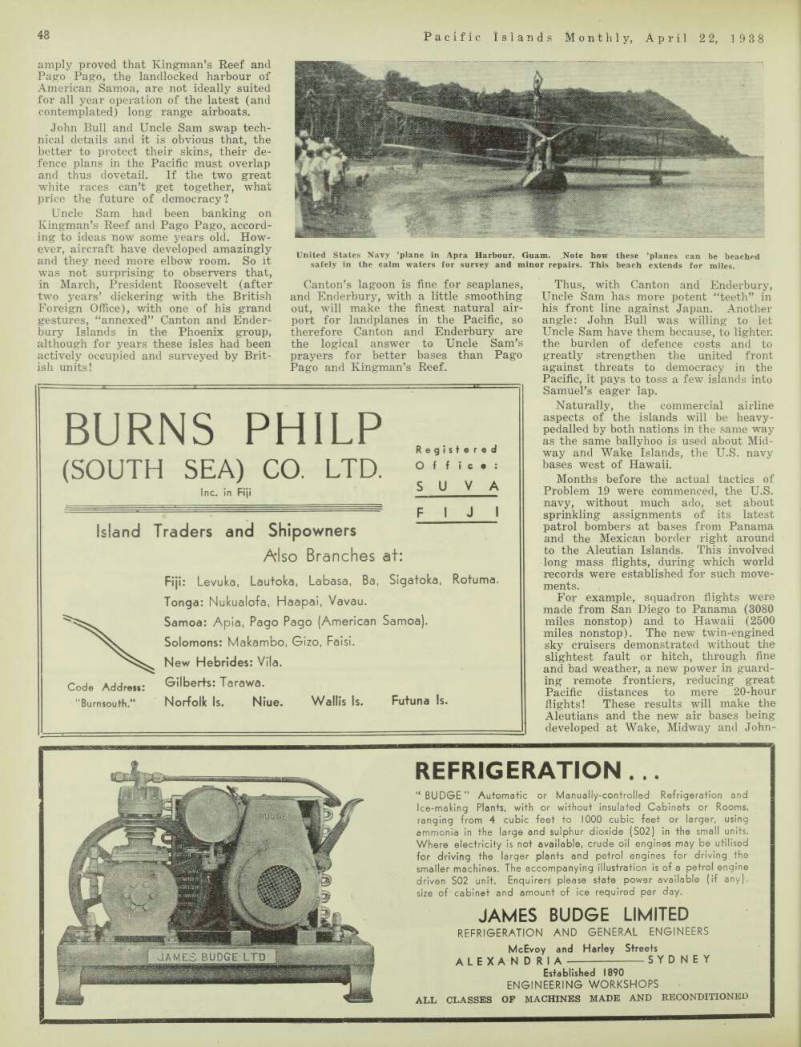
United States Navy ’plane in Apra Harbour, Guam. .Note how these ’planes can be beached safely in the calm waters for survey and minor repairs. This beach extends for miles.
ston Islands, play important roles in Problem 19’s tactics. And it is known that the fleet will examine, under simu lated war conditions, the potentialities of the undeveloped new bases at Can ton and Enderbury.
Most potent new move, however, and one which is an outright gesture at Japan, is the navy’s announcement that during Problem 19 exercises, and “probably for an indefinite period after ward”, a squadron (15 planes) of the latest navy bombers is to be stationed at Guam, America’s base right in the centre of Japan’s mandated islands!
The only harbour in Guam suitable for navy purposes is Apra harbour, upon which the village of Sumay stands. The harbour was declared a closed port by presidential order in 1912. From 1921 Jto 1931 the U.S. marine corps had am phibian defence planes stationed there, and to-day Pan American Airways uses the hangars, etc., built by the marine corps on the shore of Apra harbour.
Apra is only 1300 miles from Japan!
The navy patrol bombers to be sta tioned at Guam need not depend on shore facilities. They will be “shadowed” by self-contained aircraft tenders, super tugs which contain reserve gasoline stores and repair facilities. The bombers, moreover, are remarkably self-contained, which is only one of the features of their long-range patrol pos sibilities.
Where there is a navy air base there also is a highly technical weather re porting and radio system. Navy war games in the past have proven beyond ' any doubt the tremendous gains obtained from the expansion of weather fore casting facilities. Surface vessels that normally would run into bad weather for days on end, now can be forewarned and so dodge round storm areas in the same way as aircraft do.
This results in better economic (and thus strategic) use of all forces avail able.
These new navy bases, in a few words, mean that America is closing in, get ting closer and closer, tighter and tighter, with her encirclement of Japan’s threat to the democracies of the Pacific.
America has abandoned the “gentle man’s agreement” she had during the term of the London Treaty with Japan, which means that no more will the American forces remain behind or east of the 180th meridean, but will go ahead with establishing and maintaining a bolder front, much closer to Japanese territorial waters.
Problem 19, at the President’s per sonal orders, will sweep far south of the equator and virtually use British territorial waters, a potent gesture of friendship for Australia and New Zea land, two young countries'that may now plan and work for the future of Pacific democracy in the friendly shadow of America’s great striking power!
It is Mr. Roosevelt’s personal interest that is affecting other angles of Prob lem 19, too. He has ordered that, for the first time, newspaper reporters and photographers cannot accompany the fleet in the war games.
He has ordered complete silence of the the high command in connection with
details of the games in the Pacific.
He has ordered a large zone between the Mexican border and San Diego navy base as closed to all ships and aero planes, thus making it a secret zone in which will be carried out highly tech nical bombing tests with the latest de vices for greater accuracy.
He has ordered the storing of extra supplies, mainly of oil and gasoline, at such an out-of-the-way place as Pago Pago.
President Roosevelt means business.
He is the master of grand gestures.
Rev. Father F. Lyons, a missionary stationed in the Samarai district of Eastern Papua, is at present in Sydney, undergoing medical treatment.
Sir Maynard Hedstrom has been elected chairman of directors of Pacific Insurance Co. Ltd., Suva, in succession to Sir Henry Marks, C.8.E., who re cently resigned. Mr. B. H. Marks has been appointed a director of the Com pany.
Captain A. V. Johansson, of Messrs.
J. R. Clay and Co.’s schooner “Royal Endeavour”, of Papua, is at present on leave in Australia. Captain A. Mark well is temporarily in command of the vessel.
Mr. S. Smith, Accountant *of the Papuan Treasury Department, has been appointed Treasurer of the Territory in succession to Mr. E. C. Harris who last month retired on superannuation.
Miss Ivy Leslie, well-known in the Morobe District, New Guinea, arrived in Australia by the April “Montoro”.
She will shortly leave on a world tour, the greater part of which will be spent in travelling through Great Britain.
Mr. G. R. Edmonds, who has been acting as manager for the Union Steam Ship Co. Ltd. at Rarotonga, returned to New Zealand from the Cook Islands by the March “Matua” to take up duties at the U.S.S. Co’s Wellington office.