The Pomares Of
pp. 21-23 · Read in the full issue

Tahiti
Origin of Royal House
By W. W. Bolton, M.A.
THE Pomares were not always so named; it is but a secondary name chosen by the Head of the Family less than a century and a half ago.
The ancestors of that Head bore various names and dwelt on Fakarava, some 220 miles from Tahiti, one of the “Dangerous” (and, it must be confessed, cannibalistic) atolls of the present day Tuamotu Group.
Dates, of course, are impossible till white men appeared upon the scene; but, about 1600 A.D., one from Fakarava
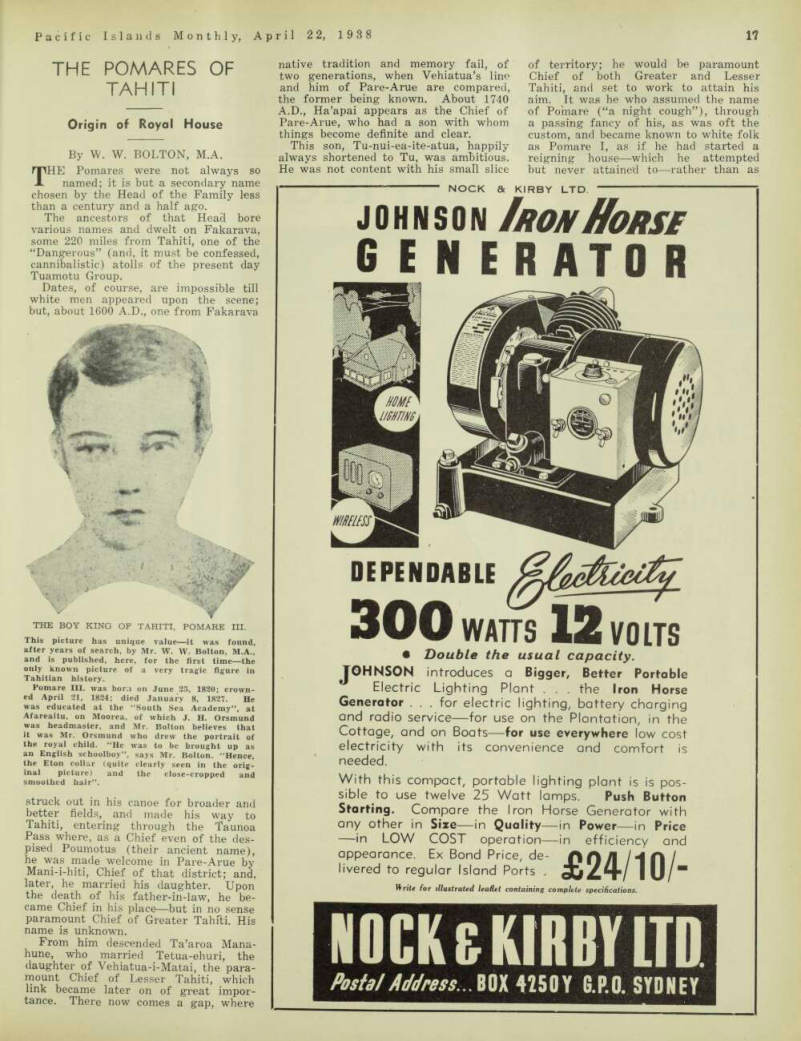
This picture has unique value—it was found, after years of search, by Mr. W. W. Bolton, M.A., and is published, here, for the first time—the only known picture of a very tragic figure in Tahitian history.
Pomare 111. was bora on June 25, 1820; crown ed April 21, 1824; died January 8, 1827. He was educated at the “South Sea Academy”, at Afareaitu, on Moorea, of which J. H. Orsmund was headmaster, and Mr. Bolton believes that it was Mr. Orsmund who drew the portrait of the royal child. “He was to be brought up as an English schoolboy”, says Mr. Bolton. “Hence, the Eton collar (quite clearly seen in the orig inal picture) and the close-cropped and smoothed hair”. struck out in his canoe for broader and better fields, and made his way to Tahiti, entering through the Taunoa Pass where, as a Chief even of the des pised Poumotus (their ancient name), he was made welcome in Pare-Arue by Mani-i-hiti, Chief of that district; and, later, he married his daughter. Upon the death of his father-in-law, he be came Chief in his place—but in no sense paramount Chief of Greater Tahiti. His name is unknown.
From him descended Ta’aroa Mana hune, who married Tetua-ehuri, the daughter of Vehiatua-i-Matai, the para mount Chief of Lesser Tahiti, which link became later on of great impor tance. There now comes a gap, where
native tradition and memory fail, of two generations, when Vehiatua’s lino and him of Pare-Arue are compared, the former being known. About 1740 A.D., Ha’apai appears as the Chief of Pare-Arue, who had a son with whom things become definite and clear.
This son, Tu-nui-ea-ite-atua, happily always shortened to Tu, was ambitious.
He was not content with his small slice
of territory; he would be paramount Chief of both Greater and Lesser Tahiti, and set to work to attain his aim. It was he who assumed the name of Poinare (“a night cough”), through a passing fancy of his, as was oft the custom, and became known to white folk as Pomare I, as if he had started a reigning house—which he attempted but never attained to—rather than as
THE BOY KING OF TAHITI, POMARE III.
the First Pomare, which is a very dif ferent thing.
And here it must be noted that there never was, nor is there to-day, any Tahitian word for either King or Queen, Prince or Princess. They have but one word, Arii, which is (e.g., Queen Pomare) always used. These titles are foreign importations. A paramount chief might be specially termed an Arii-rahi, and this was what the First Pomare was determined on.
Through his cousinly connection with Lesser Tahiti and the Vehiatuas, he se cured, without a fight, the paramountcy of the whole South Coast for a younger son of his, owing to a dispute among claimants; whilst a brother was Chief of the East Coast of Greater Tahiti; he himself being Chief of the North Coast.
But the west coast proved more than a match for him. Fight and struggle as he might, the Teva Clan of Papara, of the west coast, held him at bay. He died—suddenly, in a canoe, on Matavai Bay, opposite his home—a disappointed man, leaving his successor, a son, to achieve what he had failed to accom plish.
Pomare II left two children, a boy and a girl. The third died, an infant of months. Though the girl was by years the eldest, it was the boy, as yet also an infant, who was to be Pomare 111.
Dying as a boy, his sister became Queen, and the direct Pomare family of yesterday and to-day all follow from Queen Pomare IV, Her children were many, but those who survived ipfancy were six in number—five sons and a daughter. Of these, four left no issue.
The Royal Family of to-day, therefore, traces back to but Tamatoa and Terii tua, the Queen’s third and her youngest sons.
There seemed promise of a numerous progeny through Tamatoa, who had five daughters and a son, but son and eldest daughter died in their early years.
Teriitua was not so blest a parent. He had but one surviving child, a son Hinoi I, who married one of his Tama toa cousins, Teriimaevarua, whose off spring died. But he was not to be de nied. Nita brought him two boys: the eldest, Hinoi 11, who grew a very giant in stature, and Ariipaea, of normal size, but of abnormal geniality. The giant died childless, but his brother fortun ately has a progeny which are far too great in number for the Pomare Family ever to die out. Rather, it is likely to spread in ever-increasing numbers as the years mount up.
This is the present-day direct family of the Pomares, for Tamatoa’s other daughters married white men, English men, and though their offspring—to-day, but six adults in number—are within the circle of the Royal Family, they have ceased to bear the surname Pomare, as will their children, unless “adopted” into the Hinoi line.
There are, of course, sidelines of the family, for the first Pomare, as. has been noted, left another son than Pomare 11, besides a daughter, known to the first white men as Ovo; and, what is not known generally by other than French folk, children of an undi vorced man and wife are by French
Law bound to bear the husband’s name, whether they be his or not. He may refuse to “recognise” them as his, but they must needs bear his name. The actual parentage plays no part.
There may be such Pomares or other allied relatives or there may be not.
The matter is not of interest, however, to that student of the past or present who seeks only the direct line of the Pomares of to-day, coming directly through the Sovereignty and without dispute.
Mr. Habidullah Chaudhari, 8.A., LL.B., who has been in legal practice in India for ten years, arrived in Suva by the “Ganges” in March to join the firm of Hasan and Hasan, barristers at-law.