“Please Join Us In A Cold Beer!”
pp. 9-10 · Read in the full issue
How British Officials on Canton Island Greeted the American "Annexationists"
By John Williams.
Honolulu, Mar. 28.
AMERICA’S, “surprise” occupation of Enderbury and Canton Islands in the Phoenix Group of Central Pacific went off without a hitch, according to U.S. officials who returned to Honolulu to-day in the coastguard cutter “Roger B. Taney” after supervising the land ings and formal raising of the Stars and Stripes on each island and leaving behind permanent colonists.
Evidently the Americans expected Messrs. George Langdale and Tom Man ning, Colonial Office employees who have occupied Canton since August, 1937, to become “hot-headed” about the Ameri can landings because the fact that Messrs. Langdale and Manning, men long experienced in “outpost” work, were out standingly friendly has been played up by the American press.
The Britishers, indeed, completely rounded out their characteristic hospi tality by saying to the Americans: “Let’s leave the wrangling, if any, about the islands, to the diplomats of London and Washington, and toast our meeting in good old-fashioned beer, plenty of which we have in our refrigerator.”
However, the serious American party had work to do: landing their seven colonists, building materials, radio and meteorological instruments, and the ceremonial hoisting of the Stars and Stripes, which was done, according to the official handout, “at 9.05 a.m. on March 7”.
The Britishers stood by and watched the activities and Mr. Manning made a complete photographic record of it, which he has sent to Mrs. Manning in Auckland.
AFTER four hours of this, the Ameri cans at long last got on the right side of the British beer, the subtle effects of which were so friendship cementing that the Britishers went a step further and enticed the Americans into a poker game.
Anyhow, during the three-days’ stay of the American officials, a good time was had by all. No doubt Messrs. Lang dale and Manning will be ordering ur gent replenishments of their stores!
The Britishers told the Americans that they heard about the projected American occupation through listening in to an American mainland broadcast, but probably British official archives will tell a different story.
The Americans have set up a radio station and meteorological unit, a fea ture of which is the recording of upper air movements. Daily schedules will be maintained by Canton and Ender bury with the powerful Pearl harbour navy radio near Honolulu, in the same way as the American radio stations on Jarvis, Howland and Baker Islands have been reporting for years.
The Americans left on Canton are: Messrs. Alfred Voight, Hensley Towill,
Alex McGalliard, James Kamakaiwi, Henry Kaahea, Jacob Haili and Manuel Pires. Those on Enderbury are: Joseph Anakalea, Yau Fai Lum, William Tav ares and Harold Kim. As the names indicate most of these comparatively young men are part Hawaiian, part Chinese, part Portuguese. All come from Hawaii. It is significant to note that in her occupation of many Pacific Islands in recent years, all of which have definite strategic meanings al though the commercial aspects are be ing self-consciously emphasised, Ameri ca has not used any American-born Japanese, although such Japanese pre dominate in the population of the Hawaiian Islands.
It is a point that is not lost upon the sensitive Japanese.
THE Canton and Enderbury colonists will proceed with surveys of the best stretches for aeroplane landings.
Canton, of course, has one of the finest lagoons in the Pacific, which makes it an ideal clipper and navy patrol bomber base. It also has a stretch of hard coral sand for landplane use.
Enderbury is good for landplanes only.
Captain Perry 0. Paxon, of the U.S. army engineers, accompanied the
Britain and U.S.A. now jointly, and quite harmoniously, occupy Canton and Enderbury Islands valuable airways stations in the Phoenix Islands. A “condo minium” formula, it is believed, has been worked out.
Mr. Williams, in this article, gives some sidelights on the American “occupation”—which history will regard as one of the most remarkable diplomatic in cidents in the Pacific.
expedition and he directed the routine of work that will be followed. Mr.
Frederick E. Edgecomb, supervisor of the U.S. 19th Lighthouse District, with headquarters in Honolulu, also landed on the islands and chose sites for navi gation lights which America will build as soon as possible.
It is said that the navy “will make a very exhaustive examination” of Ender bury and Canton during the current war games of the U.S. Pacific fleet, which has announced its intention of going en masse to the vicinity of American Samoa.
Sensational stories, of course appeared in the American press about the occupation of the islands, and even Congressional members claimed that the British colonists had despoiled the American tablet on Canton (which was set “in memory of America’s war dead” by the American sun eclipse ex-
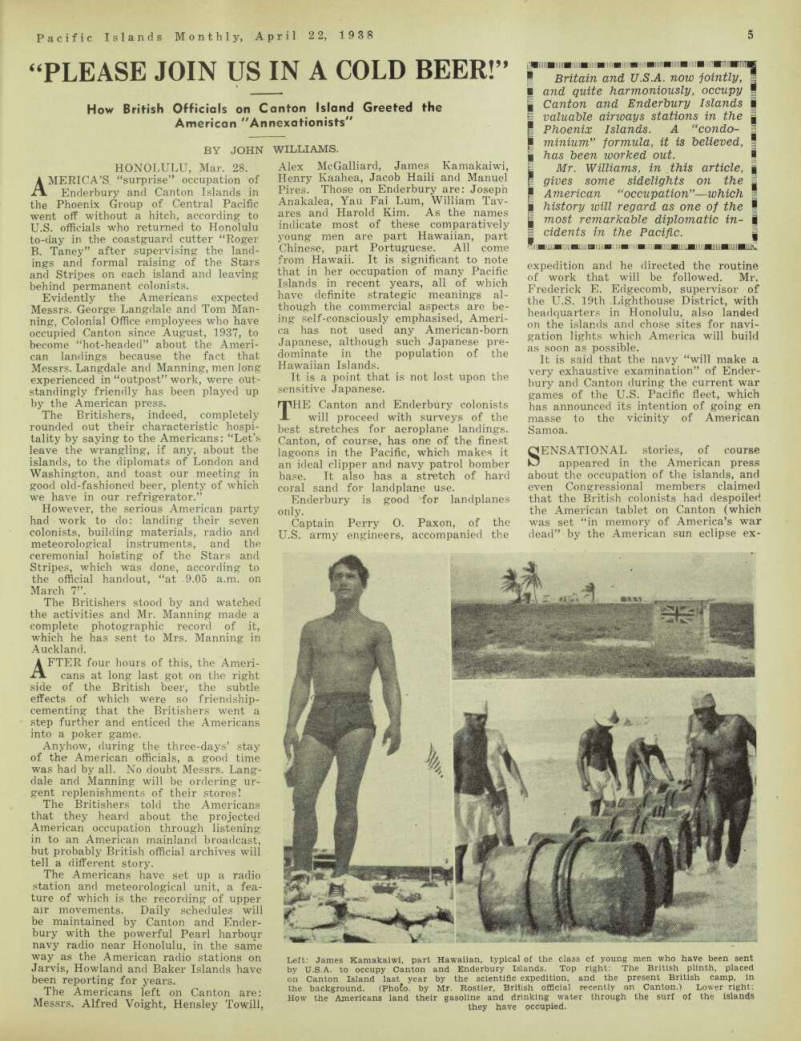
Left: James Kamakaiwi, part Hawaiian, typical of the class of young men who have been sent by U.S.A. to occupy Canton and Enderbury Islands. Top right: The British plinth, placed on Canton Island last year by the scientific expedition, and the present British camp, in the background. (Photo. by Mr. Rostier, British official recently on Canton.) Lower right: How the Americans land their gasoline and drinking water through the surf of the islands they have occupied.
pedition last year). These entirely base less statements are typical of the super ficial anti-British sentiment in America.
Officially, of course, America respects Britain. The American “annexationists” emphasised the fact that they did not molest the British flag they discovered flying on Enderbury.
The “Honolulu Advertiser” carried a typical story in which it panned the British, and the local British consul in particular, for attempting to question the right of the American sun-eclipse party in using the Phoenix Islands.
However, the consul, Mr. A. A. L.
Tuson, informed the “Advertiser” that their story was baseless, that he had not contacted the eclipse expedition at all.
MR. BOAKE CARTER, a naturalised American of British birth, who now is one of the leading news and radio news commentators in America, rapped President Roosevelt’s executive order which caused the occupation of the islands.
Asked Mr. Carter: “. . . Under what authority of the Constitution does the executive issue a ukase to take over new territory so blandly? His secretary may be superficially correct, that the annexation has nothing to do ‘with war plans’, but actually every additional is land we as a nation possess to ourselves in the Pacific is an additional stick of war dynamite thrust willy-nilly into the hands of American citizens. When the statesmen (?) of Washington issue orders picking up new territory, United States citizens are obligated to defend those islands whether they like the idea or not . . .”
Washington was swamped with re quests rrom adventurous Americans, who want to see the fabulous South Seas and play a minor role in history making, but Government officials, who received more than 100 applications on the first day, have announced that no more colonists are required for Canton and Enderbury.
I LEARN from Washington sources that the Government has prohibited Pan American Airways from using Pago Pago and Kingman’s Reef as bases in a passenger and air mail ser vice to New Zealand from Hawaii ow ing to unsatisfactory aspects of the bases as all-year operating points.
Meanwhile, the company went ahead and surveyed and okayed Rose Island, an atoll and most easterly of the Samoa Group, 150 miles east of Pago Pago.
If Pago Pago is too landlocked and small for clippers it also is too small for navy patrol bombers; and, putting two. and two together, this explains America’s hurried sharing of Canton with Britain. (This is not in accord with statements made recently by Pan American Air ways.—Ed. P.T.M.) Pan American will be permitted to use Canton, as will any British or American airline company. Imperial Airways are scheduled to make a trans-Pacific survey flight from Auckland to Canada via Canton and Hawaii in May-June next.
It isn’t much use the American press
becoming excited about Canton. No doubt John Bull has said to Uncle Sam: “Sam, if you want better air bases in the Pacific, more and more to check Japanese moves in the Pacific, I’ll move up a bit and let you in”.
And this is what Uncle Sam is doing methodically. Outwardly there will be diplomatic conversations, furrowing of brows, and protests from Japan. But what can Japan do about it? She, after all, is a past mistress at grabbing territory. Mr. Cordell Hull can make all the tactful denials he likes about secret agreements, but British and American
interests esneciallv in tC pS T
nnr/llpl 1 S°
parallel (to use the latest diplomatic term) more and more, and it will be “God help both countries the day they detour and part”.
■bSLrt. E "£ l ”a.rpS
Pi*™, ft. SSS
moves destined.