Sydney-N. Guinea
Airmail
No Start Yet—Aerodromes Not Ready
AT the moment of going to press, no one knows when the new airmail service between Sydney and New Guinea will be commenced.
The contractors (Messrs. W. R. Car penter and Co. Limited) have had their De Havilland machines and expert staff ready for several weeks; but the Com monwealth Government is still fumbling and footling over its part of the job— namely, that of providing adequate radio equipment and meteorological service at the principal stations en route, especi ally Cooktown, Port Moresby and Sala maua.
It was originally arranged, when ten ders were called in 1937, that the ser vice should commence in January, 1938.
Messrs. Carpenter & Co. Limited pur chased their aeroplanes and made their arrangements accordingly; but the Fed eral officials just muddled and dithered.
By the end of the year it was seen that there was no likelihood that they would have the aerodromes ready; and the date for the opening of the service was post poned from month to month.
In March, April was confidently an nounced; but. to-day, workmen are still busy on the installation of equipment at Salamaua and Cooktown, while, so far as can be learned, the erection of the radio masts at Port Moresby has not even been commenced.
On April 14, in reply to pointed en quiries by the “Sydney Morning Her ald”, the Commonwealth Minister for Defence stated that “the Sydney-New Guinea airmail would open in the first week in May”. Those in touch with the situation simply laughed. This, they said, was typical politicians’ bluff —there was no chance of the aerodromes being properly equipped by the end of the first week in May.
Meanwhile, the contractors are doing what they can. They are using their pilots and their machines for “survey” flights, which are being regularly carried out between Sydney and Rabaul, and a few passengers and some cargo have been carried. This does not alter the fact that the air--fleet and personnel are semi
idle, and a claim upon the Common wealth for compensation may be expect ed. The three De Havillands cost about £50,000; and, in aircraft, there is one huge overhead item which goes on whether the machines are idle or not.
That is obsolescence, and it represents probably 20 per cent, per annum or £lO,OOO per annum in the case of the Carpenter fleet. These machines are ob solete at the end of five years.
The inefficiency of Australian aviation control can be seen in other directions.
There is still no sign of the Australian- New Zealand air service; while the com mencement of the London-Sydney flying boat service, owing to Australia’s failure to provide suitable stations en route, is not now expected before October.
Mr. V. Gordon Johnston, who for 20 years was an employee of the Colonial Sugar Refining Company Limited in the Fiji Group, died suddenly in Sydney in April.
Mr. A. J. Peadon, of Ramu, New Guinea, joined Mrs. Peadon in Sydney by the April “Neptuna”. His gold claim, situated just on the border of unprotect ed country, is one of the richest in the whole territory.
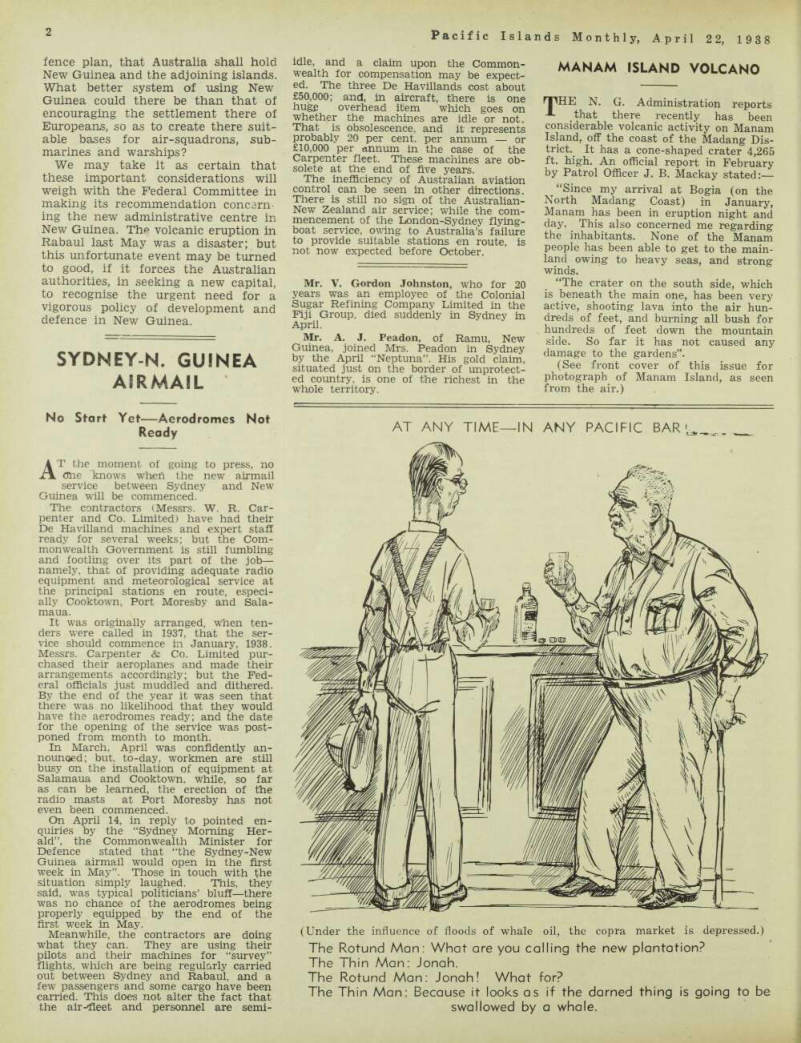
(Under the influence of floods of whale oil, the copra market is depressed.) The Rotund Mon: What are you calling the new plantation?
The Thin Man: Jonah.
The Rotund Man: Jonah! What for?
The Thin Man: Because it looks as if the darned thing is going to be swallowed by a whale.