Misima Gold
pp. 38-39 · Read in the full issue
Progress of Companies On Rich Little Island In South Eastern Papua
From Our Own Correspondent
Misima, Oct. 28.
T*HE gold mining activities on Misima, * Eastern Papua, besides putting the island on the investors’ map, have done
a great deal to bring its small commun ity into closer contact with the outside world.
Nowadays a regular mail and cargo steamer service is carried on by Messrs. Burns, Philp and Co. Ltd.’s vessel Matoma (65 tons) which makes two trips from Samarai after the arrival of each Macdhui and Montoro. Other vessels call at irregular intervals.
A small radio station at the port, Bwagaoia, keeps direct communication
with Port Moresby and Samarai. This is of great assistance, as breakages for the mines can be ordered to catch the first boat from Australia.
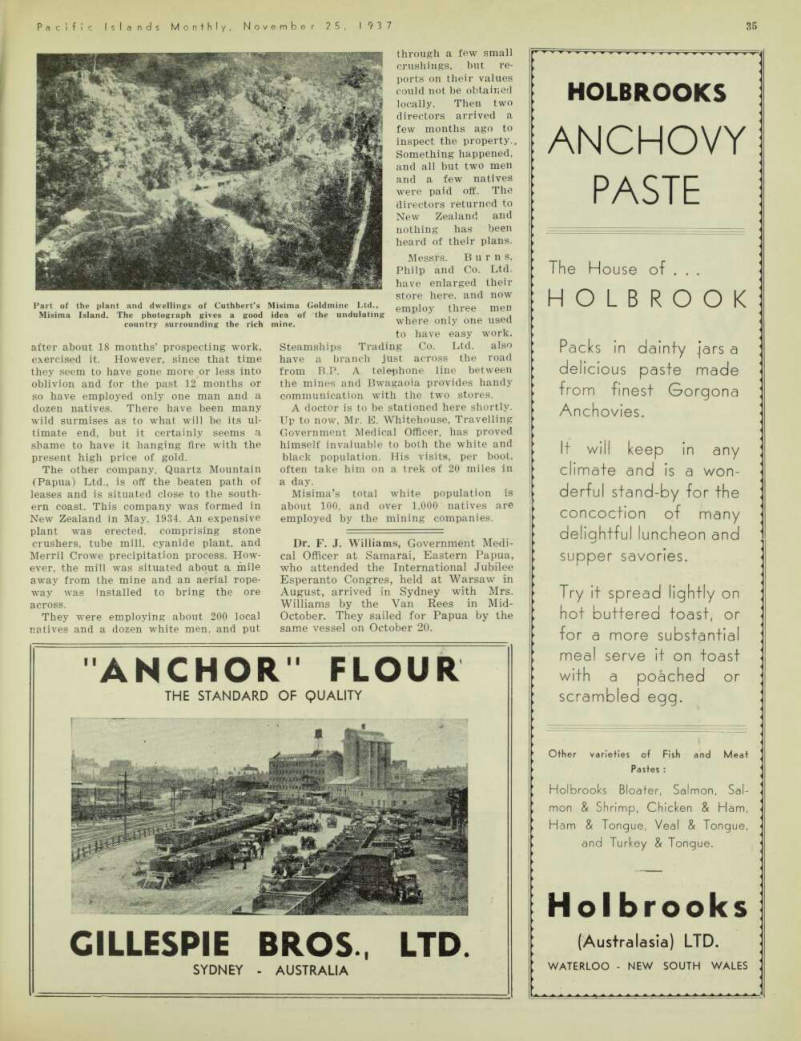
A motor road of a sort links the port with the mines. In most places this is just wide enough for one truck—driving over it being regarded as an act of hero ism. The country is so un dulating that it has been said that if it was rolled flat to a foot above sea level, it would be larger than Aus tralia! Consequently road making proves one of the greatest problems of the companies, and one of the heaviest expenses is keeping trucks in good order.
At present four companies are in operation.
Cuthbert’s Misima Gold Mine Ltd. is the only one producing. It employs about 30 white men and about 500 natives, mainly recruited from Goodenough, Nor manby, and Fergusson Islands. About 2,000 tons of ore a month is treated in a 20-head mill. This monthly tonnage is gradually being increased until, it is es timated, eventually 3,000 will be reached.
The ore is novel in the fact that there is no coarse gold, obviating the necessity for amalgamation, and no base metals, alleviating the troubles of the cyanider.
The lode itself runs in a north and south direction and Cuthbert’s have picked the centre. As the hills are so steep, no shaft sinking is thought of and the tunnel on the level of the mill site gives about 500 feet of backs. As the lode ranges from 12 to 40ft. wide mining is rather a problem in the soft country, and necessitates ample supplies of timber —all of which is procured locally, being hauled by motor trucks of the six-wheel type.
Adjoining the northern end of Cuth bert’s leases are those of Gold Mines of Papua Ltd. This Company has done a great deal of development work, and has, according to ail accounts, the same values as in Cuthbert’s. A 20-head mill is being erected there with a cyanide plant. All the machinery is on the job and the Company should be crushing within six months. Employed there are about 30 whites and 400 natives.
On the Southern end of the leases are those held at one time by Misima Gold Reefs fN.G.) N.L. Th* Oroville Dredging Company held an option over these, and
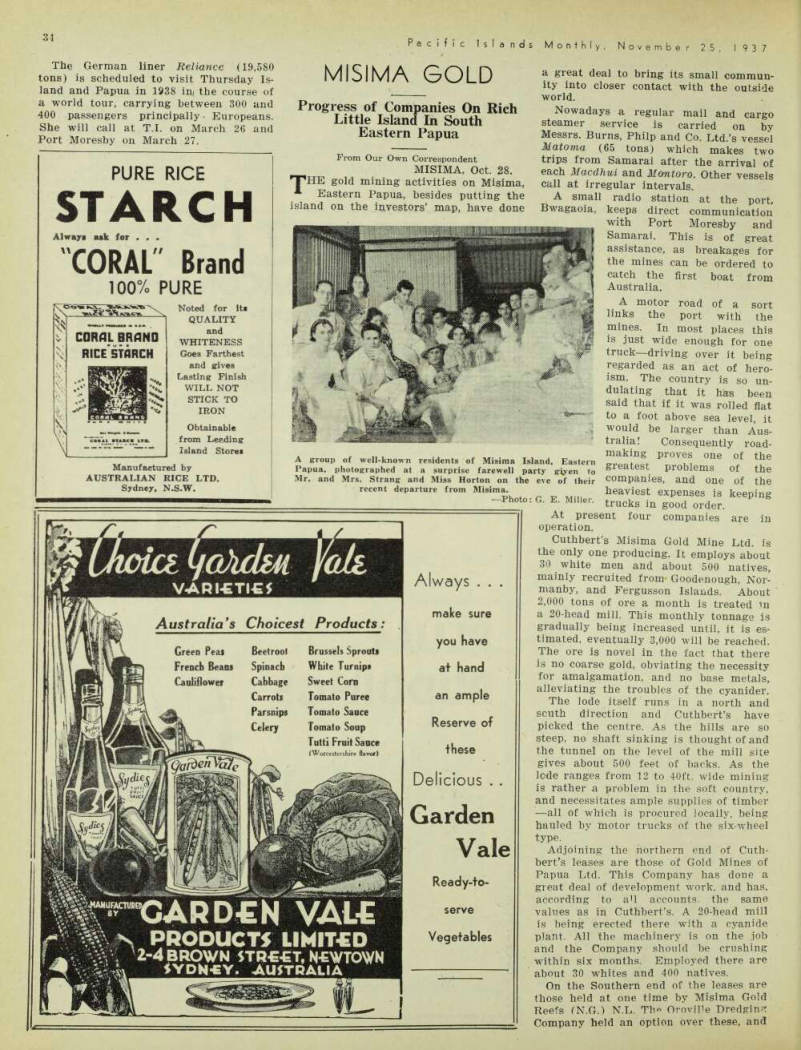
A group of well-known residents of Misima Island, Eastern Papua, photographed at a surprise farewell party given to Mr. and Mrs. Strang and Miss Horton on the eve of their recent departure from Misima.
Photo: G. E. Miller.
after about 18 months’ prospecting work, exercised it. However, since that time they seem to have gone more or less into oblivion and for the past 12 months or so have employed only one man and a dozen natives. There have been many wild surmises as to what will be its ul timate end, but it certainly seems a shame to have it hanging fire with the present high price of gold.
The other company. Quartz Mountain (Papua) Ltd., is off the beaten path of leases and is situated close to the south ern coast. This company was formed in New Zealand in May, 1934. An expensive plant was erected, comprising stone crushers, tube mill, cyanide plant, and Merril Crowe precipitation process. How ever, the mill was situated about a mile away from the mine and an aerial rope way was installed to bring the ore across.
They were employing about 200 local natives and a dozen white men, and put
through a few small crushings, but re ports on their values could not be obtained locally. Then two directors arrived a few months ago to inspect the property.
Something happened,
and all but two men and a few natives were paid off. The directors returned to New Zealand and nothing has been heard of their plans.
Messrs. Burns, Philp and Co. Ltd. have enlarged their store here, and now employ three men where only one used to have easy work.
Steamships Trading Co. Ltd. also have a branch just across the road from B.P. A telephone line between the mines and Bwagaoia provides handy communication with the two stores.
A doctor is to be stationed here shortly.
Up to now, Mr. E. Whitehouse, Travelling Government Medical Officer, has proved himself invaluable to both the white and black population. His visits, per boot, often take him on a trek of 20 miles in a day.
Misima’s total white population is about 100, and over 1,000 natives are employed by the mining companies.
Dr. F. J. Williams, Government Medi cal Officer at Samarai, Eastern Papua, who attended the International Jubilee Esperanto Congres, held at Warsaw in August, arrived in Sydney with Mrs, Williams by the Van Rees in Mid- October. They sailed for Papua by the same vessel on October 20.
Part of the plant and dwellings of Cuthbert’s Misima Goldmine Ltd., Misima Island. The photograph gives a good idea of the undulating country surrounding the rich mine.