Cotton-Growing By Japanese
pp. 22-25 · Read in the full issue



In Dutch New Guinea
Small Group Have Proved Possibilities of Industry
jyjAOT fantastic reports about Japanese have V bPPn r °n tl hr w DutCh • N6W Guinea pnpp eB f* clall y m re f er ' ence to cotton-growing there by a Japantherefore, we are glad to vnblish the following article by Mr. F. T. lan^'i^tlT 71 ' h \ m lU Gtrecht ’ Hol ' and, for this journal , on September 27.
Mr Maryn, as an official of the Netherlands Government, recently visited Papua and the Mandated Territory , and he then walked right along the north coast of New Guinea and inspected the territories to which he refers.
"DUBLIC interest in cotton-growing on ■*“ the north coast of Dutch New Guinea is increasing, both in Holland and in the Dutch East Indies. People begin to realise that there may be good investments there, and the Dutch Government recently sent out a commission to study possibilities.
In the meantime, a Japanese company has been for several years growing cotton in this area. Dutch New Guinea has many attractions for Japan in this respect. Cotton is the most important of all Japanese imports (400 million yen per year) and if it should prove possible to get part of the yearly needs from Dutch New Guinea, this, especially as regards buying and transport, should be more advantageous and easier than the pur-
chasing of the necessary quantity in India > or North and South America, countries all much farther away from Japan.
A Japanese trader, living near the village of Sarmi, on the north coast of Dutch New Guinea, some time ago made, with very good results, a small test gar den of cotton. This probably is the reason why the Nanyo Kohatsu Kaisha (South Sea Development Co.—this is the name of the company interested in D.N.G.) at first tried to start a cotton plantation near this village. They therefore applied to the Dutch East Indian Government to get a lease of 3,500 hectares in this dis trict; at the same time they applied for a second lease of 2,000 hectares in the Momi district (50 miles south of Mano kwari). Added to these requests was a memorandum in which the company gave a further explanation of future plans and asked for various facilities, According to this memorandum, the Nanyo Kohatsu intended to divide their leases into small areas of five hectares each, and every such part would be handed over to a Japanese farmer who, with the assistance of four or five native families, would open up these grounds for cotton growing. In the long run, the company said, the number of Japanese settlers might be less than one family
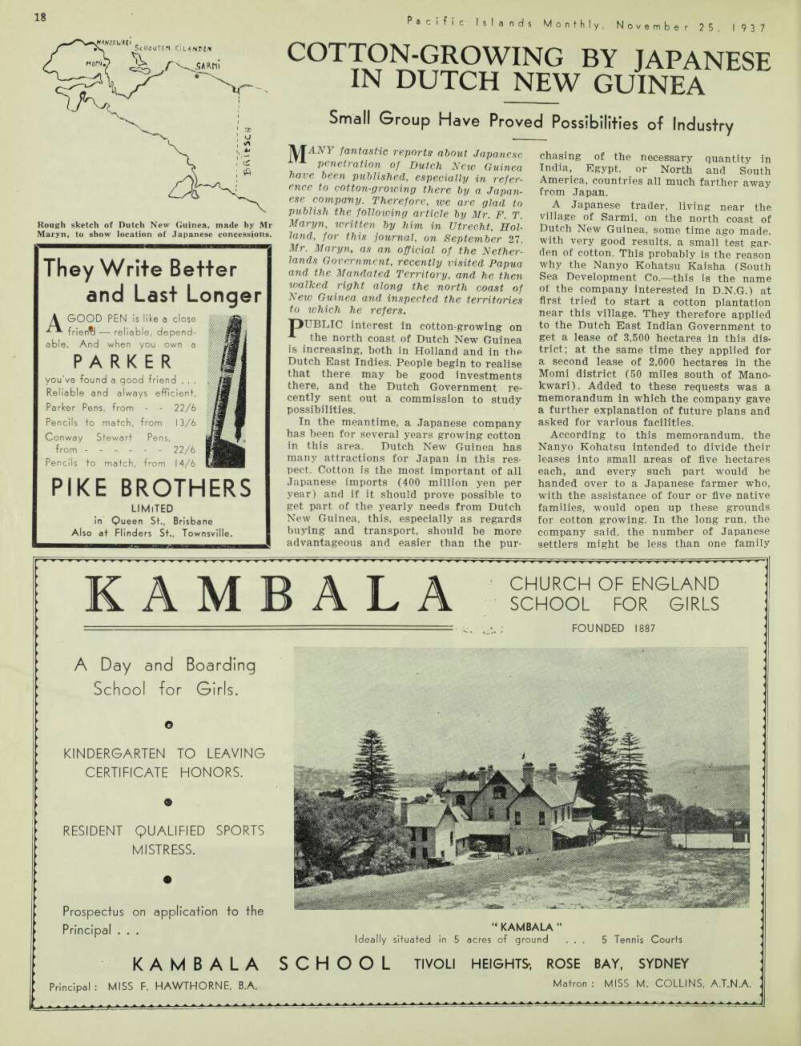
Rough sketch of Dutch New Guinea, made by Mr Maryn, to show location of Japanese concessions.
per five hectares, but in the first period, until the natives understood the culture, this number was deemed necessary.
It is easy to see that if the concession had been granted in this form, and if the Dutch East Indian Government had agreed with the suggested way of exploitation, a very important—and m companson to the number of Dutch residents, an overwhelming immigration of Japanese subjects would have taken pi ace> WELL, the concession has not been granted in this form. The leading
thought of the Dutch East Indies Govern ment apparently has been that the Japan ese company, before being regarded as serious applicants for such a large area, h a( ] prove and put into practice some o£ thejr plans the design 0 t which, as explained in the memorandum, was somewhat idealistic , So > for the Present, the Nanyo Kohatsu as been given two leases, one in the Sarmi district and one in the Momi dis trict, each of 300 hectares, with the pros pect of possible extensions as soon as
Top: The houses built by the Japan ese for the native labour at Momi.
Bottom: The cotton-cleaning factory.
areas allotted to them have been brought into culture.
It was proved, very soon, that the resfrictions made by the Government were justified. In clearing the Sarmi lease, the condition of the soil proved absolutely
unsuitable for cotton growing. In the middle of the concession was a large sago-swamp and the ground water was at various places not more than one foot below the surface. So all work was stopped and the native labour—at first 120 coolies—was dismissed. That conces sion is now deserted.
A T Momi, the Japanese company had better luck. The quality of the soil was very satisfactory, which is shown by an average crop of 2,5001b5. of cotton per hectare. The grade of the produce is estimated, both in Japan and in Hol land, as to be of first quality.
These results induced the company to extend their interests, and at the pre sent moment 700 hectares is cleared, 200 of which were planted with cotton in May of this year.
The possibilities of Dutch New Guinea are not yet sufficiently known to say that the Japanese, by taking up the Momi
valley, have taken possession of the best part of the country. But in visiting the estate it is easy to ascertain that they have assured themselves of an area ex tremely suitable for cotton growing. For there are, in this respect, many other facts that play a part.
The most important of these facts are rainfall and labour. As to the first, it is necessary that during the picking of the cotton (that is, in November) little oi no rain is falling. And this is the case in the Momi. valley.
The possibility of obtaining sufficient labour is of great importance. In the planting period, but especially in the picking-time, it is desirable to have, for about one month, a numerous labour force. In this respect the Japanese es tate is situated very favourably, being only on one day’s distance from the Schouten Islands, the population of which is willing to work and is generally employed on the estate. This labour is
Top: The experimental garden at Momi. Bottom: Drying and sorting the cotton at Momi.
available without any costs of recruiting worth mentioning. Every planter will understand how great an advantage this means; all the more, as recruiting in Java would probably amount to about £l5 per head.
However, not everything is going smooth and easy for the Japanese plan ters. Together with the first cotton crop, one of the most dreaded pests has made its appearance—viz., the pink boll-weevil.
This weevil attacks cotton plants and cotton seed, and causes great damage.
The destroying of these insects has been taken in hand scientifically, and with great energy, and no costs have been spared to assure a total extermination.
Considering the results the Japanese obtained with cotton growing in Dutch New Guinea, the conclusion must be that they succeeded in proving the possibility of it and that, in doing so, the Nanyo Kohatsu founded the first large agricul tural enterprise in this part of the Dutch Colonies. a few words about the num ber of Japanese settlers residing in Dutch New Guinea. In some periodicals, this number is estimated to be many thousands. This is not correct. At pre sent, there are on. the north coast of Dutch New Guinea 26 Japanese subjects, six of whom are women. Moreover, it is not likely that this number will increase considerably, as Dutch East Indian law does not allow foreigners to fill any situ ation unless there is no Hollander avail able for the place. This applies to the Japanese.