Tragedy In Western Papua
pp. 64-67 · Read in the full issue
David Lyall Dies At Daru After Being Brought From Strickland Head-waters In Remarkable Circumstances By Jack Hides.
A LTHOUGH he succeeded, in a heroic effort, in bringing his companion, David Lyall, out of the centre of un explored New Guinea to Daru (Western Papua) in exceptionally quick time, Mr.
Jack Hides failed to save his friend.
Lyall died of beri-beri at Daru on Sept. 17.
The story is one of the minor tragedies of Papua. It also adds another exploit to the list of Jack Hides’s remarkable achievements in Papua.
Mr. Hides retired from the service of
the Papuan Government in 1936; and he subsequently was engaged by Investors Ltd., of Sydney, to proceed to the Strick land River, Western Papua, and thence to prospect for gold in certain areas in the unexplored region around the head waters of the river, which had become
known to him on his patrols in the ser vice of the Papuan Government.
Mr. Hides chose, as his companion, Mr.
David Lyall, already well-known in New Guinea as a practical miner. Lyall was with his father on Edie Creek in 1927, when, although only 17, he worked his own claim. Father and son did well in the following years. Mr. Lyall senior died in New Guinea in 1935, and David returned to Australia. He was then a young man of independent means.
History Of Expedition
Messrs. Hides and Lyall, with plenty of equipment and stores, left Sydney early in 1937, and proceeded immediately to the Strickland River, via Port Moresby, Dam and the Fly River. At a point on the Middle Strickland, above Observatory Bend and Everill’s Steep Pass, they ex amined extensive flats and found gold prospects so promising in character that special steps were taken immediately to obtain rights over the area.
In April and May, 1937, Investors Ltd. were granted two dredging claims on the Strickland River totalling 45 square miles and 35 square miles respectively.
In May, after the last claim had been granted, Messrs. Hides and Lyall pushed on rapidly up the Strickland, over the
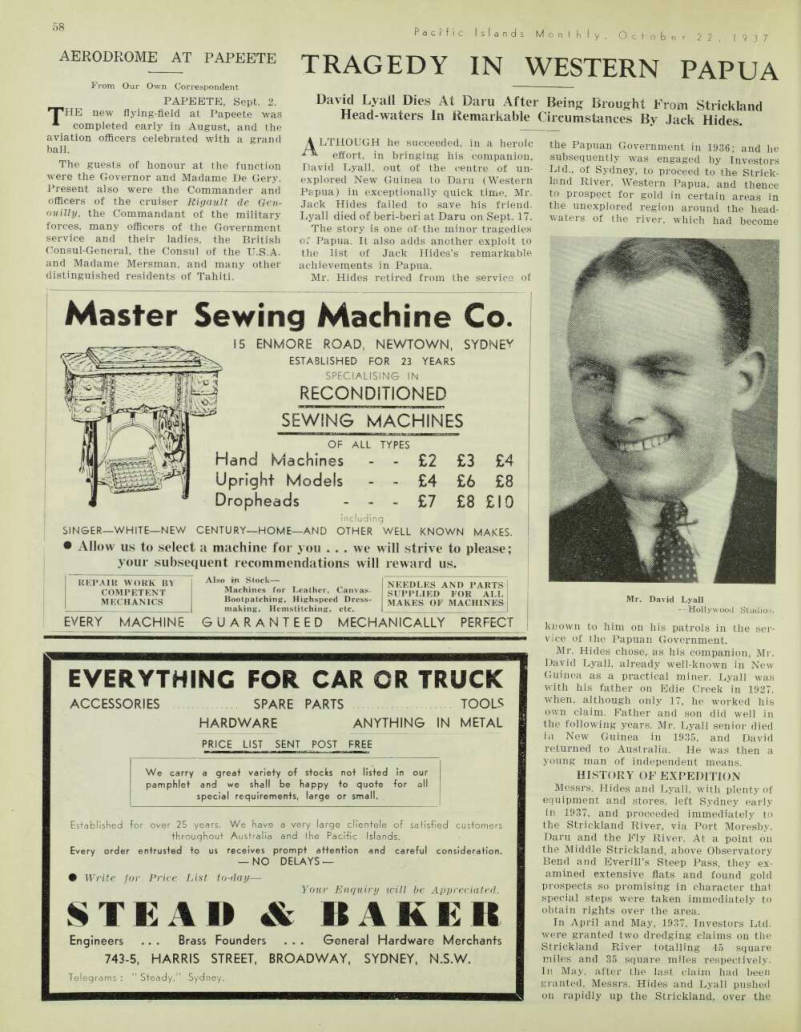
Mr. David Lyall —Hollywood Studios.
mountains, and on to the unmapped plateau near the border of Papua and the Mandated Territory, prospecting as they went.
Then, in mid-August, there commenced the series of trouble which led to Mr.
Lyall’s death.
In mid-August, Lyall became danger ously ill, suffering from dysentery, and complications. Hides, through his port able radio transmitter, asked for assis tance. Investors Ltd. in Sydney, imme diately made inquiries with a view to sending a large aeroplane from Lae out to Mount Hagen aerodrome; thence to fly south-westward to seek the prospec tors’ camp. It was hoped that the aero plane would land near the camp or, alter natively, that medical supplies could be dropped from the plane. It was necessary, of course, to learn the approximate lati tude and longitude of the camp and to arrange that smoke signals be made at a certain time.
But before any of these matters might b? dealt with finally, the radio messages from Mr. Hides ceased abruptly, and communication was never re-established.
It was obvious that some kind of acci dent had occurred (it is now known that the radio equipment had broken down) and Investors Ltd. could do nothing, be cause they did not know where to look for Mr. Hides.
The radio failed on August 18. There was no further news until September 15, when it was announced that Hides and Lyall—the latter dangerously ill—had been picked up on a raft on the Lower Fly River.
Hides’S Fine Effort
The full story is told in the following radiogram sent on September 16 by Mr.
Hides to Investors Ltd. in Sydney.
“We arrived here to-day. Lyall is in a critical condition. He is weak and help less and temporarily blind, and he is being taken to Port Moresby tomorrow by Dr. G. H. Vernon.
“We commenced to carry Lyall on August 15, when you were advised by
radio of his dangerous illness. Then our wireless failed.
“At this juncture we had crossed the mountains from the Upper Strickland, and had entered the lower end of a valley near the border of the Mandated Territory.
“I waited until August 21, hoping that an aeroplane would come to our assis tance; and then, on Lyall’s condition becoming worse, I decided to make a dash for the coast of Papua.
“Instead of re-crossing the mountains, I took a short cut down through the Juha Gorge. We had been travelling for some days, when my party was attacked by an epidemic of beri-beri.
“On the seventh day after starting, when we were at a height of 1,100 feet
above sea-level, and still in the gorge, live of my natives died from an acute and pernicious form of beri-beri, and 22 others were suffering from the disease, and helpless. I then decided to take the risk of rafting my party through the gorge.
“We commenced the journey by raft on September 1, on the top of a flood, and we succeeded in bringing Lyall and the helpless carriers safely through the gorge and down to the calmer waters of the river, making 70 miles on the first day.
“On the second day I obtained a small dug-out from the natives, and with my personal attendant, Biji, and one other native, I took Lyall and started down stream, leaving Pakai (my most trusted
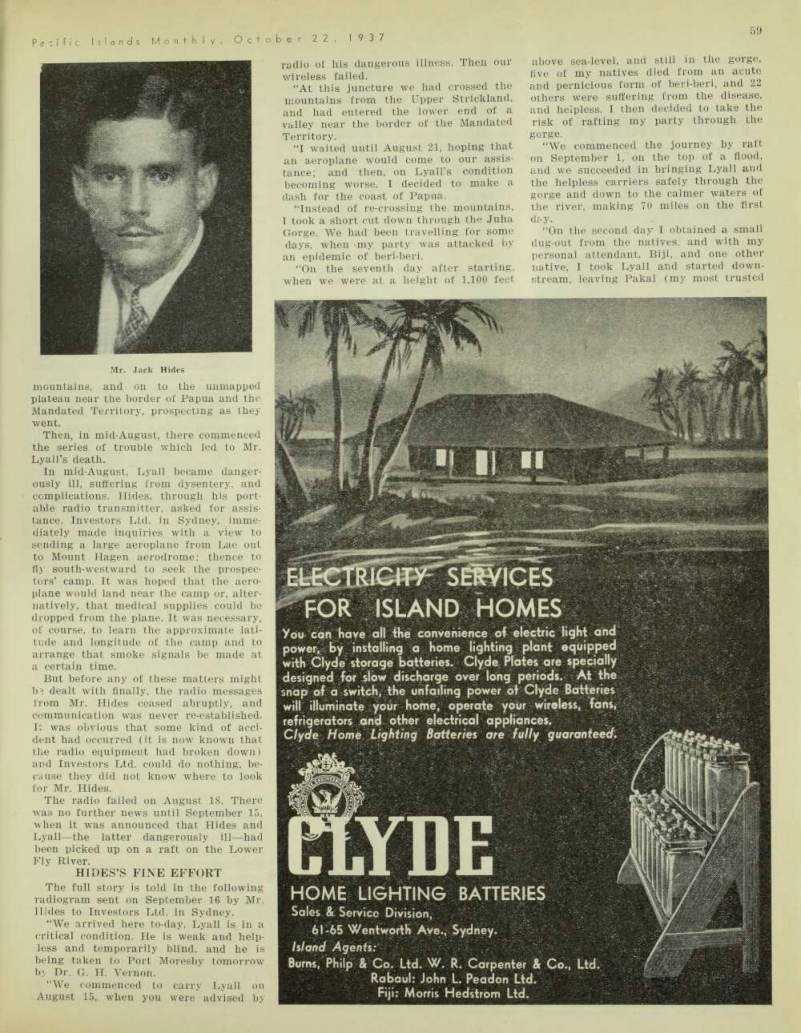
Mr. Jack Hides
native assistant, and an ex-sergeant of the Papuan Native Constabulary) to bring the remainder of the party along.
“Travelling by day and night, on Sep tember 6, we reached Totoma, on the Lower Fly. Sere, owing to my having miscalculated the phase of the moon, a disaster occurred.
“ At midnight 011 the 6th, we ran into the tidal river bore (which is represented by a huge wave > on the Lower Fiy, and travels Up-river at an appalling Speed), We just managed to reach the bank with I vnll Vmt -wro fv,,, os t the Canoe, With every thing it contained.
“Thp npyt rinv T cppf -Rili off /1™.,-, . 1,16 next Oay, i sent Bljl Oft down river for help, while I and the other native made a raft and dnwlv mrwod native maae a rart ana slowly moved Lyall down the river, under terrible COn ditions “Biji travelled 65 miles down the track less western bank of the Fly River, being
without food for the entire journey, and on the seventh day aiter ne lett us, he met the munch Fauune, wnich is oper ated by Papua Oil Development Co. Ltd. ■‘The Famine proceeded up-river witn ail speed, and it yesterday picked up Lyail and myseif, and brought us to Daru.’' The message ended with a request that the Governments of Papua and New Guinea be informed that his party main tained completely friendly relations with all the tribes met with in the course of die journey. j Ivir. R. j. D. Richardson (acting chair man of Investors Ltd.) said on September 10 that the feat performed by Mr Hides, in bringing his incapacitated companion through about 400 miles of practically unknown country, in such quick time, was a remarkable one. Only a man of his superb bush-craft, and qualities of leader ship, could have done it., Further details of Mr. Lyall’s condition would be awaited with anxiety.
The breakdown of the radio set had been most unfortunate, said Mr. Richard son. The last message received from Mr.
Hides indicated that he was prepared to return down the river, and asked for confirmation of this. The Company, hav ing found that it was impossible to land an aeroplane anywhere near Mr, Hides, replied that the return trip seemed the best solution. But Mr. Hides obviously never received that message.
The Company, added Mr. Richardson, was very grateful to Papua Oil Develop ment Co. Ltd. for the timely help given tc the Hides party, at a very critical stage. He understood that P.O.D. had in structed all its boats in the vicinity of the P’ly River to search for Mr. Hides — a generous act that was very much appreciated.
Death Of Mr. Lyall
It appears that Mr. Lyail died early on Friday morning, September 17. His heart collapsed, the result apparently of the mysterious beri-beri sickness. If it had not been for that. Hides’s remarkable feat in bringing him to Daru probably would have saved his life.
The death of Lyail in such tragic cir cumstances received a gread deal of not ice in the Australian newspapers, and there were expressions of sympathy from all classes of people, including the Governor-General (Lord Gowrie) himself.
Lyail was buried at Daru.
Hides, himself suffering from beri-beri, and deeply distressed by Mr. Lyall’s death, was facing a complicated problem.
His party of carriers were somewhere on the Strickland River, following him down. A drilling party sent by Investors Ltd. under Mr. Dufaur, assisted by Mr.
Davies, was somewhere between Pt.
Moresby and Daru. en route to the Strick land River to test the dredging claims.
The vessel Vaila 7 a was at Daru, being prepared to take the party up the Fly and Strickland.
Mr. Hides had to get some order into this situation. Fortunately, his team of carriers came safely down the river to Daru, and he was able to pay them off and arrange to send them to their homes.
Then the drilling party arrived, and he was able to supply them with valuable information and equipment, and give them assistance in preparing for their expedition up the Strickland.
Mr. Hides, under doctor’s orders, then left Daru for Thursday Island, en route to Sydney, The party under Mr. Dufaur is slowly making its way up the Strickland River, and it is expected that it will spend several weeks in the work of testing the dredging claims there.
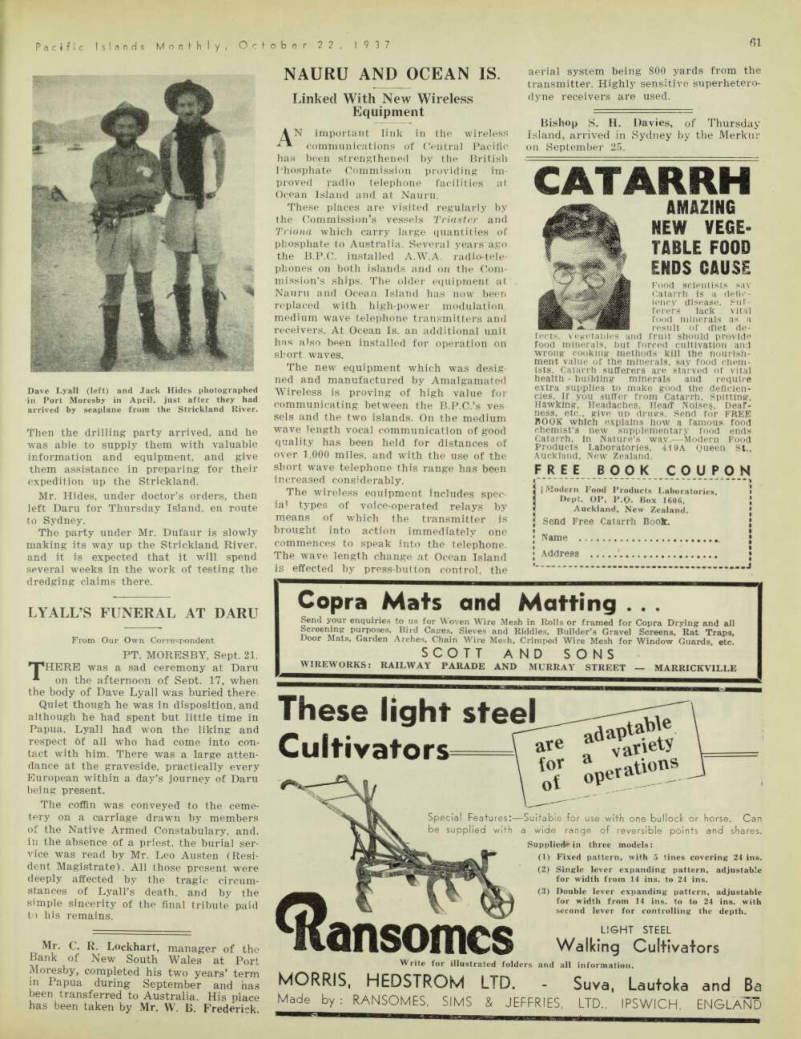
Dave Lyall (left) and Jack Hides photographed in Port Moresby in April, just after they had arrived by seaplane from the Strickland River.