What Is Wrong In
p. 62 · Read in the full issue
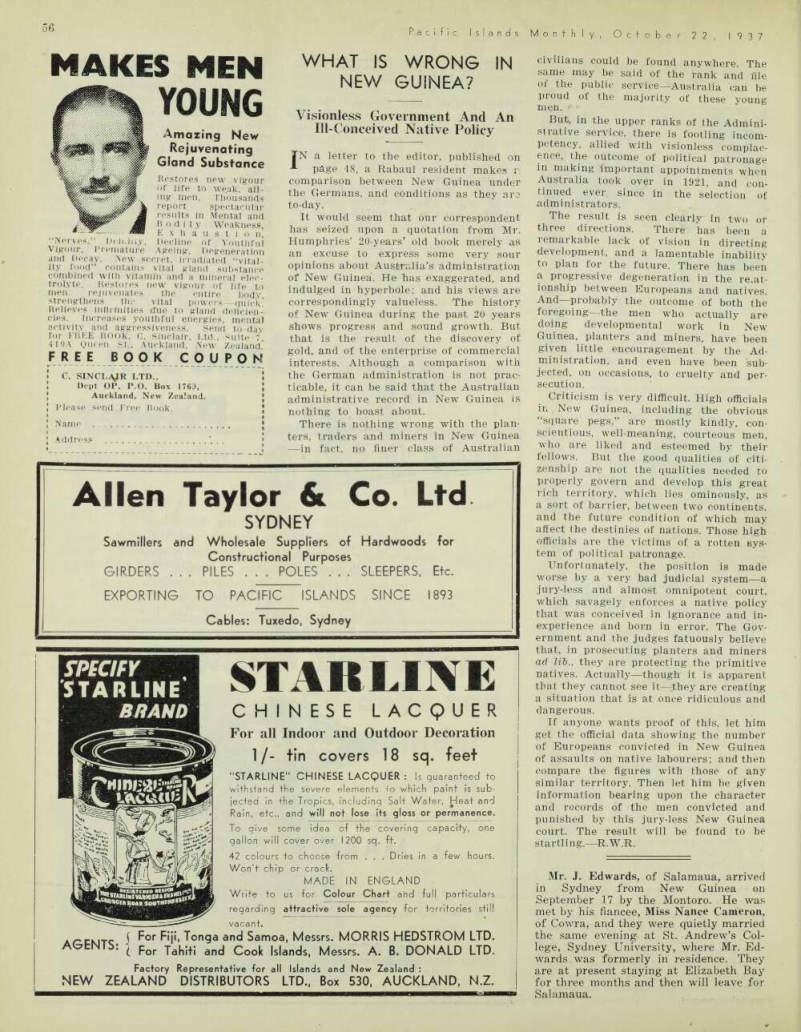
New Guinea?
Visionless Government And An III-Conceived Native Policy
IN a letter to the editor, published on page 48, a Rabaul resident makes r. comparison between New Guinea under the Germans, and conditions as they are to-day.
It would seem that our correspondent has seized upon a quotation from Mr.
Humphries’ 20-years’ old book merely as an excuse to express some very sour opinions about Australia’s administration of New Guinea. He has exaggerated, and indulged in hyperbole; and his views are correspondingly valueless. The history of New Guinea during the past 20 years shows progress and sound growth. But that is the result of the discovery of gold, and of the enterprise of commercial interests. Although a comparison with the German administration is not prac ticable, it can be said that the Australian administrative record in New Guinea is nothing to boast about.
There is nothing wrong with the plan ters, traders and miners in New Guinea —in fact, no finer class of Australian
civilians could be found anywhere. The same may be said of the rank and file or the public service—Australia can be proud of the majority of these young men.
But, in the upper ranks of the Admini strative service, there is footling incom petency, allied with visionless complac ence, the outcome of political patronage in making important appointments when Australia took over in 1921, and con tinued ever since in the selection of administrators.
The result is seen clearly in two or three directions. There has been a remarkable lack of vision in directing development, and a lamentable inability to plan for the future. There has been a progressive degeneration in the relat ionship between Europeans and natives.
And—probably the outcome of both the foregoing—the men who actually are doing developmental work in New Guinea, planters and miners, have been given little encouragement by the Ad ministration, and even have been sub jected, on occasions, to cruelty and per secution.
Criticism is very difficult. High officials in New Guinea, including the obvious “square pegs,” are mostly kindly, con scientious, well-meaning, courteous men, who are liked and esteemed by their fellows. But the good qualities of citi zenship are not the qualities needed to properly govern and develop this great rich territory, which lies ominously, as a sort of barrier, between two continents, and the future condition of which may affect the destinies of nations. Those high officials are the victims of a rotten sys tem of political patronage.
Unfortunately, the position is made worse by a very bad judicial system—a jury-less and almost omnipotent court, which savagely enforces a native policy that was conceived in ignorance and in experience and born in error. The Gov ernment and the judges fatuously believe that, in prosecuting planters and miners ad lib., they are protecting the primitive natives. Actually—though it is apparent that they cannot see it —they are creating a situation that is at once ridiculous and dangerous.
If anyone wants proof of this, let him get the official data showing the number of Europeans convicted in New Guinea of assaults on native labourers; and then compare the figures with those of any similar territory. Then let him be given information bearing upon the character and records of the men convicted and punished by this jury-less New Guinea court. The result will be found to be
startling.
R.W.R.
Mr. J. Edwards, of Salamaua, arrived in Sydney from New Guinea on September 17 by the Montoro. He was met by his fiancee, Miss Nance Cameron, of Cowra, and they were quietly married the same evenings at St. Andrew’s Col lege, Sydney University, where Mr. Ed wards was formerly in residence. They are at present staying at Elizabeth Bay for three months and then will leave for Salamaua.