A Polynesian Tragedy
pp. 58-60 · Read in the full issue
Marquesas, Cultural Leaders of Early Pacific, Are a Dying Race
By Eric Ramsden
QE all the Polynesian peoples none had a more magnificent physique than the Marquesans. Whereas to-day the Maoris, Rarotongans, Fijians and Tongans are all increasing in numbers, the Marquesans are slowly sinking into their graves, and only the shreds of one of. the most interesting cultures in the Pacific remaln -
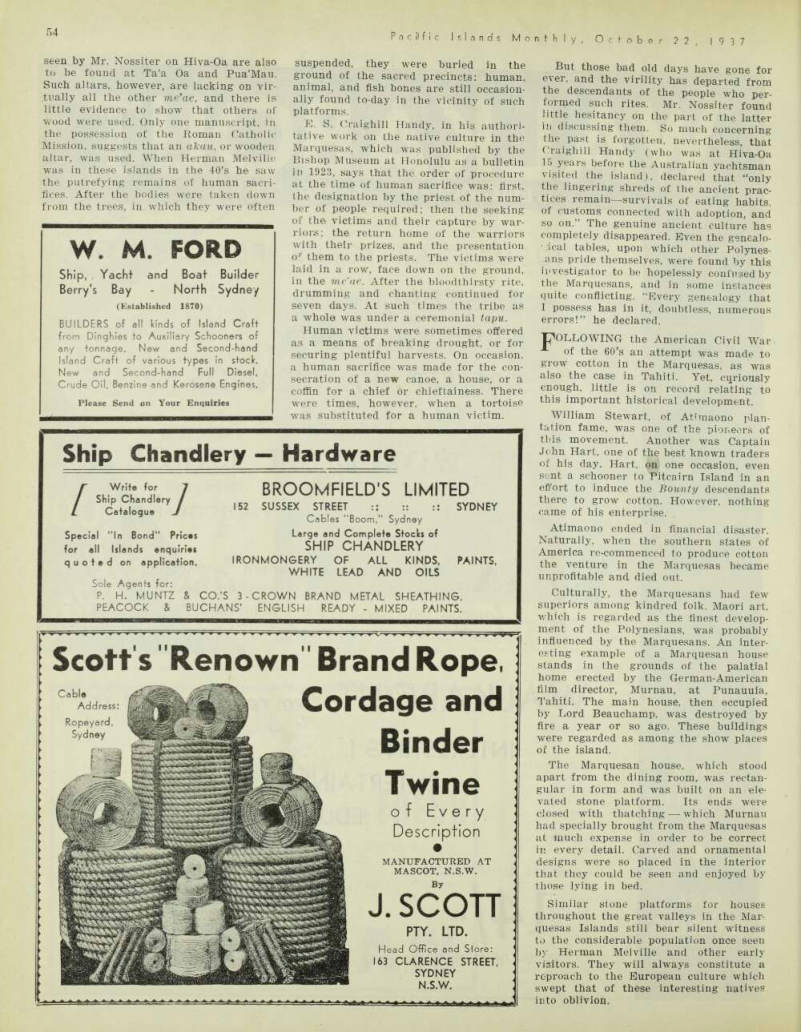
Mr. Harold Nossiter, of Sydney, who recently returned from a world cruise with his two sons in his yacht Sirius. was appalled at what he saw in the Mar quesas. Not more than'so pure-blooded Marquesans are left, Mr. Nossiter, incidentally, was fortun ate in securing the accompanying photo graph of one of the sacrificial stones on
the island of Hiva-Oa, where a good natured Marquesan posed for him on the block in the old-fashioned manner.
Scientists agree that the degeneration of the Marquesan physique is due to the introduction of European and Asiatic diseases, against which the natives have been in no way protected. When Cook visited these exquisite islands in 1774 he estimated the population at 100,000.
Liquor, drugs, and tobacco, together with a listless, inactive life, have resulted in a decay of the whole system of life, and the elimination of all natural avenues for expression.
“One sees the poor natives and half castes with loathesome skin diseases,” says Mr. Nossiter. “There are lepers in the streets of the small coastal villages, and hollow-cheeked men suffering with consumption and elephantiasis.” The Chinese, who are rapidly assuming con trol in these islands, as in Tahiti, are permitted to sell opium to the natives.
Another factor in the degeneration of the Marquesans, he contends, is that the natives wear clothing unsuitable for tro pical conditions.
Sacrificial stone blocks similar to those
A Masquesan posed for Mr. Harold Nossiter, the Sydney yachtsman, on this sacrificial stone at a me’ae on the island of Hiva-Oa. The photograph is of unique interest as among the trees, on close examination, can be seen a number of stone-carved human faces. The native is illustrating the method adopted when victims were placed on the stone in former years.
seen by Mr. Nossiter on Hiva-Oa are also to be found at Ta’a Oa and Pua’Mau.
Such altars, however, are lacking on vir tually all the other me’ae, and there is little evidence to show that others of wood were used. Only one manuscript, in the possession of the Roman Catholic Mission, suggests that an akau, or wooden altar, was used. When Herman Melville was in these islands in the 40’s he saw the putrefying remains of human sacri fices. After the bodies were taken down from the trees, in which they were often
suspended, they were buried in the ground of the sacred precincts: human, animal, and fish bones are still occasion ally found to-day in the vicinity of such platforms.
E. S. Craighill Handy, in his authori tative work on the native culture in the Marquesas, which was published by the Bishop Museum at Honolulu as a bulletin in 1923, says that the order of procedure at the time of human sacrifice was: first, the designation by the priest of the num ber of people required: then the seeking of the victims and their capture by war riors; the return home of the warriors with their prizes, and the presentation o F them to the priests. The victims were laid in a row, face down on the ground, in the me'ae. After the bloodthirsty rite, drumming and chanting continued for seven days. At such times the tribe as a whole was under a ceremonial tapu.
Human victims were sometimes offered as a means of breaking drought, or for securing plentiful harvests. On occasion, a human sacrifice was made for the con secration of a new canoe, a house, or a coffin for a chief or chieftainess. There were times, however, when a tortoise was substituted for a human victim.
But those bad old days have gone for ever, and the virility has departed from the descendants of the people who per formed such rites. Mr. Nossiter found little hesitancy on the part of the latter in discussing them. So much concerning the past is forgotten, nevertheless, that Craighill Handy (who was at Hiva-Oa 15 years before the Australian yachtsman visited the island), declared that “only the lingering shreds of the ancient prac tices remain— survivals of eating habits, of customs connected with adoption, and so on.’ The genuine ancient culture has completely disappeared. Even the genealo ' ;ical tables, upon which other Polynes ians pride themselves, were found by this investigator to be hopelessly confused by the Marquesans, and in some instances Quite conflicting. “Every genealogy that I possess has in it, doubtless, numerous errors!” he declared, the American Civil War of the 60’s an attempt was made to grow cotton in the Marquesas, as was also the case in Tahiti. Yet, curiously enough, little is on record relating to this important historical development.
William Stewart, of Atimaono plan tation fame, was one of the pioneers of this movement. Another was Captain John Hart, one of the best known traders of his day. Hart, on one occasion, even sent a schooner to Pitcairn Island in an effort to induce the Bounty descendants there to grow cotton. However, nothing came of his enterprise.
Atimaono ended in financial disaster.
Naturally, when the southern states of America re-commenced to produce cotton the venture in the Marquesas became unprofitable and died out.
Culturally, the Marquesans had few superiors among kindred folk. Maori art. v/hich is regarded as the finest develop ment of the Polynesians, was probably influenced by the Marquesans. An inter esting example of a Marquesan house stands in the grounds of the palatial home erected by the German-American film director, Murnau, at Punauuia, Tahiti. The main house, then occupied by Lord Beauchamp, was destroyed by fire a year or so ago. These buildings were regarded as among the show places of the island.
The Marquesan house, which stood apart from the dining room, was rectan gular in form and was built on an ele vated stone platform. Its ends were closed with thatching which Murnau had specially brought from the Marquesas at much expense in order to be correct in every detail. Carved and ornamental designs were so placed in the interior that they could be seen and enjoyed by those lying in bed.
Similar stone platforms for houses throughout the great valleys in the Mar quesas Islands still bear silent witness to the considerable population once seen by Herman Melville and other early visitors. They will always constitute a reproach to the European culture which swept that of these interesting natives into oblivion.