Secret Agreement Which Governs Plans For South
pp. 12-76 · Read in the full issue
Pacific Air-Mail Service
Explanation of Hazards and Arguments Which Have Delayed Inauguration of Service
*T 'HE amount of hacking and fil ling which has taken place in connection with the plan of Pan- American Airways to establish a Hawaii Auckland air-mail service must have puzzled many people. In this article, Mr. 'Williams lets a great deal of light in upon the situation. Of special interest are the terms of the secret agreement of October, 1936, published for the first time.
The opinions expressed are Mr.
Williams 1 own. He is an able Aus tralian journalist, noiv resident in Hawaii, and he has made a close and careful study of international aviation developments, especially in relation to the Pacific.
By John Williams
nPHE keynote of the British Empire policy of Trans-Pacific aviation is summarised in the text of the secret resolutions signed on October 2, 1936,
in Wellington, New Zealand, by Mr.
F G. L. Bertram, for the United King dom; Sir Archdale Parkhill, for the Commonwealth of Australia; and Mr. P.
Fraser, for the Dominion of New Zea land.
The document, detailing the resolu tions, reads: — (1) That Pan-American Airways be advised that the N.Z. Government cannot agree to any modification to the 1935 agreement. (2) It is understood that in the event of the failure of Pan-American Airways to carry out the agreement with the N.Z. Govern ment for the provision of a Trans-Pacific air service, the Government of Australia wiil not provide alternative landing facili ties in Australia. (3) That in the event of Pan-American Airways deciding to carry out the 1935 agreement w’ith the N.Z. Government, steps be initi ated through the Governments of the United Kingdom, the Dominion of Canada, the Commonwealth of Australia, and the Dominion of New r Zealand with a view to considering the early establishment of a service in line with the reciprocal rights referred to in Clause 12 of the agreement. (4) That, in any case, steps be taken at once to initiate discussions between the Govern ments of the United Kingdom, Canada, Australia, and New Zealand with a view to the full consideration of the establish ment of an air service across the Pacific at the earliest possible date. (5) Following the discussions between the Gov ernments of the United Kingdom, Canada, Australia, and New Zealand, negotiations be opened with the Government of the United States of America with a view to exploring the possibilities of the establish ment of the best and most effective services on a completely reciprocal basis. (6) The New Zealand Government will take the initiative in promoting the discussions mentioned in (3), (4), and (5).
The conference of the Empire aviation and post office experts in Wellington in September and October, 1936, fully con sidered the possibilities of the Pan- American service entering New Zealand.
The original agreement referred to in Resolution (1) was signed on November 25, 1935, by the N.Z. Government (Mini ster of Transport, Mr. J. G. Coates) and Pan-American Airways (Mr. Lisle Alder ton, Auckland legal representative of the
American firm).
This agreement was not signed until its terms had been considered by the Empire governments, although the N.Z. press earlier had announced the prelimi nary discussions. The press at this time did not hesitate to scold the N.Z. Govern ment (although the conservative group was in power) for its apparent slowness in not signing the agreement. This was because the ballyhoo of the American company’s pressure had bewildered the
management of the papers, with the re sult that for months the news was muzzled, and, when it was announced, it definitely was pro-American.
Great care must be used by Govern ments in considering co-operation with foreign air services. Dangerous prece dents might be established. For example, the birth of the Pan-American Airways system was a result of foreign air repre sentations in Washington. That history is interesting.
History Of P.A.A.
TN 1925, the German head of a small air -*■ company operating in South America
applied for an air-mail contract to lift mail from Florida to South America via the Panama Canal zone. This Dr. von Bauer was turned down. But he persisted and came back to Washington in 1926.
An ex-American army officer, Capt. J.
K. Montgomery, who officially had con sidered Dr. Bauer’s plans, raised the cry in Washington of: “We can’t allow foreigners to fly into America!” and he interested his backers in the German plans. After a lot of political lobbying in Washington and Havana, Montgomery’s group, which he called Pan-American Airways Inc., launched the Florida to Havana service.
Two aviation promoters, Reed Cham bers and Juan T. Trippe, at this time were at a loose end; their last flying efforts, respectively Florida Airways and Colonial Airways, haying proved unsuc cessful for them. These men had inter ested various capitalists.
The two groups started conferences with Montgomery’s group. Followed
months of haggling, one group trying to outwit the other. Holding companies were formed (they still control the des tinies of Pan-American’s network) and great U.S. capitalists like the Rockefel lers, Vanderbilts, and other banking trusts, and interlocking aviation manu facturing interests, were coaxed into the scheme. Trippe was appointed active head of the amalgamation, which decided to use the name of Montgomery’s company.
Thereafter, the Pan-American system grew lustily in the boom period of U.S industrial history—thanks to the ideas o* a German!
British Foreign Office
Caution
nPHE well-informed British Foreign Office knows all this history, familiar to students of U.S. capitalism, and nat urally it did not want to unduly allow the Empire countries to be high-pres sured into signing agreements with Pan- American. It is worthy of mention now that, until the agreement was signed, the
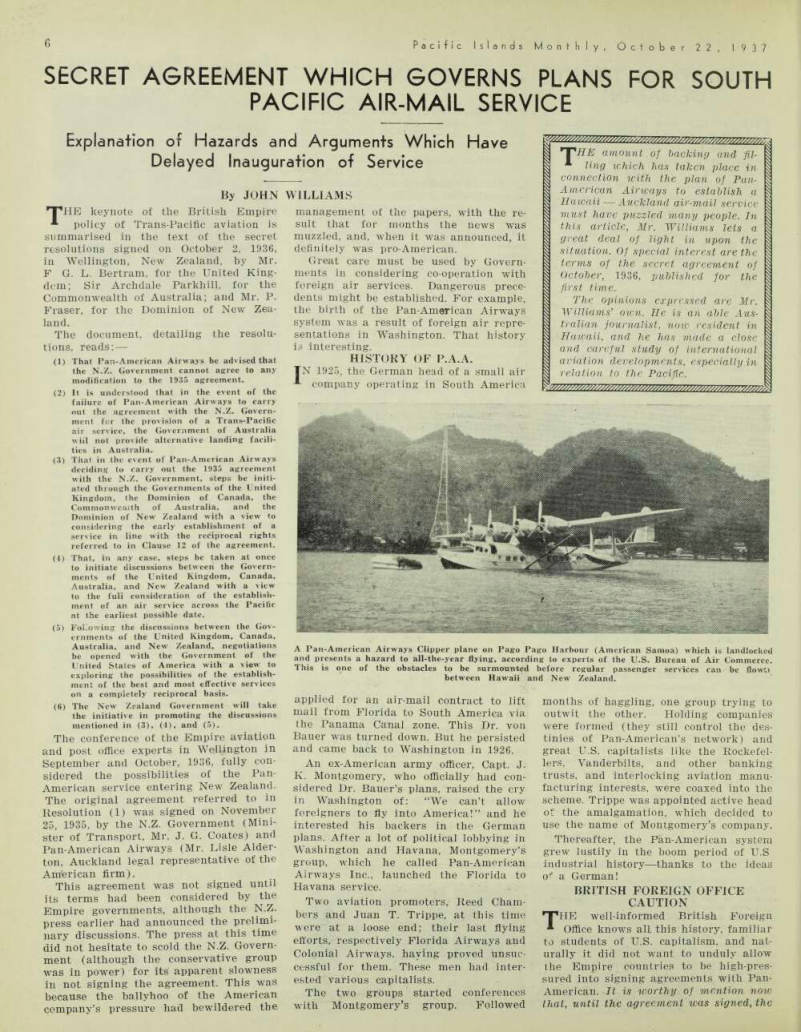
A Pan-American Airways Clipper plane on Pago Pago Harbour (American Samoa) which is landlocked and presents a hazard to all-the-year flying, according to experts of the U.S. Bureau of Air Commerce.
This is one of the obstacles to be surmounted before regular passenger services can be flown between Hawaii and New Zealand.
American company's attitude was that if N.Z. did not hurry and sign the agree ment, the company would make a deal with Australia to fly direct to Australia , cutting out New Zealand.
That the Foreign Office would not let this bluff work is seen in Resolution (2) of the secret agreement. Meanwhile, too, there had been a change of Government in New Zealand.
According to the agreement signed in November, 1935, Pan-American agreed to have the service into Auckland operating by December, 1936. Meanwhile, there were squabbles on the Pan-American board of directors and two important directors, James Murchie Eaton and Grover Loen ing, resigned and led important public revelations into the great monopoly be ing established by the company. One of the bad effects of the monopoly was that the construction of big trans-ocean planes was at a standstill in America because Pan-American, the major operator, was buying only from constructors toeing the line to suit the company, Eaton and Loening declared.
The result was that during 1936 Pan- American was shy of equipment to launch all the services to which it was committed. For example, it had no planes to spare to open the service to Auckland, as per the agreement.
However, luck stepped in. Pan-Ameri can declared it could not launch the service because of the U.S. maritime strike of late 1936, although all U.S. freighters were not affected, including the freighters, North Haven and North Wind , for so long chartered by the com pany for carrying materials, etc., for opening new routes. There were plenty of freighters available.
At this time, too, President Roosevelt ordered an audit of Pan-American’s South American network which resulted in 1,000,000 dollars annually being stopped from post office subsidies! A cool million a year!
Of course, the N.Z. Government was tcld that Pan-American were sorry about the maritime strike; and requested that the agreement be extended so that the company need not fly the first scheduled plane into Auckland until December, 1937. Now internationally air-minded and supported by the secret resolutions of October, 1936, the N.Z. Government ex
tended the Pan-American agreement as requested.
N.Z. Not So Slow-Coach
'X'HESE details are being given so that *• of the government might real ise that the government was not so slow coach. Is New Zealand to remain an in tegral part of the Empire? If so, it must keep in step with Empire schemes, es pecially the long range Empire air-mail plan. John Bull’s family may be less spectacular than some American compan ies, but the family does things thoroughly.
For example, when the agreement was
(Continued on Page 69)
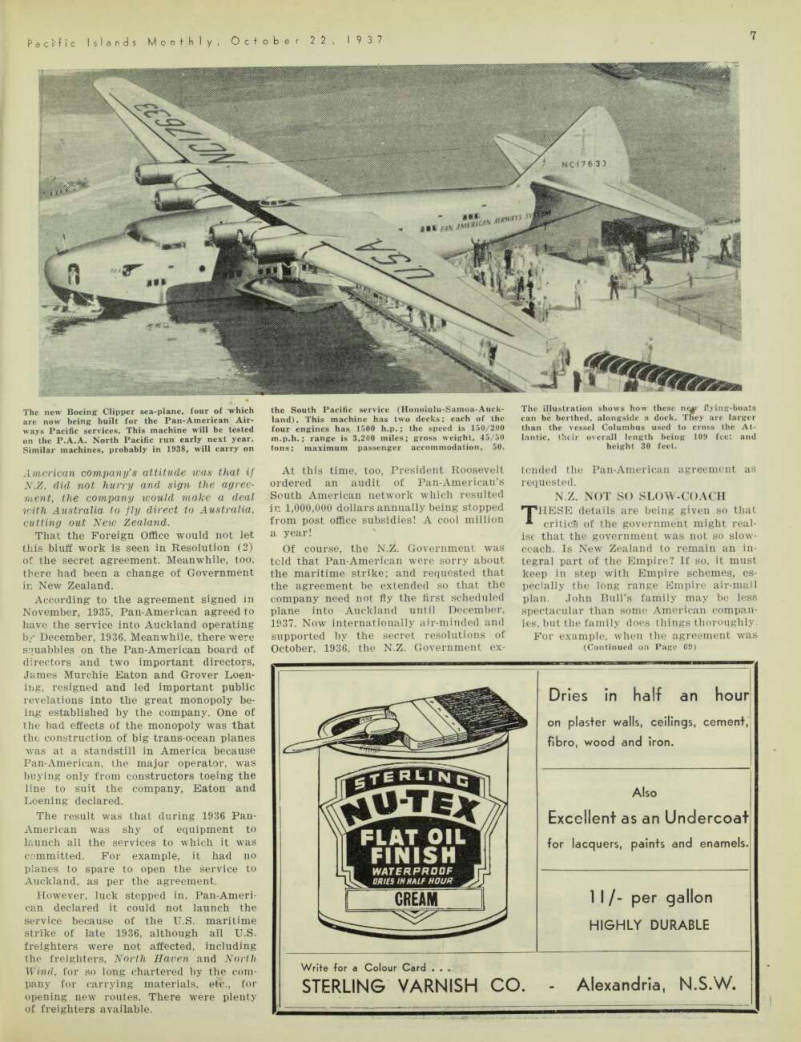
The new Boeing Clipper sea-plane, four of which are now being built for the Pan-American Air ways Pacific services. This machine will be tested on the P.A.A. North Pacific run early next year.
Similar machines, probably in 1938, will carry on
the South Pacific service (Honolulu-Samoa-Auckland). This machine has two decks; each of the four engines has, 1500 h.p.; the speed is 150/200 m.p.h.; range is 3,200 miles; gross weight, 45/50 tons; maximum passenger accommodation, 50.
The illustration shows how these nap flying-boats can be berthed, alongside a dock. They are larger than the vessel Columbus used to cross the At lantic, their overall length being 109 feet and height 30 feel.
signed with Pan-American in 1935, the company boasted that the first planes would be flying into Auckland by July, 1936!
Of course, the Imperial Conference, after the Coronation, fully considered the secret resolutions signed in October. 1936, and accepted them, particularly the sentiments. Accordingly, Mr. Walter Nash was sent to Washington to carry out resolution (5). He discussed recipro city with the U.S. Government; and it is known that the U.S. State Department opposes the idea of allowing British planes to fly into San Francisco, Hawaii, and other U.S. Pacific ports. America is self-conscious about Japan in the Pacific, and is hesitant about agreements with other countries consequently. If America allows British planes to fly from Van couver to Ban Francisco, then to Hawaii en route to Australasia, can Japanese planes be kept out of the Zf.S. ports f British and American interests do not partner with steamers, so why should they with aeroplanes? The public, which foots all the bills, insists upon competi tion for better service.
The North Atlantic aviation experi ments are a good illustration. Pan- American and Imperial Airways have carried out coincident test flights. In accordance with the British Empire scheme, Imperial could fly simply into
Canada and let a local Canadian-U.S. ser vice take passengers down to New York, etc. Of course, Pan-American is anxious to maintain British goodwill, because Pan-American depends so much upon it for entrance into British ports.
Fast Ships Versus Air Liners
MUCH of the enthusiasm over the North Atlantic tests has been dam pened by the fact that the crack French liner Normandie steamed into New York with a big passenger load the same day as the British flying-boat Cambria ar rived empty. The elapsed time of the plane and the steamer was about the same—nearly four days! This important fact, though, is kept hidden by vested air interests.
New Zealand must learn that, until aeroplanes can battle against storms and get through, good steamers like the record-breaking Awatea are far more reliable and practical for all year schedules. Pan-American has demon strated that delays are too numerous for public patience, especially in winter. No matter how big and better the planes are built, adverse weather must always decide whether the planes will fly. Last winter, between San Francisco and Ha waii, all three Trans-Pacific clippers at the same time were delayed for three weeks! Simply through weather 1.500.000 dollars worth of equipment was lying idle, apart from the crews and ground workers and high priced mails (which were sent on by steamer eventually!).
If trans-ocean planes were paid solely upon results, there would be less non sensical claims made for them by pro
moters, who, incidentally, are paid only by results.
America already is learning that the North Atlantic aviation alone is going to keep her busy. German and French test flights indicate the future. President Roosevelt has assigned Mr. Grover Loen ing, the best-informed American (who resigned from Pan-American because he could see the writing on the wall) to report upon the possibilities of inter national aviation as affecting U.S. com panies. Mr, Eaton, who resigned from Pan-American, too, after building up the operating system, has become head of a new American company which is to launch trans-Atlantic services from New York to south European ports supported by a successful parent steamship company already serving the same ports.
Of course, too, on the North Atlantic, German helium zeppelin interests, backed
with U.S. capital, are going ahead with ambitious plans.
Warning To N.Z.
TTHESE and other important possibili * ties make it absurd that the N.Z.
Government should be strong-armed into committing itself to a long-term agree ment, especially with a foreign company.
The U.S. Government, through post office mail subsidies, is using great care in this regard, and making all its contracts short-term, even with steamers.
The U.S. post office already has an nounced that it cannot subsidise the Pan- American service into Auckland until July, 1938, at the earliest. The subsidy is being held up solely on account of the reciprocity aspects of Resolution (5) of the secret Resolutions. As a result of Mr.
Nash’s visit to Washington, Uncle Sam is determined not to be hustled into any move which might prejudice the years to come.
The N.Z. Government was scolded by that country’s press because it did not rush into an agreement with the Ameri can company.
Trouble is that the reporters for the N.Z. newspapers, as yet inexperienced in the subtle ramifications of U.S. capi talistic enterprises, have been believing too much of what they have been told.
Uncle Sam is more wary. He is taking more time about being committed to the scheme than did the N.Z. Government.
Meanwhile, the two Governments are continuing the reciprocity conversations.
These alone will decide what is to be done.