"Get Busy or Get Out!" - Australia and New Guinea
pp. 5-6 · Read in the full issue
New Guinea
TF Australia, before long, is not involved in international trouble over New Guinea, she deserves to be. Three of the world’s greatest powers are clamouring aggressively for colonies, and forcing the other three great powers to arm to the teeth, so as to defend their territories.
The holding of occupiable country can be justified, nowadays, only if that coun try is being occupied and developed for human needs.
Australia sits on top of one of the world’s richest and most desirable new territories—New Guinea—and does little more than twiddle her thumbs. She has, on the mainland of New Guinea, the opportunity to open up an attractive country to European occupation, and the personnel and the machinery and the money with which to do it. But, because these things are in charge of -politicians and politicians’ nominees, nothing is done. It cannot go on much longer.
The Mandated Territory of New Guinea, when taken over by Australia, was merely a group of very large, coconut-growing islands, with an unknown and undevel oped mainland, along the coasts of which a few coconut plantations were scattered.
The kind of administration needed by
such a primitive country and small white population was established; and to-day, in all matters of policy, it thinks very muck along the lines that it did in 1921.
Australia, apparently, sees nothing un usual or providential in the fact that, since 1921, a flourishing gold industry has been established in the interior of the mainland; that that industry, through gold royalties, customs duties, license fees, etc., provides undreamed-of revenues for developmental activities; and that, north-west of those Morobe goldfields, there has been discovered a vast region of cool and fertile uplands and river systems, eminently suitable for occupation and development. Why cannot the fortuitous gold industry be used to opei up and develop the tablelands country?
The discovery of the Centra 1 New Guinea plateau, in 1932-33, passed almost unnoticed in Australia. Yet there thus was brought to our knowledge one of the most attractive regions within the world’s tropical territories. Australian indifference towards it is tragic and, in an international sense, criminal.
This new country lies, roughly, be tween the New Guinea-Papua border and
the mountain ranges which parallel the northern New Guinea coast. It runs from the Markham Valley, behind Lae, for hundreds of miles north-westward, into the headwaters of the Fly and Sepik Rivers, near the Dutch frontier. Within it, are three great river systems the Markham (which flows south-east into Huon gulf) ; the Ramu (flows north-west to the coast near Madang); and the Pu rari (which, in some still unknown way, finds a track through the central moun tain ranges and flows south into the Gulf of Papua).
This region, apparently, is a crazy quilt of grassy downs, innumerable large and small rivers, patches of splendid forest, mountain-peaks running up to ever lasting snow, valleys like beautiful parks tucked away in the folds of the ranges.
Most of it, apart from the frequent moun tains, lies at an average altitude of 5,000 feet—which, although it is only a few degrees from the equator, means that it has an equable climate.
I have talked to many men who have been to the Ramu, Wahgi, Chimbu, and Mount Hagen stations—prospectors, gov ernment officials, air-pilots—and all say, usually with enthusiasm, that it is “a white man’s country,” with immense possibilities.
The Morobe district, wherein are the goldfields, is broken and mountainous, incapable of much agricultural develop
ment. Yet it is proposed to build a road in from Salamaua to Wau.
Why cannot some far-visioned bureau crat —if there is one! —consider, instead, a road from Lae up the Markham Valley, across the Ramu —Purari tableland, and sc- on to Madang; with a side-road up the Wampit or Watut Valley into the Bulolo?
This, of course, would be a longer route than Salamaua —Wau, but it is needed only for slow, heavy, cheap traffic. Aero planes always will provide the important transport in this part of New Guinea.
Co-operation with the strongly-established and highly-efficient aerial transport com panies might be, in fact, the first prin ciple in any policy for the development of the Central New Guinea Tableland.
The opening-up of the Central Table lands, via the Markham and the Ramu. would not be expensive. General Wisdom,
with vision for which he was not given credit at the time, easily built 30 miles of highway, from Lae, up the Markham -T-the first step in a great plan. But Canberra was indifferent. Wisdom is gone, nepotism dominates New Guinea af fairs, and the road, these many years, has been given over to disrepair and jungle growth.* Various people in Australia, babbling in ignorance, declare that Australia’s re cord in New Guinea is good, and they quote statistics to show increased settle ment, increased trade, increased develop ment, etc. This is merely the rubbish talked by politicians. Actually, if we sub tract from N.G. statistics the figures for which the gold industry is directly and indirectly responsible, the result is lamentable and discreditable. The development and growth that have taken place in New Guinea are directly due to the initiative and enterprise of the prospector-pioneers, and of the gold min ers and gold companies and trading com panies which followed them. One may search the official records of this terri tory for the last two decades and find very little to justify the claim by the Administration that it has done anything worth noticing, of its own volition, to encourage the settlement and develop ment of the Territory. For the most part it has sat complacently in its office chairs? and seized gratefully upon the revenues brought by the gold companies and com mercial firms to its doors without any apparent effort on its part.
If the Administration had had any developmental policy worthy of the name it by now would have had something to show for those providential revenues— something to take the place of the gold
industry, when it peters out (as it must) ir. another 20 years. But—as the Treas urer’s statement presented at the Legis lative Council in Rabaul last month shows only too clearly—those revenues are being treated as natural and normal, and used mostly to expand the Admini strative establishment and make it more comfortable. “Public works” have been carried out—roads, ’ bridges, aerodromes, wharves—but there is not one sign of anything being done, other than would be done by an unimaginative parish-pump politician in Australia. Most of the new public works are in and about Morobe.
What is being planned to protect that asset—to keep those public utilities in use after the goldfields are finished?
What will happen then to, maybe, £lOO,OOO worth of administrative mach inery (buildings, roads, wharves, aero dromes, etc.)?
The Administration regards New Guinea as it did in 1921 —it seems incapable of producing a policy to meet the new conditions. The carefully-selected men of its district services—splendid material here!—are trotting around in well-worn tracks, which lead practically nowhere.
The team of experts in the department of agriculture, led by an officer of wide experience, seem to be engaged mostly on routine duties—instead of being em ployed, as they should be, in collabora tion with district services and public works, as the spearhead of an advance upon new country and new agricultural enterprises. The truth is that the rank and file of the public services wait, as they must, for instruction and inspira tion from Rabaul: and Rabaul apparent y lives on the formulae and in the tradi tions of 1921.
It is common knowledge that New Guinea can produce, in addition to copra, such crops as coffee, cocoa, rubber, tea, equal to anything in the world. It has the soil, the climate, the labour, the market—and now it has, on the Central Tableland, a region healthy for white planters, and their women and children.
A policy to embrace these things would have both political and economic value— it would justify Australia’s hold on New Guinea, and establish new industries to itake the place of the gold industry, and so employ the considerable administrat ive machinery created in connection with the gold industry.
It will be said, of course, that native rights and interests must take preced ence over ail considerations of new settlement. That argument can be ignored.
Statistics and expert evidence will show that, on the Central Tablelands, as in New Guinea generally, there is plenty of land for new settlement, after all pos sible native needs have been liberally provided for.
This is no new subject. Again and again, in recent years, attention has been drawn to Rabaul’s policy of laissez-faire ; but Rabaul sheltered complacently be hind Canberra. Now, bigger forces are at work—Australia, so far as New Guinea is concerned, may be told by a world
court to get busy or get out.
R.W.R.
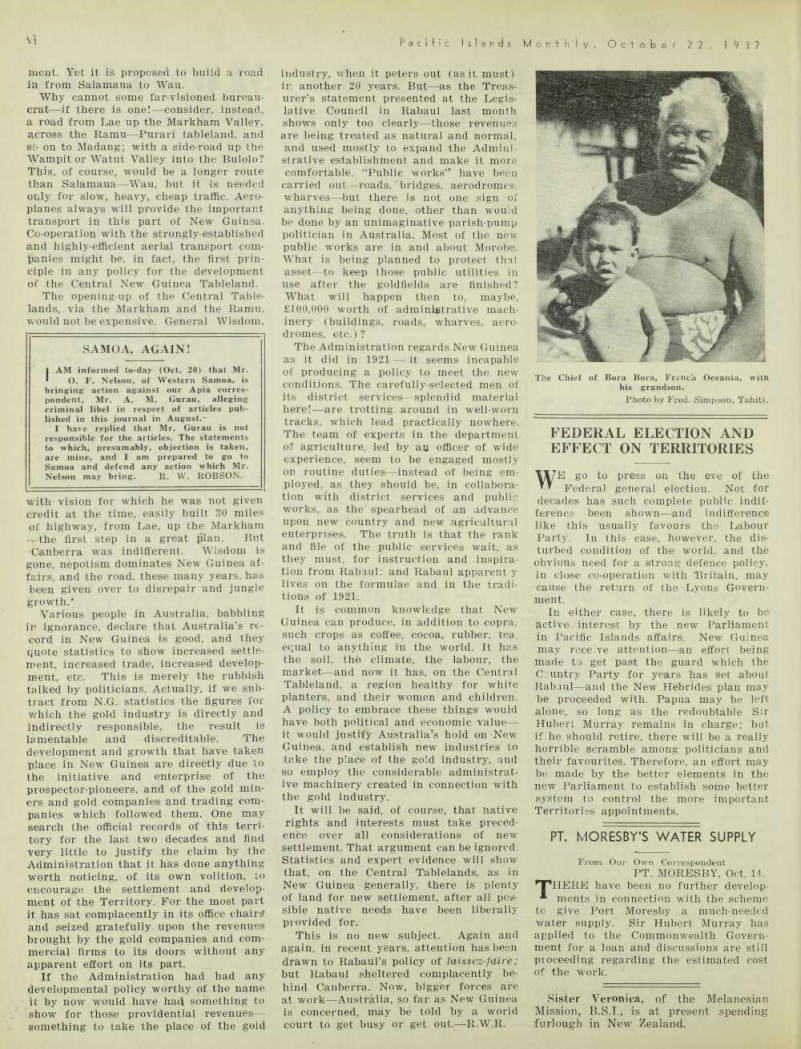
The Chief of Bora Bora, French Oceania, with his grandson.
Photo by Fred. Simpson, Tahiti.