Life On Pitcairn Island
pp. 23-25 · Read in the full issue
An Interesting Example of Modern-Day Socialism
Written for the “Pacific Islands Monthly ” by Mrs. Ada M. Christian.
readers may be interested to * know something of modern life on Pitcairn Island, original home of the Bounty mutineers.
Many of the occupations of to-day are similar to those of former years, although in some things we have attained to more modern achievements.
House-building was, and is still, the most laborious. The timber has to be fret-sawn and boards carried from the other side of the island, over high hills, then down to the village in wheel barrows, the only means of conveyance we have.
The original houses were small, two
roomed cottages, and clap boarded with miro (a hard and durable wood), without any linings. Beds were fixed along the sides of the inner room. The other served as sitting and dining-room. The roofs were made from the leaves of the pandanus palm, the preparation of which is very unpleasant, as the thorns on either side of the leaf and on the mid-rib not infre quently cut into the hands.
This has given place to iron roofs on the houses of to-day.
Even though they demand
more work and expense, the pre sent houses are far more comfortable than they were. Each home has a living room, and each member of the family has a bedroom of his or her own. Each room is ceilinged. Glass windows take the place of windows made of island wood. All dwelling-houses have wooden linings. Kitchens and dining-rooms are separate, and are only clapboarded.
One has to go a long way to find better bake-ovens than ours, made of stone.
We cook in an open fireplace. Owing to the luxurious growth of trees, we arc never in need of wood.
Our church is a two-storied building,
and has a seating capacity of 200 in each room. The school-house has accommoda tion for the four divisions—the kinder garten, primary, intermediate, and junior. Children from the age of six to sixteen must attend school. Attendance under or over these ages is optional.
Products Of The Soil
Cultivating the soil and raising food has its routine in daily life. The prin cipal products are sweet potatoes, bananas, yams, taro, corn, beans, and arrowroot. Vegetables do well if pro tected from the mischievous fowls.
Of fruits raised, we have pawpaws,
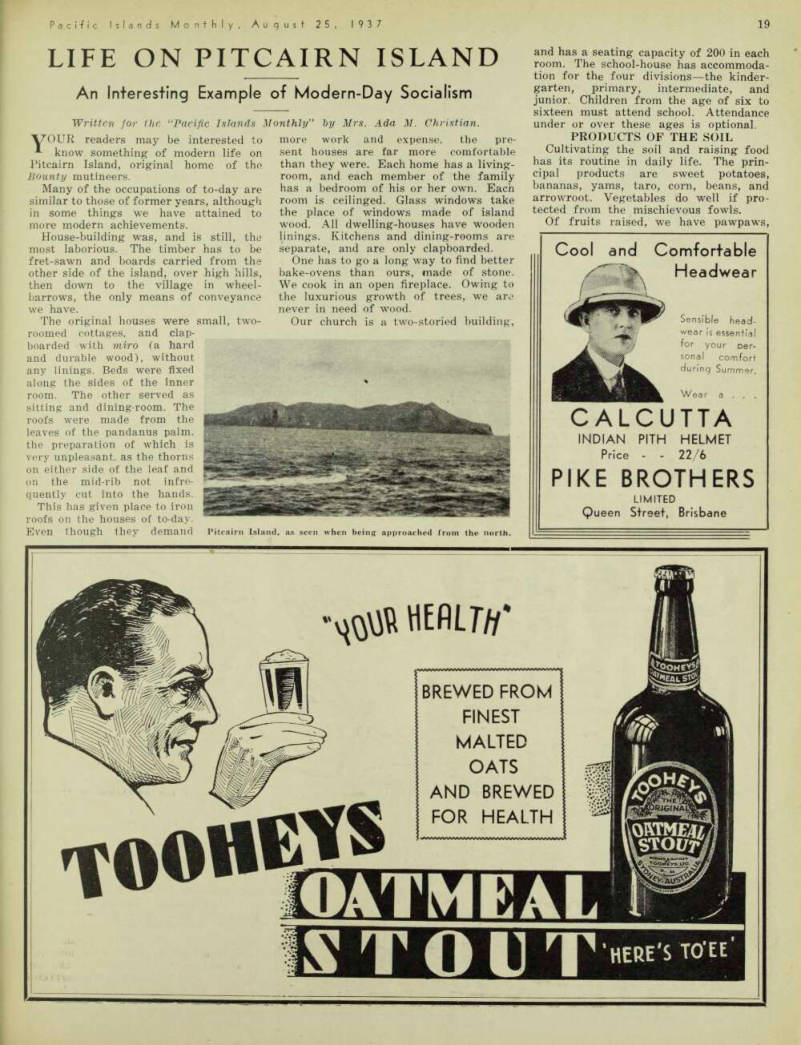
Pitcairn Island, as seen when being approached from the north.
melons, pineapples, mangoes, peaches, oranges, and guavas. Oranges are of much commercial value. Rose apples (so named because their sweet smell, as well as the taste, resembles the scent of roses) grow on tall trees. Parts of the island are thickly wooded with these trees, which are used for firewood.
Coconuts are grown and the rich, beautiful milk takes the place of cows' milk. The milk is obtained by grating the nuts, then with water and a good squeezing by hand, the delicious whits milk is washed out. This, left over night in cold weather, makes lovely butter.
Sugar cane is grown, and the sweet molasses takes the place of sugar.
Build Own Boats
Up to the present century the Islanders have depended on kind friends to supply their boats. Queen Victoria sent two dur ing her reign, and other friends con tributed to the need.
Not willing, however, to be dependant on charity always, our men thought it lime to do something in helping them selves by building their own boats. There fore, under the oversight of Francis Christian, a direct descendant of Fletcher Christian, of Bounty fame, of the fourth generation—and who had a little experi ence in boat building when living a few months in Mangareva, one of the Gambier Islands—they started to build a boat,, which proved a success. Pictairn is now the happy possessor of six fine, strongly built home-made boats, a wonder and admiration to all who come our way.
For fishing purposes, canoes are made
from a certain kind of tree, hollowed out and fixed up for the purpose.
Women, too, have their daily duties to perform. In planting, they help the men, doing the lighter part of the work.
Each family has its own allotment of land to cultivate, which has been handed down from their forefathers. Cooking, laundering, and other heure-work as well
as caring for the children, are done by the women in their homes.
Curio-making is done by both men and women, the men making wood-work and the women weaving hats, baskets of different shapes, and fans, etc., from the leaves of the pandanus palm tree.
These, with fruits are taken on board passing ships and sold for money, or ex-
changed for clothing, soap, or other necessary articles.
Little Use For Money
We have to buy clothing, and all manu factured articles necessary for the sus tenance of life, as well as foods not grown on the island. Among ourselves, there is very little use for money, for we help -one another by exchanging work.
For instance, if I want a
dress made, I go to one who makes dresses and bargain with her to sew me a dress, while I weave her a basket, or vice versa. Or, if any one is in need of help in any way. service is rendered free of charge.
Three original names are left on the island —Christian, Young, and McCoy. Additional names are Warren, Coffin, Clark, and Jacobson.
Our domestic animals are dogs, cats, fowls, turkeys and ducks: the last two have been imported of late.
Goats run wild on the rocky hills of the island.
The language spoken among ourselves is a perversion of mixed English and Tahitian. However, there are few pure Tahitian words spoken, and more Eng lish.
Killing U* Ihe Bell
We have one bell, a large, bronze one, a present made to the people shortly after their return from Norfolk Island,
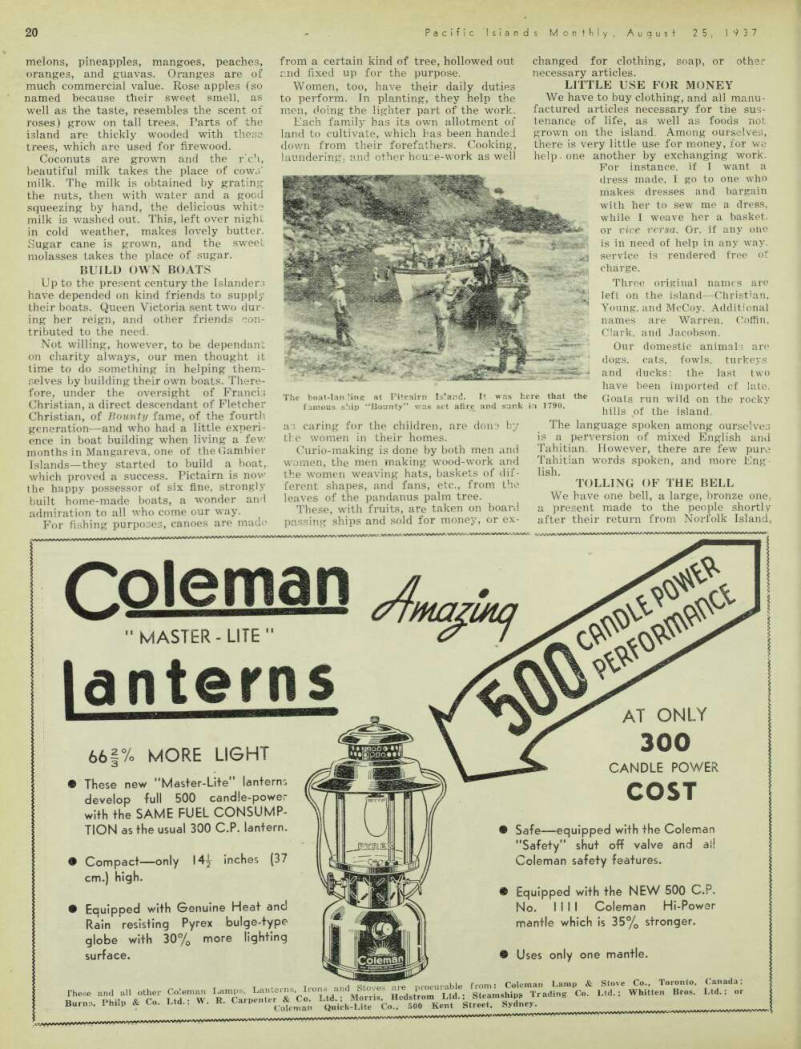
The boat-landing at Pitcairn Island. It was here that the famous- ship “Bounty” was set afire and sunk in 1790.
by Capt. Stevens, of one of H.M. ships.
All public activities centre in the bells.
For all religious services the bell is rung twice. A notice bell of one stroke is given half an hour before meeting; and 10 minutes before meeting commences, two strokes are rung, when all wor shippers leave home and get to the church house in time to commence ser vice.
For both day and Sabbath school, the tegular ding-a-ding is rung. For ail religious services, two bells are rung.
For any Government work, or meeting, three strokes are sounded.
Five strokes show that a ship is in and time to be boarded. Four strokes is a signal that there is community stuff to be divided. The length of the ringing of the bell on all occasions is left to the prudence of the bell-ringers—except a call to funeral service, when the number of strokes is limited to the age of the person.
Governed By Council
We are governed by a chief magis trate and council of five men, elected yearly, who start work on New*Years Day.
Games the children like best are ball, cricket, rolling hoops and flying kites.
Change of work is about all the recrea tion older folks have. On holidays, our young men take pleasure in boat-racing.
The people in general are musical and most of the young women play the organ well. Organs, in addition to phono graphs, are in many homes.
Half-past-nine or ten o’clock is the usual hour for retiring, and 6 a.m. is rising hour. The routine for the day commences and closes with family wor ship.
Up to 1885, when the Seventh Day Adventist religion was introduced to the people by an American missionary (Mr.
John I. Tay) the people were strict ad herents of the Church of England.