Vale. Frank Prykei
pp. 11-78 · Read in the full issue
By Mrs. Alice Allen Innes, formerly of Salamaua, New Guinea
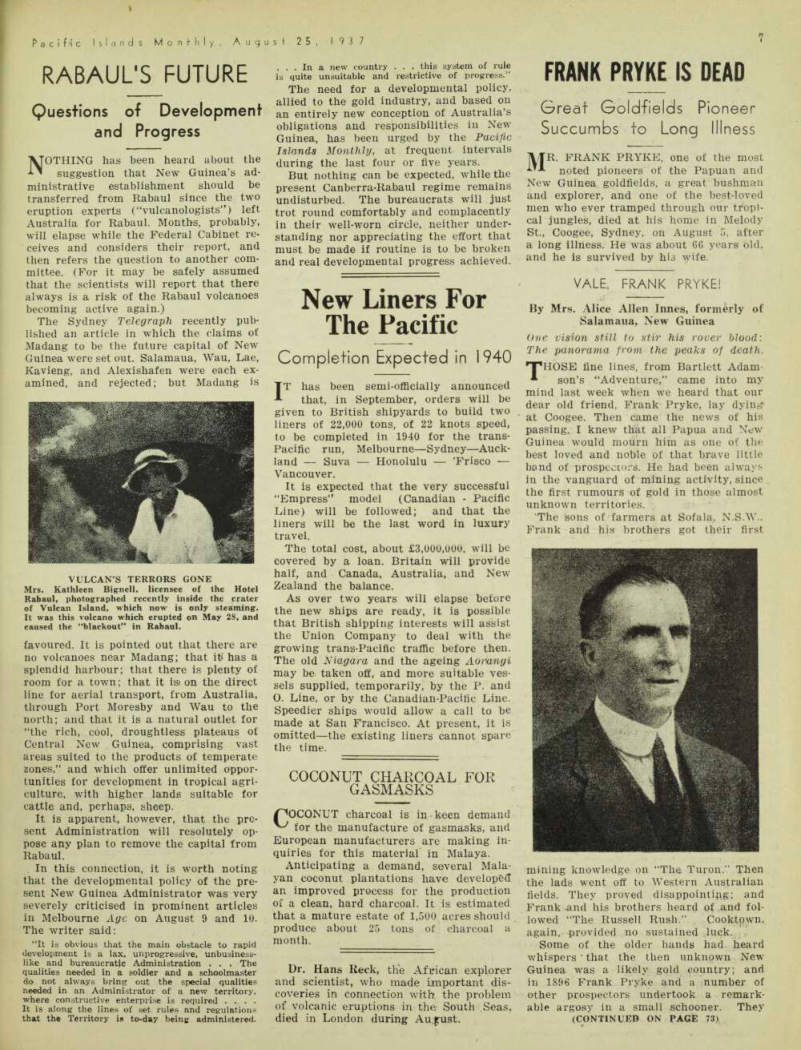
One vision still to stir his rover blood : The panorama from the peaks of death. •THOSE tine lines, from Bartlett Adam * son’s “Adventure,” came into my mind last week when we heard that our dear old friend, Frank Pryke, lay dying at Coogee. Then came the news of his passing. I knew that all Papua and New Guinea would mourn him as one of the best loved and noble of that brave little band of prospectors. He had been always in the vanguard of mining activity, since the first rumours of gold in those almost unknown territories.
The sons of farmers at Sofala, N.S.W..
Frank and his brothers got their first
mining knowledge on “The Turon.” Then the lads went off to Western Australian fields. They proved disappointing; and Frank and his brothers heard of and fol lowed “The Russell Rush.” Cooktpwn, again, provided no sustained luck.
Some of the older hands had heard whispers ' that the then unknown New Guinea was a likely gold country; and in 1896 Frank Pryke and a number of other prospectors undertook a remark able argosy in a small schooner. They
(Continued On Page 73)
reached Samarai (then called Dinner Island), which was the only settlement.
Sudest, Misima and Murua Islands had all been prospected, and small mining groups had left Samarai and sailed for those, then, remote places.
McLaughlan’s Creek was the first settle ment on the mainland. Frank, his brother and a party of 10 men went up the Musa River. It proved a dangerous trip, even for the excellent bushmen that they were natives most savage, food supplies short, and torrential rains. The gold was traced, but not in payable quantities.
Travelling back, they got colours at Bartle Bay.
Hearing of gold at the back of Cairns, and having had severe malaria, the Pryke brothers made their way to Cairns hinter land. then on to Jordan Creek. It proved a wildly exciting “rush,” but over estimated.
Obsessed with the idea that New Guinea held good gold, in the unexplored territory, the intrepid Frank decided to face the hardships and fever again. In 1900. he and George Klotz set out and finally discovered Cloudy Bay (125 miles east of Port Moresby). They worked that area very profitably.
With his brother Dan, Frank returned to the Musa (Eastern Papua), at the head of the Kaviri Valley, in 1907, and again fortune favoured them. About this time the question of the New Guinea boundary between Papuan and German Territorv, became acute and was finally settled.
Fiank and his brother were working a claim on the Waria River. Though they were now over the border, and in Ger-
man territory, Dr. Halil (the German Administrator) recognised them as pion eers, and very fairly allowed them to work their claim out, without paying royalties, or duty on foodstuffs. - Realising the importance of the gold mining industry, the Papuan Govern ment, about 1910, decided to subsidise prospecting expeditions. It was about this time that Matt Crowe and Jim Pryke went with Frank Pryke and discovered the famous Lakekamu field, in Central Papua.
A most hazardous expedition was then undertaken by Frank Pryke, which nearly cost him his life. The party left on December 1, 1910, and ascended the Vailala River for 130 miles. Robert Elliott and Charles Priddle, sound min ers and fine explorers, accompanied the leader. The party formed a base camp, at the extreme limit of navigation of the Vailala, and thence followed up the waters of the lovo. Fine colours were traced here. Then a disappointing prospect of the Evori affluent was made. At Dohiti, a smaller river, joining with the Vailala. was ascended, and then the party worked across country to Kerema Station, closely investigating the new country en route.
This knowledge proved of great assis tance to later prospectors and patrols.
Frank Pryke was attacked in an unpro voked fight with the Kukukukus about here, and was dangerously wounded by an arrow. He was carried to safety, and nursed and cared for in the rough little camp, until further travelling could be arranged.
It was in 1914 that Frank Pryke was again chosen for a further exploration prospecting trip. This time, he led the Kismet expedition (organised by Sir Rupert Clarke) up the Fly River. Frank
and his brother made the outstanding mining, and exploration trip in New Guinea history on that occasion, and only their natural modesty and dislike of publicity prevented well-deserved recog nition.
Many a laugh my late dear old friend and I have had together over the sen sational “discoveries” of bumptious new comers and wealthy ditherers who in vade the coastal waters of New Guinea and explore a few miles up a river or two (piloted by the usual brand of leg pulling humbug!). As Frank once told me: “They do their daily dozen in pygmies and cannibals!”
However, Frank’s diaries may cause a deal of genuine appreciation to those really interested. One that I have here as I write I would, were it within my power, place with reverence in the Mit chell Library, feeling that it belongs to a nation which holds such men as Frank Pryke to be the real pillars of New Guinea prosperity.
The expedition led by Frank Pryke and his brother followed the Mungae and
Piencae (Fly) Rivers to their source, in the Star Mountains, in Dutch New Guinea. Varying country and different new types of natives were met with and records kept carefully. Traces of gold were found on the Black, Palmer and Alice Rivers. The earliest pygmies were also seen and photographed at the head waters of the Alice. Limestone was here found to be the predominating feature on all the river beaches.
The return journey was most difficult on account of hostile natives. Finally, the party was attacked whilst they were sheltering under a 25ft bank, and the leader was again wounded by an arrow —this time, a severe elbow wound. He was incapacitated for three months, and returned to Australia, where he settled down to a business life.
In 1926, gold, as Frank Pryke so often had predicted, was discovered at Edie Creek (Kaindi). He knew that this would be a rich field—especially for those who got in early. So Frank went gladly back with Les. Joubert, his old chum, to a very happy partnership. They worked the lease at Merri Creek, and then went on to Koranga. The latter brought them both security, and compensation for all those hard years.
From a ‘‘handful of Cooktown prospec tors,” (or, I might say, “a schoonerful of explorers and adventure lovers”) Frank Pryke saw his ‘‘land of Golden Hopes” grow into the great Morobe min ing field.
New Guinea beckoned them, and held them—as the tropics ever does. Real ‘‘trail finders,” Frank Pryke and his col leagues ‘‘smelt out” the likely country over the unknown ranges, and then, when they found gold, they sent the call to one and all, sharing their knowledge and country freely. Not for them the company promoting touches —not theirs the city office and easy chair!
Dan Pryke, who opened up some West Australian fields was also on the Papuan fields with his brothers. He died some years ago, aged 63. Jim Pryke, Frank’s younger brother, also a well known miner, was killed in France early in the war. They were a fine trio of pioneers and prospectors.
There will be those who will describe Frank Pryke as a most successful miner.
There will be old friends who will say of him that he had all the finest qualities of mateship. But I, who knew him so long, and knew so much of his great hearted manhood and wide vision, his
tolerant good humour and love of his fellowmen, his great tact and courtesy, and his sane judgment in handling either ‘‘bush kanakas” or trained native ser vants—l shall ever think of him as one of Papua’s and New Guinea’s greatest bushmen and explorers, and an ambas sador of civilisation.
Every acquaintance became his friend.
What greater monument could he have than a sweet memory in the heart of all who knew him?