Britain And D.S.A. Co-Operate
pp. 9-10 · Read in the full issue
Maintenance of Trans-Pacific Service Between America and Australasia
9 I’RANS-Pacilic airline developments * during the month have been inter esting, and they possess features which have a direct bearing upon the future of transport and communications in the South Seas.
It was announced in March last that, after lengthy negotiations, an agreement had been made between the New Zealand Government and Pan-American Airways (which already operate a regular airmail service across the North Pacific between ’Frisco and Hong Kong).
The agreement provided for the estab lishment, about the end of this year, of a regular aeroplane service between Hawaii and Auckland, via American Samoa. It was definitely a condition of the agreement That, in return for the Americans being allowed to establish a seaplane base in British territory, in Auckland, British aviation interests should be allowed, when they were Veady, to establish a seaplane base in American territory in Hawaii.
At that time, it was not thought that Britain contemplated the early establish ment of a trans-Pacific airmail service between Australia or New Zealand and North America; but. since then, British activity in securing clear titles to Cen tral Pacific islands which are suitable as aeroplane stations, on the route be tween N.Z. and Hawaii, shows that Brit ain has a trans-Pacific service well in mind.
Out of this fact there developed a diffi culty that threatened to cripple the- N.Z P.A.A. agreement.
The hop from Hawaii to ’Frisco is practicable; but the hop from Hawaii to Vancouver (which is the nearest point of Canadian territory) is considerably longer. Therefore, it appeared that an
essential part of the British trans-Pacific plan would be the right of British aero planes to fly from Hawaii to ’Frisco.
To this, of course, the Americans ob jected. Apparently, it was pointed out that the right of British aeroplanes to land on American territory in Hawaii d d not include, the, right to land on American territory in California. It was also pointed out that the agreement be tween N.Z. and P.A. Airways was not necessarily an agreement between British interests and the United States Govern ment.
We do Hot know if it is so, but.it ap pears likely that Washington has said to Britain: “If your planes are to be permitted to fly from Hawaii to San Francisco, our planes must have the right to fly from New Zealand to Aus tralia.”
There was keen discussion, in August, between the N.Z. Minister for Finanee (Mr. Nash) and the.U.S. Government, in Washington, and it seemed at first that an impasse had been reached.
It is now believed, however, that a plan has been evolved for the friendly reconciliation of British and American trans-Pacific aviation interests.
It is considered likely that the British and American’airlines will work together in carrying on a service between North America and Australasia, just as they have arranged to do across the Atlantic, between North America and Britain. In this event, American and British mach ines would operate from each other’s bases in North America, Hawaii, N.Z. and perhaps, Australia; and. in connection with this, it is irkely that an important aviation station will be established in Fiji.
The, Americans pi ready ha ve seaplane
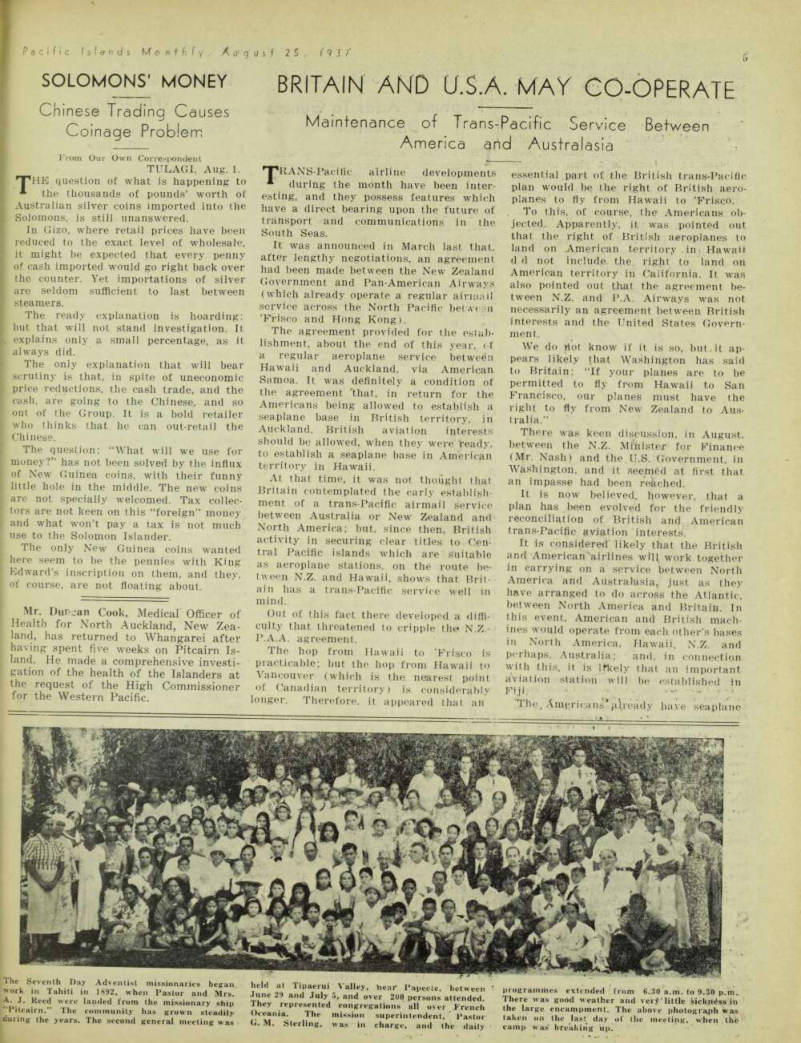
The Seventh Day Adventist missionaries began, work in Tahiti in 1892, when Pastor and Mrs.
A. J. Reed were landed from the missionary ship “Pitcairn.” The community has grown steadily during the years. The second general meeting was
held at Tipaerui Valley, hear Papeete, between June 29 and July 5, and over 200 persons attended.
They represented congregations all over French Oceania. The mission superintendent. Pastor G. M. Sterling, was in charge, and the daily
programmes extended from 6.30 a.m. to 9.30 p.m.
There was good weather and very little sickness in the large encampment. The above photograph was taken on the last day of the meeting, when The camp was breaking up.
stations surveyed and more or less pre pared at Kingman Reef and Pago Pago (American Samoa); and there is a station for land aeroplanes on Howland Island.
The British have protected Christmas Island and Canton Island (Phoenix Group) as possible landing stations, and it looks as if there is a plan to place an emergency station on Sunday Island (Kermadec Group), between Fiji and Auckland.
The Americans had definitely planned to run between Hawaii and Auckland, via Kingman Reef and American Samoa.
The British plan apparently was to run between Auckland and Hawaii, via Fiji,
and Canton Island. But if there is to be co-operation between the tw r o nations the route obviously will be via Fiji, which is by far the most important territory in the Central Pacific.
There is still a possibility of a route being established from Fiji to Australia via Ne-fr Caledonia, but it does not ap pear to have entered into the present discussions.
It is considered likely that some deci sion will be announced shortly, as the N.Z. Minister, Mr Nash, has just returned to New Zealand.
The original agreement was made be tween the N.Z. Government (Labour)
and Pan-American Airways; and as Im perial Airways (British) is virtually the British shipping combine in another form, and the Labour Party dislikes the combine extremely, N.Z. did not worry much about protecting Imperial Airways' interests.
But when Mr. Savage and Mr. Nash were in London attending the Corona tion and the Imperial Conference, they were given information which convinced them of the need for protecting British interests in the Pacific, and also for culti vating friendly relations with the Ameri cans.
This meant practically a revision of the agreement. Pan-American Airways did not like it: and it certainly appeared as if New Zealand had “cray-fished” on an agreement.
However, it looks as if an amicable settlement is in sight. Tickets issued to passengers probably will be interchange able on both lines.
North Pacific Service
Fares on the trans-North Pacific air service operated by Pan-American Air ways, have been fixed as follows: San Francisco to Honolulu, 360 dollars (ap proximately £A90), to Midway 445 dol lars, to Wake 587 dollars, to Guam 704 dollars, and to Manilla 799 dollars. Fares cover ground transport at all stations except San Fancisco, all meals., the sleep ing berth between San Francisco and Honolulu, and hotel accommodation at Midway. Wake, and Guam. A regular service was begun on November 21, 1936.
Mr. W. M. Middleton, of Kulili Planta
tion, Madang, left Brisbane in August
for New Guinea by the Montoro.
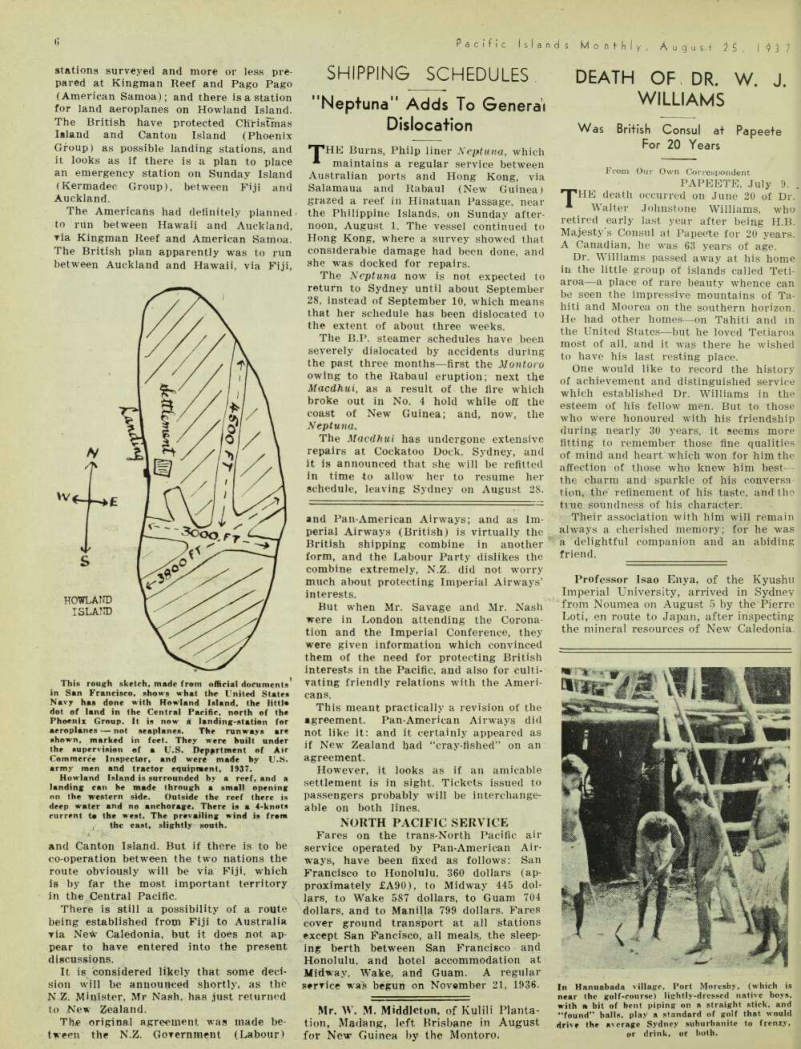
This rough sketch, made from official documents in San Francisco, shows what the United States Navy has done with Howland Island, the littlo dot of land in the Central Pacific, north of the Phoenix Group. It is now a landing-station for aeroplanes not seaplanes. The runways are shown, marked in feet. They were built under the supervision of a U.S. Department of Air Commerce Inspector, and were made by U.S. army men and tractor equipment, 1937.
Howland Island is surrounded by a reef, and a landing can be made through a small opening on the western side. Outside the reef there is deep water and no anchorage. There is a 4-knots current to the west. The prevailing wind is from the east, slightly south.