Men Who Knew Yesterday
pp. 49-50 · Read in the full issue
Mr. W. W. Thomas, of Fiji
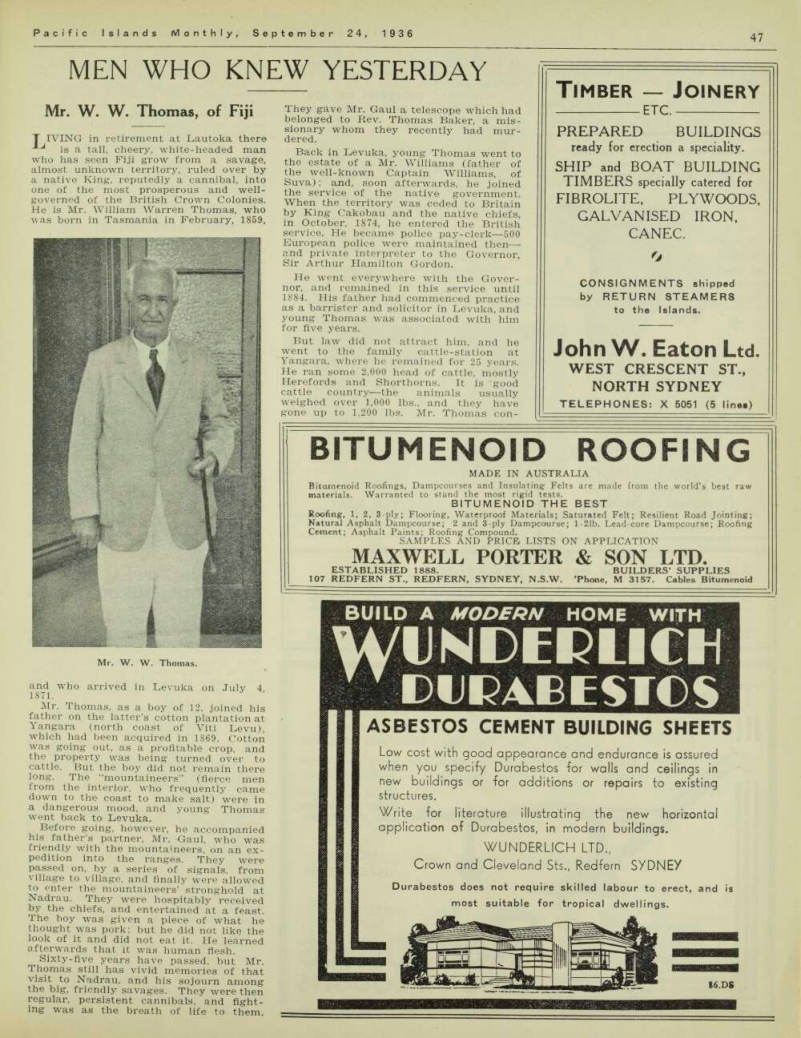
T IVING in retirement at Lautoka there is a tall, cheery, white-headed man who has seen Fiji grow from a savage, almost unknown territory, ruled over by a native King, reputedly a cannibal, into one of the most prosperous and well governed of the British Crown Colonies.
He is Mr. William Warren Thomas, who was born in Tasmania in February, 1859,
and who arrived in Levuka on Julv 4 1871.
Mr. Thomas, as a boy of 12, joined his father on the latter’s cotton plantation at Yangara (north coast of Viti Levu), which had been acquired in 1869. Cotton was going out, as a profitable crop, and the property was being turned over to cattle. But the boy did not remain there long. The “mountaineers” (fierce men from the interior, who frequently came down to the coast to make salt) were in a dangerous mood, and young Thomas went back to Levuka.
Before going, however, he accompanied his father’s partner, Mr. -Gaul, who was friendly with the mountaineers, on an ex pedition into the ranges. They were passed on, by a series of signals, from village to village, and finally were allowed to enter the mountaineers’ stronghold at Nadrau. They were hospitably received by the chiefs, and entertained at a feast.
The boy was given a piece of what he thought was pork; but he did not like the look of it and did not eat it. He learned afterwards that it was human flesh.
Sixty-five years have passed, but Mr.
Thomas still has vivid memories of that visit to Nadrau, and his sojourn among the big, friendly savages. They were then regular, persistent cannibals, and fight ing was as the breath of life to them.
They gave Mr, Gaul a telescope which had belonged to Rev. Thomas Baker, a mis sionary whom they recently had mur dered.
Back in Levuka, young Thomas went to the estate of a Mr. Williams (father of the well-known Captain Williams, of Suva); and, soon afterwards, he joined the service of the native government.
When the territory was ceded to Britain by King Cakobau and the native chiefs, in October, 1874, he entered the British service. He became police pay-clerk—soo European police were maintained then— and private interpreter to the Governor, Sir Arthur Hamilton Gordon.
He went everywhere with the Gover nor, and remained in this service until 1884. His father had commenced practice as a barrister and solicitor in Levuka, and young Thomas was associated with him for five years.
But law did not attract him, and he went to the family cattle-station at Yangara, where he remained for 25 years.
He ran some 2,000 head of cattle, mostly Herefords and Shorthorns. It is good cattle country—the animals usually weighed over 1,000 lbs., and they have gone up to 1,200 lbs. Mr. Thomas con
Mr. W. W. Thomas.
trolled butcheries at Lautoka and Ba.
Eventually, he sold out to his brothers, and they later sold to the Colonial Sugar Refining Co.
Mr. Thomas saw the first Indian lab ourers arrive in Fiji in the ship Leoin Das, about 1877. They were disembarked
at Levuka, and indentured to the various planters. To-day, there are nearly 90,000 Indians, settled in Fiji.
Horrible Incident Of 1871
Mr. Thomas has many lively memories of early Levuka. He still recalls with horror, an incident that occurred in 1871.
The Lavoni tribe were entrenched in a strong position on top of Ovalau Island, and were being besieged by the armies of Bau. Finally, the Lavoni people were induced by a missionary, who was acting as an intermediary, to surrender to the Bau people, on condition that they would be protected and would not be taken as slaves. The Lavoni folk were duly rounded up, left their stronghold, and were marched down to the native village in Levuka.
Then a cruel thing occurred. The help less Lavoni people, about 200 men, women and children, were put up at public auction in Levuka, and sold as slaves to planters in the islands round about.
“That was one of the most disgraceful incidents in the history of the South Seas,” says Mr. Thomas. “I remember hearing my father say to my mother; ‘That is the most awful piece of bar barism I ever saw. We need labour, but we should not be a party to things like that’.”
The need for labour led to kidnapping, or “blackbirding,” and some old-time skippers achieved great notoriety. The native government seized, at Levuka, one particularly infamous brig, called the Carl, and that was the end of her. Among the rogues and cut-throats aboard her, Mr. Thomas was interested to find the son of the pastor in the village he had lived in, in Tasmania.
A Forgotten Port
The man who organised the native government, in the seventies, was a re tired naval officer, George Austin Woods.
He believed in developing trade; and there was a surprising amount of traffic between Fiji and the British colonies in those days.
In 1873, there were three steamers running between ’Frisco and Sydney, which served Fiji.' The port of call was °n Kadavu, the big island southward of Viti Levu, and a little steamer of 200 tons maintained communication between Levuka and Kadavu. The latter was a bright little place, with a hotel and a few stores. The bottom had fallen out of cotton: but there was plenty of activity.
Trade was absolutely free, and living was very cheap.
South Seas Rendezvous
Levuka, in the seventies, w'as a ren dezvous for the South Seas. Many well known Pacific “characters” came in there.
A hotel kept by William T. Sturt was a famous meeting-place. Sturt himself was a remarkable person. Once a man, W'ho had ordered a drink of whisky (6d), poured a huge “nip” out of the bottle.
Sturt ostentatiously walked to the till, took out 3d, and handed it to his cus tomer. “What’s this for?” demanded the latter, suspiciously. “I made a mistake — you’re a wholsesale, and not a retail customer. You must have wholesale rates,” said Sturt.
It was in Sturt’s hotel that Mr. Thomas, then a youth of 16 or 17, met Captain “Bully” Hayes. He describes Hayes as a big, broadshouldered black-bearded man, with a slight American accent and a jovial manner. After he was murdered in 1877, his widow and two daughters, lived in Levuka for a while, at the Planters Club Hotel, kept by a Mr. Ryan.
The girls were fascinating creatures — musical, good singers, very vivacious, and they could dance in a way that won the hearts of Levuka’s younger set. Mrs.
Hayes kept a private boarding house in Suva for a time, and later was licensee of the Victoria Hotel.