Indian Community In Fiji
pp. 31-34 · Read in the full issue
Critical Examination of One of Most Interesting Settlements in South Seas
By R. W. Robson
AN Indian community of at least 85,000 persons, part of the prosperous and flourishing sugar industry, has been grafted upon the Crown Colony of Fiji.
These Indians have solved the labour problem for the Colonial Sugar Refining Co. Ltd.; and in that way, and also because they have settled down as an apparently homogeneous community of industrious peasants, they have ensured the economic future of Fiji.
They are hungry for land (of which, for tunately, there is an and for education; they are increasing twice as fast as the Fijians (who number, now, about 90,000); and they are determined to have political power and a proper recog nition of their status in the commercial and administrative life of Fiji. The British Colonial Office gets a headache whenever it tries to plan a future in which the three Fiji communities—Europeans, Fijian and Indian—shall have even-handed justice.
Effect On Europeans’ Future
THERE is no future in Fiji for the “small” European—the Indians have taken that away. Slowly, inexorably, the Indians have become,
or are becoming, thej small farmers, traders,! and shopkeepers of I Fiji. They completely! control land transport] —all taxis, car-hire! services and local and] trans - island (Vitij Levu) bus services] are in their hands. In dians and Fijians pro-] vide house servants, and crews for small j vessels. Indians, Chi- j nese and half-castes — i and, to a lesser degree,! the Fijians provide,] to an increasing ex-1 tent, the artisans, salesmen and clerks ] required by this rapid- j ly growing Crown
Colony.
Europeans are want ed in Fiji for the pro fessions, for the leader ship of large commer cial concerns, for key I positions in industries, and as owners of large plantations and farms.
But all the small jobs, from unskilled labour up to work requiring considerable general and technical education will go
in future mostly to the Indians—although Fijians and half-castes can successfully put in a claim.
The Fijian, in intelligence and adapt ability, is quite the equal of the Indian.
But the Fijian, whatever his ethnological make-up, is mostly Polynesian when it comes to regular, sustained work. He has no use for it, and prefers to sit in the sun, on his allotment of communal land, while bountiful Nature provides most of his needs. A growing number of Fijians are allowing the European’s sense of an obli gation to labour to enter their plan of life; but the Fijians generally cannot be de pended upon for a labour supply. Further more, the Fijian, in an economic sense, is not enterprising and aggressive, like the Asiatic.
Spread Of The Indians
SPREADING out from the sugar districts, the Indians have settled in every district in Viti Levu, and in many in Vanua Levu, and have dug in. All over Viti Levu, except in the mountainous interior, alternating with Fijian villages, groups of their ugly little shacks are to
be seen—humpies of board and corrugated iron. Like the Chinese gardeners in Aus tralia, they have no care for aesthetic
beauty—their whole thought and energy are concentrated upon producing the most and the best from their little allotments of land.
Their staple product, if they are any where near a sugar-mill, is cane. If not, they grow staple food crops, such as rice and dahl (a valuable food, something like a split pea), and cotton, the production of which is increasing. Their domestic ani mals are goats, full or half-bred Zebu oxen (for transport), horses and fowls.
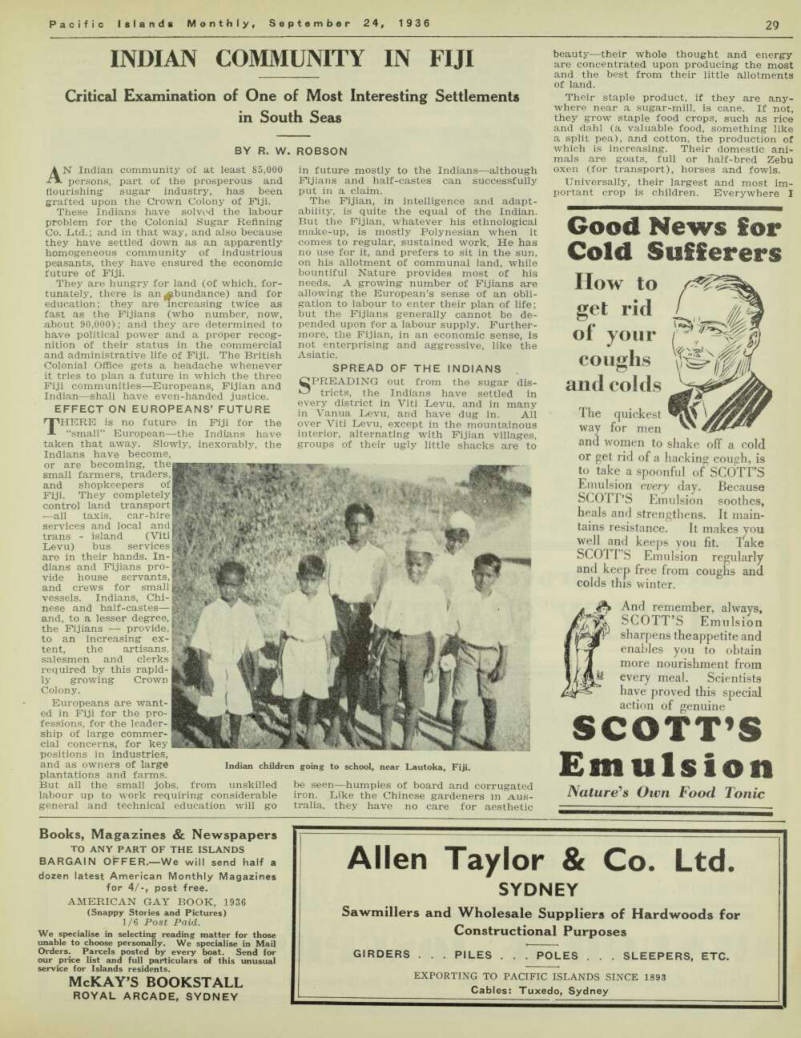
Universally, their largest and most im portant crop is children. Everywhere I
Indian children going to school, near Lautoka, Fiji,
went among the Indian villages, I found swarms of children; happy, well-fed, well clothed, attractive little rogues.
These Indians marry early. On Sunday, July 26, there were seven statutory notices of Indian marriages posted before the Courthouse in Lautoka; and the following details were copied therefrom:
The bulk of the Indian population is clustered around the big sugar mills in Viti Levu. Practically the whole of the vast areas of flat land, between the moun tains and the sea, along the northern and western coasts of Viti Levu, is under sugar-cane. This land, for the most part, is leased out by the Sugar Company to the Indian farmers, who grow the cane under contract and guarantee for the C.S.R. Company.
The humpies and shacks of the Indian growers are scattered through this cane land —hidden, mostly, by the growing cane.
It is now the policy of the Company to encourage the growers to build better houses. Not a bad idea.
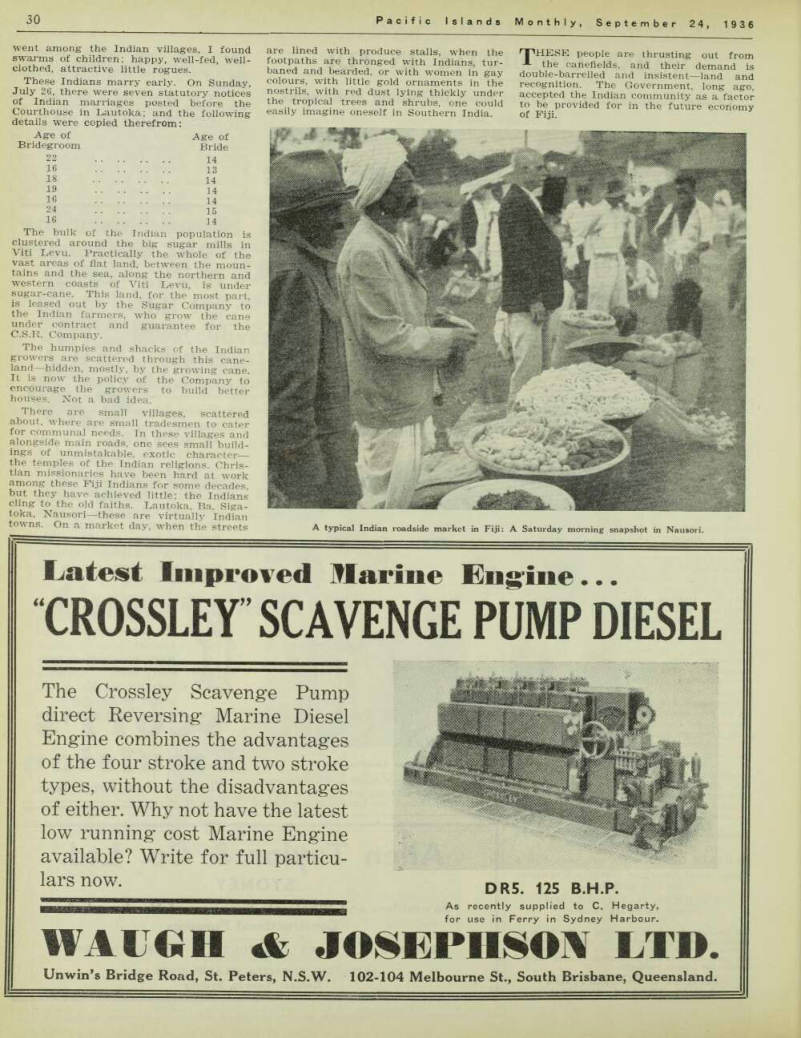
There are small villages, scattered about, where are small tradesmen to cater for communal needs. In these villages and alongside main roads, one sees small build ings of unmistakable, exotic character the temples of the Indian religions. Chris tian missionaries have been hard at work among these Fiji Indians for some decades, but they have achieved little; the Indians cling to the old faiths. Lautoka, Ba. Siga toka, Nausori—these are virtually Indian towns. On a market day, when the streets
are lined with produce stalls, when the footpaths are thronged with Indians, tur baned and bearded, or with women in gay colours, with little gold ornaments in the nostrils, with red dust lying thickly under the tropical trees and shrubs, one could easily imagine oneself in Southern India.
r T'HESE people are thrusting out from the canefields, and their demand is double-barrelled and insistent—land and recognition. The Government, long ago, accepted the Indian community as a factor to be provided for in the future economy of Fiji.
A typical Indian roadside market in Fiji: A Saturday morning snapshot in Nausori.
Age of Age of Bridegroom Bride 22 ... ... 14 16 ... ... 13 18 ... .. .. 14 19 ... ... 14 16 ... 24 ... .. .. 15 16 ...
There is plenty of land. Experts calcu late that this large, amazingly fertile island of Viti Levu could comfortably carry ten times its present population.
They compare it, in size, fertility, produc tivity, and general physical features, with Jamaica. Jamaica supports 1,250,000 people; Viti Levu something under 120,000.
Indian settlement, properly directed and controlled, could make Viti Levu marvel lously productive.
At first sight, the thing is simple. There is far more land available than is at pre sent needed by Fijians. The Indians settle down very happily in this great tropical island, and are good farmers. Parcel the land out among the Indians, on a tenure which will encourage the farmer, while safeguarding the ultimate ownership of the Fijian.
But it is not as easy as that. First of all, the Indians want a greater and ever greater security of tenure. They hate the C.S.R. tenure, under Ifrhich they occupy land practically only so long as they can be depended upon to produce cane. They want security. There is not a great deal of freehold land available —much of it is represented by the original grants to Europeans for cotton-growing. The In dians will pay any price for freehold —they paid £6O per acre recently for freehold near Ba. Failing freehold they seek always for long leases.
The Government is not unsympathetic to this demand. It is recognised that the Indians are there for all time, that they are good farmers, and that increased pro duction will be for the good of Fiji.
But, if Indians are to hold and work this land, two paramount interests must be considered and protected—the financial interests of the Europeans, who pioneered, pacified and developed this country; and the original land interests of the Fijians.
The Fijians are as numerous as the In dians, and they are increasing in numbers, now, but not so fast as the Indians are increasing. The Indian couple has a child per annum: the Fijian couple a child every two or three years.
Fiji chiefs ceded Fiji to Britain, in trust for the Fijian people; and recognition of this fact constitutes the first principle of British administration in Fiji. The right of the Fijians to Fijian land is the foun dation of all government in that Crown Colony. No one, European, or Indian, or a ny° ne else, may come in and occupy Fijian land, unless the governing authority is first convinced that such occupation shall not injure the Fijians, either now or in the future.
Demand For European Status
A XOTHER source of embarrassment to the Government is the aggressiveness of the Indian, and his demand for equal communal, if not individual, rights, with the European and the Fijian. Let me quote two recent instances of this difficult, jealous spirit.
The Municipal Council built attractive salt-water baths on the water-front at Suva, for the use of Europeans. Indians were not allowed to use the baths. They applied repeatedly for admission, and were refused. Then they protested bitterlv, in the fashion that may be imagined. ' The Council, conscious that there are Indian as well as European ratepayers, was not quite happy in its mind; so it built another lot of baths, for the use of the Indian com munity. They told me, when I was in Suva in July, that not one Indian had used the Indian baths. The Indians did not want baths at all—what they actually were demanding was equal status with 'Euro peans.
It was the practice of the Suva agent of a leading steamship company, when preparing lists of Fiji passengers for the newspapers, to put the usual prefix of
“Mr.” or “Mrs” before the names of Euro peans, but not before the names of In dians. No disrespect was intended or ap peared— it was assumed, as it is in many places, that Asiatic people do not appre ciate European titles. That agent was much surprised to receive, transmitted through his head office, a very fierce protest against this so-called deliberate discourtesy from the newly formed Indian Chamber of Commerce in Suva. Indian passengers are now “Mr.”
Little things; but they suffice to show the temper of the Indian community. The history of the demand for the common roll, the alteration of the constitution of the Legislative Council to meet the new con ditions created by Indian aspirations, and the substitution of nominated town boards for the elected borough councils (to avoid
the embarrassment of the Indian agitation for a common roll for the municipalities)— all these are recent things which do not need recapitulation, but they show the difficulties which confront the Government of Fiji when it is planning for the future of the Colony.
PERSONALLY, I am inclined to think that those difficulties are mostly on the surface. All this supersensitiveness about status and titles, this agitation for a common roll and greater recognition in connection with government, come not from the mass of Indians, but from a very small section of them—which claims to speak on behalf of all the Indians.
There are somewhere about 85,000 Indians in Fiji. They are not of one race or religion. There are approximately 10,000
Mohammedans, 25,000 Madrassis, and 45,000 Hindus. The Hindus exercise all the power and influence—the others come nowhere. The Hindus, in their turn, are dominated and controlled by the Arya Samaj, which is a Vedic cult —really a resuscitation of the ancient religion which ante-dated Brahminism. The Ayra Samaj is in the hands of clever, young educated Indians, who seem to have plenty of money. Put in another way: A small group of educated Indians control Arya Samaj; Arya Samaj controls the Hindus; and the Hindu section controls the Indian community in Fiji.
Actually, 95 per cent, of the adult In dian men in Fiji do not care two hoots about politics, or the common roll, or any thing other than the percentage of sugar in their cane (which is the basis of the payment they receive from the Sugar Company) and the possibility of getting land on a secure tenure. They do as they
are told by a handful of educated Indians who are eager for power.
I expected to find Fiji seething with the political unrest of the Indians. Actually, I found the Colony completely—almost monotonously—quiet and peaceful. Let the Government do something to satisfy the Indians’ land hunger, and it need worry no more about political agitation— and agitators.
The Problem Of Languages
THE education of these people is a real problem. In that sense, they cannot be regarded as a homogeneous community —among them, they employ eight or ten languages. Among the Madrassis there are Tamil, Telegu, Kanerese and Mala’ayum; there is Hindu; there is Urdu; and there are two or three other languages commonly used. The children are being taught their mother-tongue (whichever it may be) and English; but the change-over to English, which would seem to point the way to the future of this community in this Colony, is surprisingly slow.
The Marist Brothers conduct a good many schools among these Indian child ren; and it has been noted, as an indica tion of how these people cling to their own institutions, that while these children accept the European education readily enough, they rarely abandon their own religions.
Fijians And Indians
ONE of the most interesting things con nected with this Indian Colony in Fiji is the complete absence of any racial mixture between Fijians and Indians.
They live together, in apparent social har mony, in villages all over Fiji, but they do not mix. There are in Fiji thousands of half-castes; but they are the offspring of unions between Europeans and Fijians, and Chinese and Fijians. There may be half a dozen Indian-Fijians in existence, but they are so rare that the thing really is a natu ral phenomenon.
There seems little chance of an Indian - Fijian rapprochement. Their cultures are as the Poles apart. The Indian, very proud of his traditions and his institutions, regards the Fijian as a savage, a barbar ian. The Fijian, for his part, regards the ceaselessly-toiling Indian as a Kaisi —a slave. The Fijian never was a labourer: he is a warrior and hunter, the defender of his home —the routine of growing and preparing food belongs to the women.
Even to-day, if a Fijian hires himself out as a labourer, he is ashamed—he always seeks a job in a district far removed from his home.
So the Fijian and the Indian regard each other with a kind of humorous contempt.
The Indian thinks the Fijian is a good natured savage; the Fijian looks upon all Indians as Kaisi.