Fiji’S New Goldfield
Two Real Mines, Two or Three Possibilities and a Lot of “Duds”
By R. W. Robson, Written
In August.
WHEN the car left the main road at Tavua and ran in land 6 miles to the Tavua gold field, among the foothills of the Fijian mountains, I was stirred with a great curiosity.
I had seen the Sydney and Melbourne stock exchanges go mad over this place; and then a slump, wherein thousands of fool investors ran around lamenting “the collapse of Fiji gold.” Where lay the truth?
Tavua goldfield amazed me.
Instead of the little mining camp of 1935, here were intense
activity, and scores of substantial build ings, being added to daily. A big cluster of buildings, buzzing with machinery, marked the Emperor Mine. The steel skeleton of a large new powerhouse crowned the hill (see photograph). All this did not look like “collapse.”
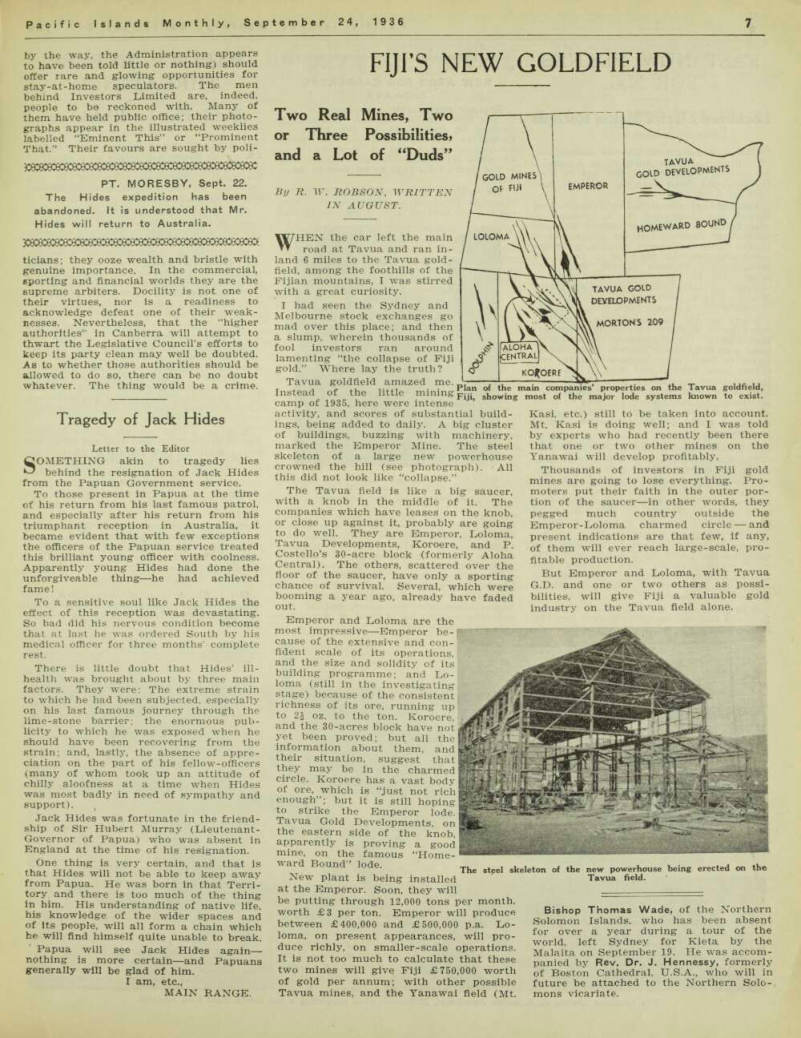
The Tavua field is like a big saucer, with a knob in the middle of it. The companies which have leases on the knob, or close up against it, probably are going to do well. They are Emperor, Loloma, Tavua Developments, Koroere, and P.
Costello’s 30-acre block (formerly Aloha Central). The others, scattered over the floor of the saucer, have only a sporting chance of survival. Several, which were booming a year ago, already have faded out.
Emperor and Loloma are the most impressive—Emperor be-| cause of the extensive and con fident scale of its operations,! and the size and solidity of its building programme; and Lo loma (still in the investigating stage) because of the consistent richness of its ore, running up to oz. to the ton. Koroere, and the 30-acres block have not yet been proved; but all the information about them, and their situation, suggest that they may be in the charmed circle. Koroere has a vast body of ore, which is “just not rich enough”; but it is still hoping to strike the Emperor lode.
Tavua Gold Developments, on the eastern side of the knob, apparently is proving a good mine, on the famous “Home ward Bound” lode.
New plant is being installed at the Emperor. Soon, they will
be putting through 12,000 tons per month, worth £3 per ton. Emperor will produce between £400,000 and £500,000 p.a. Lo loma, on present appearances, will pro duce richly, on smaller-scale operations.
It is not too much to calculate that these two mines will give Fiji £750,000 worth of gold per annum; with other possible Tavua mines, and the Yanawai field (Mt.
Kasi, etc.) still to be taken into account.
Mt, Kasi is doing well; and I was told by experts who had recently been there that one or two other mines on the Yanawai will develop profitably.
Thousands of investors in Fiji gold mines are going to lose everything. Pro moters put their faith in the outer por tion of the saucer—in other words, they pegged much country outside the Emperor-Doloma charmed circle and present indications are that few, if any, of them will ever reach large-scale, pro fitable production.
But Emperor and Loloma, with Tavua G.D. and one or two others as possi bilities, will give Fiji a valuable gold industry on the Tavua field alone.
Bishop Thomas Wade, of the Northern Solomon Islands, who has been absent for over a year during - a tour of the world, left Sydney for Kieta by the Malaita on September 19. He was accom panied by Rev. Dr. J. Hennessy, formerly of Boston Cathedral, U.S.A., who will in future be attached to the Northern Solo mons vicariate.
Plan of the main companies’ properties on the Tavua goldfield, Fiji, showing most of the major lode systems known to exist.
The steel skeleton of the new powerhouse being erected on the Tavua field.