Men Who Knew Yesterday
pp. 42-44 · Read in the full issue
By Julian Hillas
1. Viggo Rasmussen
"T'HERE are many schooners,” remarked JL a resident grown old and wise in the Islands, “and many captains. But, unfor tunately, there is only one Viggo Ras mussen. When Viggo retires it will be the end of an era.”
The words made me think; and, listen ing, it struck me that the man whose Christian name some fifteen thousand natives prefix with “Papa” must be an exceptional kind of person, and one whom it would be well worth meeting.
Accordingly, a morning came which found me rowing out to the “Tiare Ta poro,” where she lay at anchor opposite A. B. Donald and Co.’s main store in Rarotonga. There were a hundred and twenty feet of her, all white paint, and such a gleaming row of ports along the after deck-house that she looked more like some trim pleasure-yacht than the rather elderly copra-carrier which she really is. And down in the tiny saloon, ten feet by twelve, this impression was further heightened by ivory-white bulk heads and little starched curtains on polished rods. Below the skylight, a round brass clock struck the nautical hours.
Four bells sounded as I came aboard, but I hesitate —since it was a first visit — to say what time it was when I left. Talk ing to Viggo—for everyone calls him by his first name—one is unconscious of time.
Here, in this blond and genial Dane, was someone who had indeed come close to fulfilling the average dreams of youth,
trading, ashore and afloat, in the Pau motu, Society, Gambier and Cook Groups for nearly forty years. Gradually, be cause Viggo is reticent where his own experiences are concerned, I managed to extract the main events in the life of one who has rightly been described as the last of the independent and semi-in dependent traders whose tall-masted schooners were once a familiar sight to every islander in the Pacific.
Born in Copenhagen 58 years ago, young Rasmussen went to sea at the early age of 14, and after serving an apprentice ship in the cold northern waters off the Iceland coast, arrived by devious stages in Tahiti, four years before the close of last century.
Leaning over the ship’s side, he watched the conglomerate crowd stroll past the waterfront. The red roofs of Papeete shimmered in the heat-haze, flamboyant trees made crimson footpaths along the shady roads; and, away to the left of the town, white-curled clouds capped the Dia dem as it rose above Fautaua, where the brown mountain stream tumbled noisily into famed Loti’s pool. A somnolent off shore breeze carried languorous scents of vanilla and the primrose-hearted frangi pani. It was a veritable isle of dreams; and, when his vessel sailed away a few days later, young Rasmussen had required little persuasion to remain behind.
Working first for one company and then another, sometimes as supercargo and sometimes ashore, he soon acquired an all-round knowledge of trading. Those were the halcyon days of the pearl trade,
and many thousands of pounds’ worth passed through Rasmussen’s hands be tween ’96 and ’O6, the majority coming from the scattered atolls of the Paumotu and Gambier Groups.
In ’97, five thousand native divers were at work in Hikueru lagoon alone; and, on the same island, during ’O3, Rasmussen had his first experience of a hurricane.
In a single night, between sunset and sunrise, four hundred divers out of twelve hundred were lost. The seas bared a strip of land three miles long by a quarter wide, leaving only the surface of the coral foundation below. Palms, trees, houses and animals were all washed away; and one elderly woman, clinging desperately to a piece of planking, was blown across to a small uninhabited atoll ten miles dis tant. Four days later she paddled her self back to Hikueru in a canoe which had also drifted ashore.
After this, hurricanes became a matter of course, and to date he has weathered seven, four of which have been at sea.
During the ten years which he spent in French Oceania Rasmussen remembers the loss of forty vessels in those waters, most of these being wrecked in calm weather whilst working cargo off the reef.
Surprisingly few wrecks were due to the more spectacular hazards of the sea, although at Takaroa the barque “Roches ter” was driven ashore during a hurricane and beached with all yards standing far above high-tid© mark in the bush.
The number of small cutters which sank or went astray among the labyrinthine reefs and channels of the Paumotus was enormous.
An instance of the truth that a little knowledge in the wrong hands is apt to prove dangerous was demonstrated by a half-caste Chilean trader who wished to take a cutter from Mangareva to Marutea —a by no means great distance. Having borrowed a compass, he approached old Captain Doom and from him ascer tained the correct course to set. Taking no chances, the latter scratched a mark on the rim of the compass. The cutter sailed away, but was soon bobbing up and down so wildly that it was only with the
greatest difficulty that she was kept on her course. Presently the Chilean gentle man had an idea, and, making a wooden peg, wedged this between the free dial and the fixed copper rim of the compass at the point marked by Captain Doom!
With tl}e congratulations of the crew ringing in his ears he then sat back wait ing for Marutea to appear on the sky line. After waiting a fortnight he was considerably startled, but by no means unrelieved, to find himself under the lee of Hivaoa, in the Marquesas!
Joining the well-known Auckland firm of A. B. Donald and Co., Rasmussen came to Rarotonga in 1906, and was for many years in charge of their trading-station on Mitiaro. It was, I think, during this period that the prefix “Papa” made its appearance, although it was not in com mon usage until he took command of the “Tiare Taporo,” after Captain Joe Win chester’s death in 1918, and, following a. short spell afloat as skipper of the schooner “Vaite.”
The “Tiare Taporo” had “made news” during the War, when she picked up the marooned merchantships’ crews left on Mophelia by the notorious raider Von Luckner, after a tidal wave wrecked the “Sea Adler.” The Count’s mirror hangs to-day in the cabin of the “Tiare,” and every morning reflects the kindly blond features' of “Papa” Viggo.
Somebody, some day, will perhaps write the saga of this man and his little white sailed schooner. As it is, many books have mentioned them and one, Tom Richards’ “White Man, Brown Woman,” is dedicated to him. Authors Nordhoff, Hall, Prisbie, Zane Grey, Gouverneur Morris, the late Robert Keable, and sev eral others have all, at one time or an other, sat in the “Tiare’s” saloon as she rode at her moorings below the purple hills which flank the harbour at Tahiti.
Douglas Fairbanks has stepped across her gangplank and the shapely legs of Lila Lee have scrambled up the tall scaf folding which surrounded the “Tiare” when she lay on slip way at Papeete.
Time and environment have woven themselves set closely into the fabric of
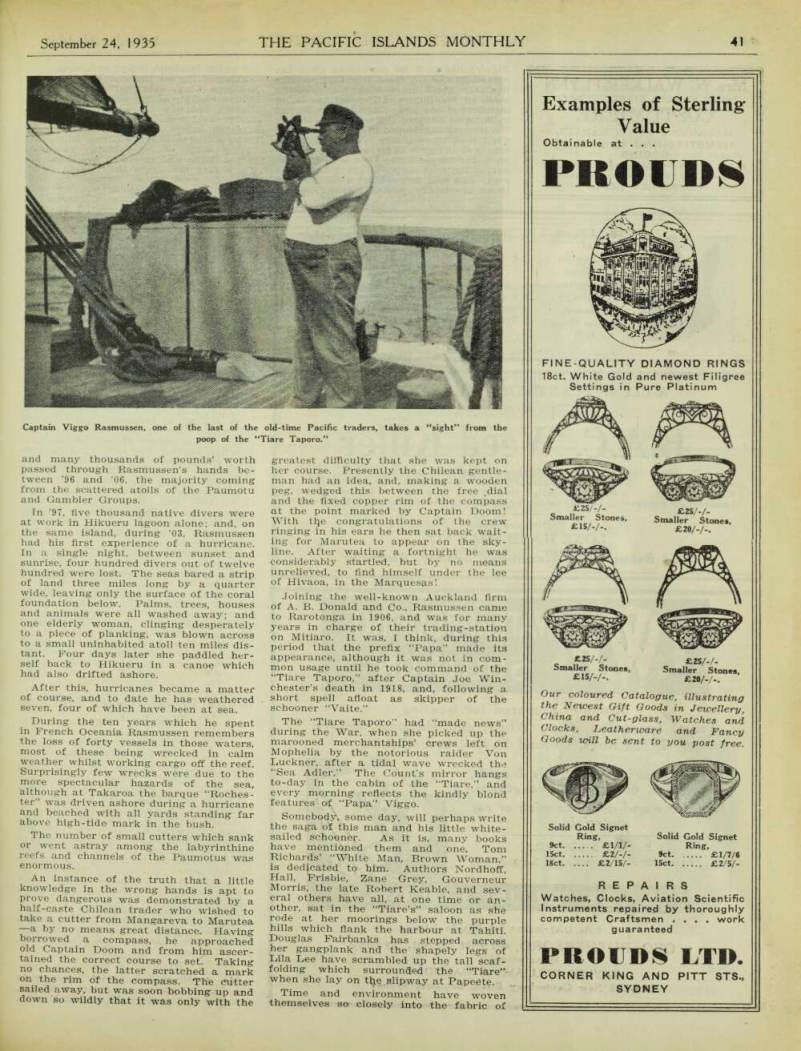
Captain Viggo Rasmussen, one of the last of the old-time Pacific traders, takes a “sight” from the poop of the “Tiare Taporo.”
Viggo’s life that he now looks upon the inhabitants of the Cook Islands, and par ticularly those in the remote northern atolls of Manihiki and Penrhyn, as being members of one large family which he has voluntarily adopted. Much concerned by the poverty occasioned in these islands by the fall in copra prices “Papa” Viggo en couraged the girls to go in for hat-making on a far bigger scale than hitherto and, during the past couple of years, has taken away and sold upwards of a thousand of those beautifully plaited white rito hats
for which Manihiki Island is famous.
Commenting on the changes which he has seen, Viggo said that nothing struck him so forcibly as the difference between the old and new types of trader. For merly, these seemed to be almost without exception sailors, so that the Islands weie really a kind of Fiddlers Green, where the ageing souls of sea-captains remained within sight and sound of the ocean on which they had spent their lives. Some of them were rather strange in their methods of book-keeping but, as they always managed to show a substantial profit at the end of the year, I was left to draw my own conclusions regarding the modern genus and the relative values of accountancy and efficiency.
“The colour bar,” said “Papa” Viggo, in answer to a further question, “never existed in those days, just as it does not exist now, either in Tahiti or Rarotonga* among people of real standing. Of course,” and I will not swear that there was not a suspicious twinkle in his eye* “of course, you must remember there were very few white women here then.’ "V iggo himself is married to a Penrhyn islander, and has his home on that lonely 40-miles riband of palm-tufted coral which rings 108 square miles of lagoon, containing some of the best pipi pearl-shell beds in the Southern Pacific.
Rowing ashore again, after a lunca which included fresh eels brought over from Mitiaro in kerosene tins, I turned and looked back at the “Tiare,” with the short rotund figure of her captain sil houetted against the saloon companion way, and I found myself repeating the old resident’s words. “When Viggo retires it will be the end of a definite era.”
It was true. A man may be the last of his kind, and yet not represent any thing of the epoch of which he is part, while another, on relinquishing his activi ties, marks his passing as it were with a full stop.
A new age is dawning in the Islands; the sands of “yesterday” are fast slip ping through the hour-glass of time, and, for better or worse, the glamorous days of romance, of adventure and of kindly leisurely contact with the natives are already numbered.
There will never be another “Papa Viggo born into this era of feverish com mercialism; and, even if there were, I greatly doubt if he would be able to find therein a counterpart of the “Tiare Taporo.”